Advertisement
- United States
- /
- Telecom Services and Carriers
- /
- NasdaqGS:CMCSA
Is Comcast (CMCSA) Attractively Priced After Extended Share Price Weakness?

Reviewed by Bailey Pemberton
- If you are wondering whether Comcast's current share price reflects its true worth, this breakdown will help you connect the dots between the business, its risks, and what you are actually paying for each share.
- The stock last closed at US$28.30, with returns of 1.2% over 7 days, a 6.7% decline over 30 days, and returns of 4.2% lower year to date, 6.0% lower over 1 year, 12.4% lower over 3 years, and 35.5% lower over 5 years.
- These recent moves sit against a backdrop of continuing interest in large US telecom and media names. In this space, investors often weigh subscription stability against content and infrastructure investment. For Comcast, that broader sector conversation helps frame whether the share price shifts reflect changing expectations on risk, growth, or both.
- On Simply Wall St's 6 point valuation checklist Comcast scores 5 out of 6. The next sections will walk through how different valuation approaches look for the stock and then finish with a more holistic way to think about what that score really means.
Find out why Comcast's -6.0% return over the last year is lagging behind its peers.
Approach 1: Comcast Discounted Cash Flow (DCF) Analysis
A Discounted Cash Flow model takes estimates of a company’s future cash flows and discounts them back to today to arrive at an estimated value per share. For Comcast, the model used is a 2 Stage Free Cash Flow to Equity approach, based on projections of the cash available to shareholders.
Comcast’s latest twelve month free cash flow is about $18.44b. The model uses analyst estimates for several years, then extends the projections further, with Simply Wall St extrapolating free cash flow out to 2035. For example, projected free cash flow for 2030 is $14.71b, with discounted values provided for each year in the 10 year projection window.
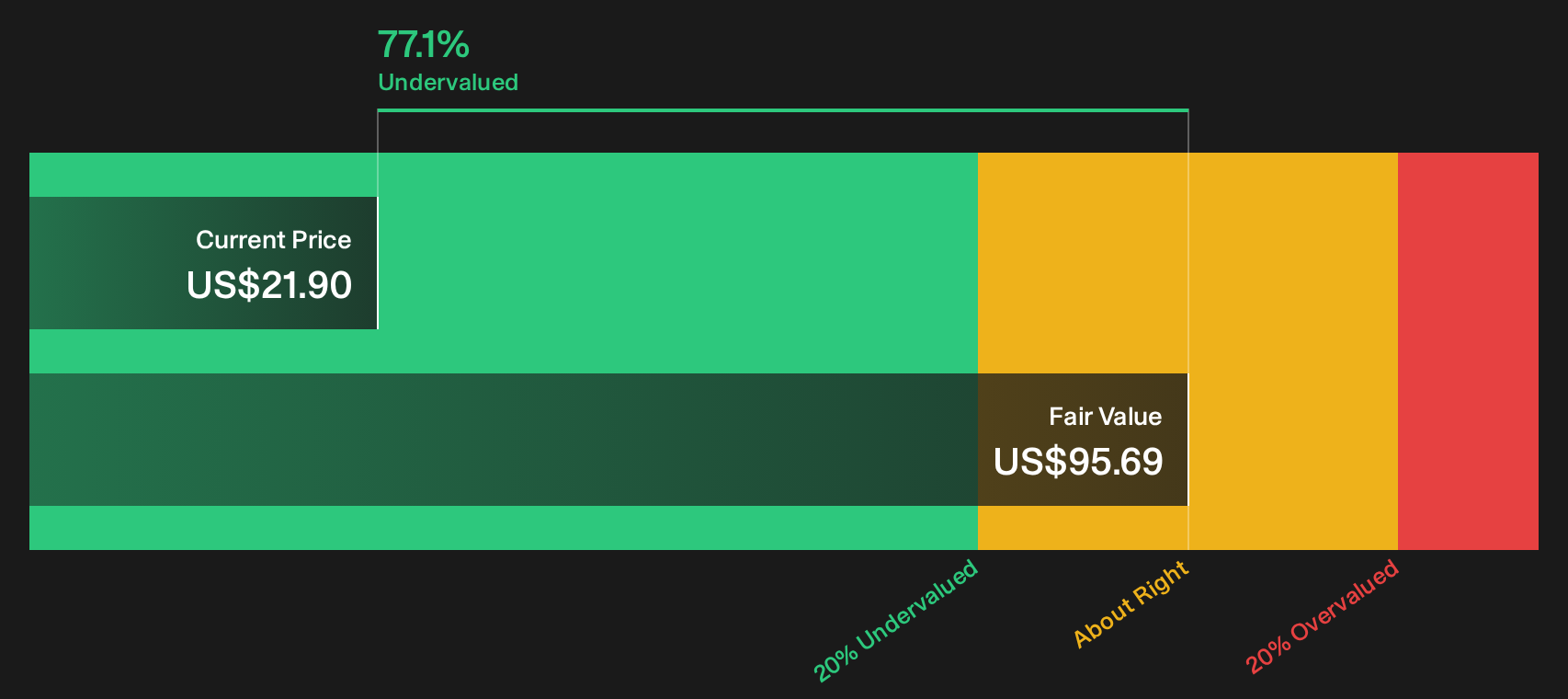
Bringing all of those projected cash flows back to today results in an estimated intrinsic value of US$74.55 per share. Compared with the recent share price of US$28.30, the DCF output suggests the stock is 62.0% undervalued on these assumptions.
Result: UNDERVALUED
Our Discounted Cash Flow (DCF) analysis suggests Comcast is undervalued by 62.0%. Track this in your watchlist or portfolio, or discover 60 more high quality undervalued stocks.
Approach 2: Comcast Price vs Earnings (P/E)
For profitable companies, the P/E ratio is a useful way to link what you pay per share to the earnings that each share generates. It gives a quick sense of how many years of current earnings the market is effectively pricing in.
What counts as a “normal” P/E depends on what investors expect for growth and how they view risk. Higher expected earnings growth or lower perceived risk often go with higher P/E ratios, while lower growth or higher risk usually line up with lower P/E ratios.
Comcast currently trades on a P/E of 5.09x. That sits below the Telecom industry average P/E of 17.12x and below the peer group average of 6.41x. Simply Wall St also calculates a “Fair Ratio” of 11.54x, which is an estimate of the P/E you might expect for Comcast given its earnings profile, industry, profit margins, market cap and risk factors.
This Fair Ratio is more tailored than a simple peer or industry comparison because it adjusts for Comcast’s own mix of growth, risk and profitability rather than assuming all Telecom stocks should share the same P/E.
Comparing the Fair Ratio of 11.54x with the current P/E of 5.09x suggests the shares trade at a discount on this metric.
Result: UNDERVALUED

P/E ratios tell one story, but what if the real opportunity lies elsewhere? Start investing in legacies, not executives. Discover our 19 top founder-led companies.
Upgrade Your Decision Making: Choose your Comcast Narrative
Earlier it was mentioned that there is an even better way to understand valuation, so now it is time to look at Narratives. These let you attach a clear story about Comcast to concrete numbers like fair value, future revenue, earnings and margins, and then compare that fair value with the current share price to decide whether the gap looks attractive, stretched, or somewhere in between.
On Simply Wall St’s Community page, Narratives are short, structured viewpoints used by millions of investors that connect a company’s business drivers to a forecast and a fair value. They automatically refresh when new data such as news or earnings is added so your story stays aligned with the latest information.
For Comcast, one Narrative with a fair value of about US$23.28 builds in revenue declining 1.1% a year to US$119.6b and earnings of US$9.4b by 2029 at a P/E of 10.0x. Another Narrative with a fair value of about US$43.62 assumes revenue growth of 1.47% a year to US$131.7b and earnings of US$13.8b by 2028 at a P/E of 13.33x. By seeing these side by side, you can decide which story feels closer to your own view and whether Comcast’s current US$28.30 price sits above or below the fair value that matches your Narrative.
For Comcast however we will make it really easy for you with previews of two leading Comcast Narratives:
Start with the bullish case if you want to see what the upside story looks like when things go right operationally. Then contrast it with a more cautious view that leans into broadband and cost headwinds. Together, they bracket a valuation range that you can compare directly with the current US$28.30 share price.
Fair value: about US$68.19 per share.
Implied undervaluation versus US$28.30: roughly 58% below this fair value.
Revenue growth assumption: about 14.07% a year.
- Highlights broadband, wireless and Peacock as key contributors, with Q1 2024 total revenue of US$30.1b and broadband ARPU growth of more than 4%.
- Points to higher adjusted EPS, segmentation through the NOW brand, and wireless integration as ways to support customer retention and broaden the customer base.
- Values Comcast at about US$239.86b enterprise value, using long run profit margins and ratios such as a trailing P/E of 10.20, forward P/E of 8.68 and P/S of 1.28.
Fair value: about US$23.28 per share.
Implied overvaluation versus US$28.30: roughly 22% above this fair value.
Revenue growth assumption: about 1.13% annual decline.
- Emphasises risks from broadband saturation, fiber and fixed wireless competition, cord cutting and higher programming and sports rights costs that could pressure earnings.
- Builds in revenue falling 1.1% a year, profit margins moving from 16.2% to 7.9% and earnings of US$9.4b by 2029, supported by a P/E of 10.0x on those earnings.
- Flags heavier capital spending, regulatory scrutiny and the potential for lower Street price targets as reasons why some analysts anchor closer to US$23.28.
Seeing these two Narratives side by side helps you decide whether your own expectations for Comcast are closer to a higher growth, higher fair value path or a more muted outcome where competitive and cost pressures weigh on earnings. Once you have a view on which story feels more realistic, you can decide how the current price stacks up against your preferred Narrative for Comcast, or even build your own version that tweaks the revenue, margin and P/E inputs to match your assumptions using the See what the community is saying about Comcast.
Do you think there's more to the story for Comcast? Head over to our Community to see what others are saying!

This article by Simply Wall St is general in nature. We provide commentary based on historical data and analyst forecasts only using an unbiased methodology and our articles are not intended to be financial advice. It does not constitute a recommendation to buy or sell any stock, and does not take account of your objectives, or your financial situation. We aim to bring you long-term focused analysis driven by fundamental data. Note that our analysis may not factor in the latest price-sensitive company announcements or qualitative material. Simply Wall St has no position in any stocks mentioned.
New: AI Stock Screener & Alerts
Our new AI Stock Screener scans the market every day to uncover opportunities.
• Dividend Powerhouses (3%+ Yield)
• Undervalued Small Caps with Insider Buying
• High growth Tech and AI Companies
Or build your own from over 50 metrics.
Have feedback on this article? Concerned about the content? Get in touch with us directly. Alternatively, email editorial-team@simplywallst.com
About NasdaqGS:CMCSA
Comcast
Operates as a media and technology company worldwide.
6 star dividend payer and undervalued.
Similar Companies
Market Insights


Advertisement
Weekly Picks
CE


Ceazar on Eva Live ·
This small cap is building the AI workforce of the future
Fair Value:US$7.4351.3% undervalued
100 followersusers have followed this narrative
0 commentsusers have commented on this narrative
17 likesusers have liked this narrative
CL


Clive_Thompson on Take-Two Interactive Software ·
Take-Two Interactive: The Calm Before the Storm NASDAQ: TTWO Last Price: $242.41 Date: May 15, 2026
Fair Value:US$276.9720.3% undervalued
17 followersusers have followed this narrative
0 commentsusers have commented on this narrative
8 likesusers have liked this narrative
NI


niteco on Honeywell International ·
Honeywell - The Demand-Side of the AI Infrastructure
Fair Value:US$320.1927.6% undervalued
6 followersusers have followed this narrative
0 commentsusers have commented on this narrative
2 likesusers have liked this narrative
BJ


Bjergby on PagSeguro Digital ·
PagSeguro: A Cheap Bet on a Bank Hiding Inside a Payments Company, Priced for Failure
Fair Value:US$23.861.6% undervalued
2 followersusers have followed this narrative
0 commentsusers have commented on this narrative
1 likeusers have liked this narrative
Recently Updated Narratives
KA


kapirey on CSG ·
CSG represents a high-quality industrial compounder operating in a structurally growing and geopolitically reinforced market,
Fair Value:€3037.3% undervalued
1 followerusers have followed this narrative
0 commentsusers have commented on this narrative
0 likesusers have liked this narrative
AR

artoflosing on BlackBerry ·
Accidental transformation from Phones to Physical AI.
Fair Value:CA$16.2228.2% undervalued
1 followerusers have followed this narrative
0 commentsusers have commented on this narrative
0 likesusers have liked this narrative
RO


RockeTeller on Andean Silver ·
Andean Silver, This ASX Silver Restart Story Smart Money is Loading Up On (111Moz AgEq + Ready Infrastructure)
Fair Value:AU$32.5793.6% undervalued
14 followersusers have followed this narrative
3 commentsusers have commented on this narrative
1 likeusers have liked this narrative
Popular Narratives
GO

GoldenSands on QuantumScape ·
QuantumScape: A Mispriced Deep‑Tech Inflection Point With Multi‑Billion‑Dollar Optionality
Fair Value:US$8589.8% undervalued
116 followersusers have followed this narrative
2 commentsusers have commented on this narrative
33 likesusers have liked this narrative
AN


AnalystConsensusTarget on NVIDIA ·
NVDA: Expanding AI Demand Will Drive Major Data Center Investments Through 2026
Fair Value:US$268.6119.8% undervalued
1192 followersusers have followed this narrative
7 commentsusers have commented on this narrative
34 likesusers have liked this narrative
TR


tripledub on lululemon athletica ·
Lululemon Got Boring Right About the Time It Got Cheap. That's Usually the Point
Fair Value:US$22042.1% undervalued
27 followersusers have followed this narrative
6 commentsusers have commented on this narrative
32 likesusers have liked this narrative
