- United States
- /
- Semiconductors
- /
- NasdaqGS:AVGO
Broadcom (NasdaqGS:AVGO) Unveils Expanded Optical Solutions Amid Market Decline (14% Last Week)

Broadcom (NasdaqGS:AVGO) saw a 14% decline in its share price over the past week, possibly influenced by the broader market turmoil caused by the announcement of new tariffs, which pushed the Nasdaq into bear market territory. This fall coincided with Broadcom's announcement of expanded optical interconnect solutions, indicative of its focus on AI infrastructure. Despite presenting significant innovations at the Optical Fiber Communications Conference, Broadcom wasn’t immune to the market’s downturn, which saw semiconductor stocks, including Nvidia and Intel, particularly hard hit. The market's broader decline of 9.4% compounded challenges, reflecting widespread investor apprehension amidst evolving trade policies.
We've identified 3 weaknesses for Broadcom that you should be aware of.
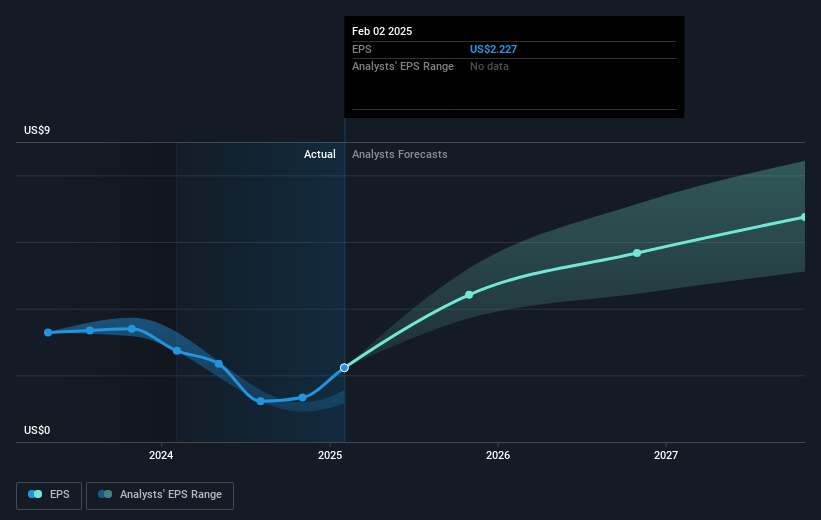
The recent developments highlighted in the introduction, including Broadcom's expanded optical solutions, align with its strategy to invest in AI infrastructure and secure future growth. However, the announcement coinciding with new tariffs and market volatility might influence investor sentiment, possibly affecting revenue and earnings forecasts by introducing uncertainty around trade impacts.
Broadcom's shares have shown impressive long-term growth, with a total return exceeding 553% over the past five years. Over the last year, Broadcom outperformed the US Semiconductor industry, which faced a decline of 10.7%. This historical performance indicates resilience, although recent share price declines contrast with its long-term trajectory.
The current share price of US$168.52 reflects a significant discount to the consensus analyst price target of US$250.42, implying a 32.7% potential upside. While analysts foresee strong growth in revenue and earnings, projected to climb to $89.8 billion and $37.4 billion, respectively, by 2028, the recent market downturn serves as a reminder of external risk factors that could affect these forecasts. Investors should weigh these uncertainties against the company's strategic positioning in AI and semiconductor markets.
Review our growth performance report to gain insights into Broadcom's future.
This article by Simply Wall St is general in nature. We provide commentary based on historical data and analyst forecasts only using an unbiased methodology and our articles are not intended to be financial advice. It does not constitute a recommendation to buy or sell any stock, and does not take account of your objectives, or your financial situation. We aim to bring you long-term focused analysis driven by fundamental data. Note that our analysis may not factor in the latest price-sensitive company announcements or qualitative material. Simply Wall St has no position in any stocks mentioned.
Valuation is complex, but we're here to simplify it.
Discover if Broadcom might be undervalued or overvalued with our detailed analysis, featuring fair value estimates, potential risks, dividends, insider trades, and its financial condition.
Access Free AnalysisHave feedback on this article? Concerned about the content? Get in touch with us directly. Alternatively, email editorial-team@simplywallst.com

A landmark settlement is meant to punish Meta (META). If the 1998 tobacco deal is any guide, it might protect it.
Any moat with an opt-out clause for your competitors is just a fence around your own garden.
Worth looking at what previous legal action actually did to Meta rather than reaching for tobacco. The FTC's record five billion dollar privacy fine in 2019 was met with the stock rising, because it came in below fears and removed an open question. GDPR was designed to constrain large platforms and increased their share of the European ad market, because compliance cost fell hardest on small intermediaries. The FTC's antitrust case, the one that could genuinely have broken the company up, was decided in Meta's favour last November. The only thing that ever meaningfully hurt the business was Apple changing a tracking default, and Meta out-spent that too, while the ad-tech firms that could not afford to rebuild disappeared. The pattern is not that Meta survives regulation. It is that regulation keeps costing its smaller competitors more.
 Andrew Legget
Great earnings season, but are the earnings real?

About NasdaqGS:AVGO
Broadcom
Designs, develops, and supplies various semiconductor devices and infrastructure software solutions internationally.
Exceptional growth potential with outstanding track record and pays a dividend.
Similar Companies
Market Insights


Weekly Picks


The Team Behind a $2 Billion Johnson & Johnson (JNJ) Deal Just Took Over This $105 Million Cancer Biotech


The $135 Billion Bet That Should Make Every Shareholder Nervous


The "Landlord of Orbit" – A Deep Value Play Ahead of the Starlab Era

Uber’s Valuation Depends On Who Captures The Economics Of Driverless Rides
Recently Updated Narratives

Resonance Health will triple revenue growth to 30.83% in five years


Santacruz Silver, 5.6M Oz Silver Producer Trading at Low Multiples, 100X Per-Share Upside in $200 Silver


"Grid-to-Chip: How Eaton Controls the Physical Bottlenecks of AI Data Centers"
Popular Narratives


The company that went from selling GPUs to gamers to becoming the AI arms dealer of the 21st century.

A wonderful business at reasonable price.


