Advertisement
- United States
- /
- General Merchandise and Department Stores
- /
- NasdaqGS:AMZN
Is It Time To Reassess Amazon.com (AMZN) After Its Strong Multi Year Share Price Run?
SI

Reviewed by Bailey Pemberton
- If you are wondering whether Amazon.com shares are offering good value at current levels, it helps to strip away the noise and focus on what the numbers actually say.
- The stock recently closed at US$250.56, with returns of 5.1% over 7 days, 19.4% over 30 days, 10.6% year to date, 45.2% over 1 year and 134.3% over 3 years. This naturally raises questions about how much of this performance is already reflected in the price.
- Recent headlines have focused on Amazon.com's ongoing investment in its retail and cloud businesses and its role in broader trends in e commerce and digital services. This context helps frame why investors are closely watching the balance between growth expectations, execution risks and what they are paying for the stock.
- Right now, Amazon.com has a valuation score of 2 out of 6. The key question is how different valuation approaches interpret that score and whether a more complete framework, introduced at the end of this article, can give you a clearer view of what the shares might be worth.
Amazon.com scores just 2/6 on our valuation checks. See what other red flags we found in the full valuation breakdown.
Approach 1: Amazon.com Discounted Cash Flow (DCF) Analysis
A Discounted Cash Flow model takes estimates of a company’s future cash flows and discounts them back to today using a required rate of return, aiming to translate all those future dollars into a single present value per share.
For Amazon.com, the model uses last twelve months Free Cash Flow of about $40.1b as a starting point. Analysts provide explicit forecasts for several years, and Simply Wall St then extrapolates further using a 2 Stage Free Cash Flow to Equity approach. Under this framework, projected Free Cash Flow for 2030 is $141.3b, with interim years ranging from a forecast outflow in 2026 of $20.6b to progressively larger inflows in later years.
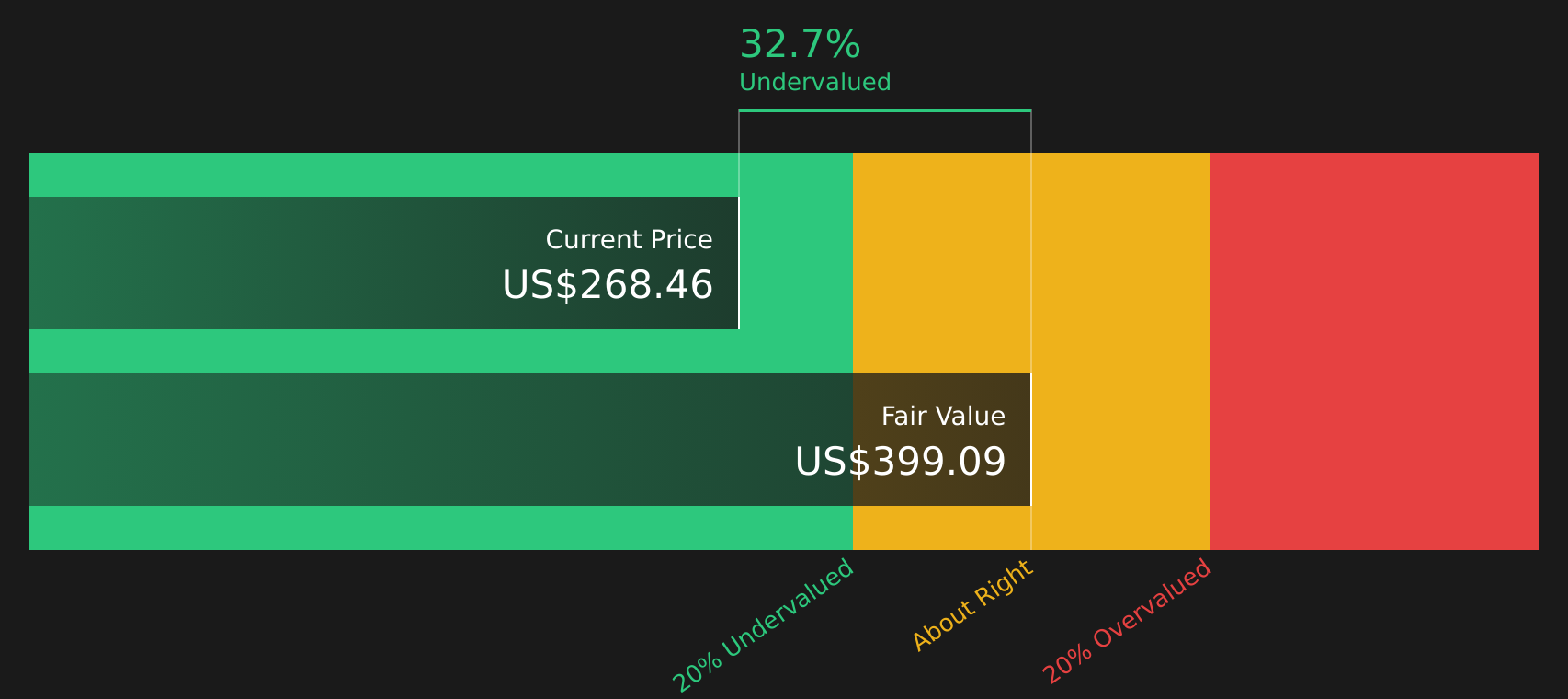
When all these projected cash flows are discounted back and summed, the model arrives at an estimated intrinsic value of US$297.89 per share. Compared with the recent share price of US$250.56, this implies an intrinsic discount of 15.9% based on this DCF view.
Result: UNDERVALUED
Our Discounted Cash Flow (DCF) analysis suggests Amazon.com is undervalued by 15.9%. Track this in your watchlist or portfolio, or discover 59 more high quality undervalued stocks.
Approach 2: Amazon.com Price vs Earnings
For profitable companies, the P/E ratio is a straightforward way to connect what you pay for each share with the earnings that back it. It helps you see how many dollars of price the market is attaching to each dollar of profit.
What counts as a “normal” P/E comes down to what investors expect for future growth and how much risk they see in those earnings. Higher growth and lower perceived risk usually justify a higher multiple, while slower or less predictable earnings tend to warrant a lower one.
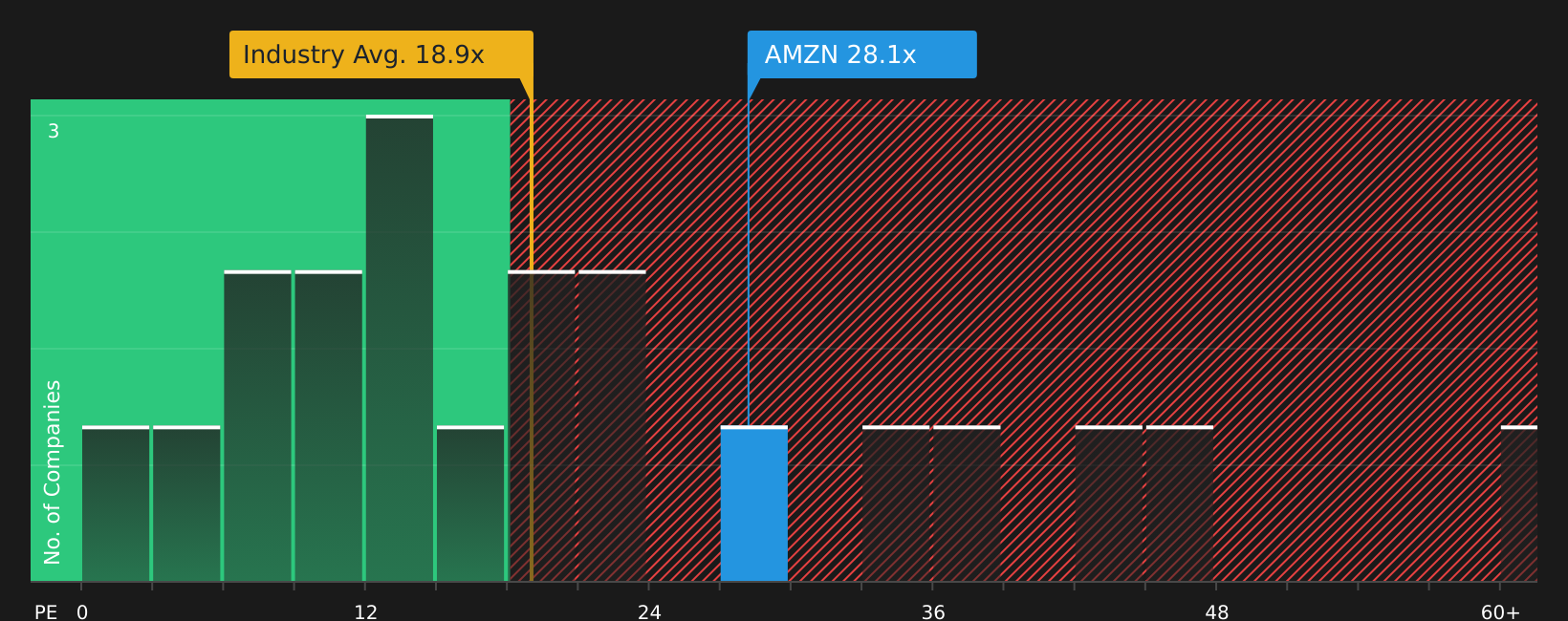
Amazon.com currently trades on a P/E of 34.69x, compared with the Multiline Retail industry average of 21.95x and a peer average of 28.70x. Simply Wall St’s Fair Ratio for Amazon.com is 39.38x. This Fair Ratio is a proprietary estimate of what P/E might make sense given the company’s earnings growth profile, industry, profit margins, market cap and risk characteristics.
Because the Fair Ratio anchors the P/E to company specific drivers rather than broad group averages, it can be more tailored than a simple comparison with peers or the wider industry. With Amazon.com’s current P/E below the Fair Ratio, the shares screen as undervalued on this metric.
Result: UNDERVALUED
P/E ratios tell one story, but what if the real opportunity lies elsewhere? Start investing in legacies, not executives. Discover our 19 top founder-led companies.
Upgrade Your Decision Making: Choose your Amazon.com Narrative
Earlier we mentioned that there is an even better way to understand valuation, so this is where Narratives come in as a simple way for you to pair a clear story about Amazon.com with your own numbers on future revenue, earnings, margins and fair value.
A Narrative is your view of what drives Amazon.com, written as a short story that sits on top of a set of assumptions. Instead of just accepting a single DCF or P/E output, you connect the business you think Amazon.com is building to a financial forecast and then to a fair value per share.
On Simply Wall St, Narratives are easy to use, live inside the Community page and are already created by millions of investors. This means you can pick one that fits you or adjust the assumptions yourself, then see a live Fair Value and compare it directly with today’s share price to consider whether the stock looks expensive or cheap on your terms.
These Narratives update automatically when new earnings, news or analyst forecasts arrive, so your fair value view moves with the information rather than staying frozen. You can also see how different investors interpret the same stock, from a cautious Amazon.com view at a fair value of about US$141 to a much more optimistic Narrative closer to US$500.
For Amazon.com however we will make it really easy for you with previews of two leading Amazon.com Narratives:
Fair value: US$450.00 per share
Implied undervaluation vs last close: 44.3%
Revenue growth used in this Narrative: 8.95%
- The author argues that Amazon is intentionally keeping margins lower in the near term to fund large AI, cloud and automation projects that are expected to lift earnings power later on.
- AWS, advertising and more efficient retail operations are presented as the main profit engines, with AI tools and custom chips aimed at locking in enterprise customers.
- The Narrative frames the current share price as not fully reflecting potential future operating income if margins and mix shift play out as expected.
Fair value: US$222.55 per share
Implied overvaluation vs last close: 12.6%
Revenue growth used in this Narrative: 15.19%
- This author focuses on how online retail, third party sellers, AWS and advertising could support higher earnings power, but also highlights that heavy reinvestment may keep free cash flow muted for some time.
- The Narrative lays out detailed segment assumptions on revenue mix and margins, with particular attention to the role of AWS and advertising in overall profitability.
- Based on those assumptions, the indicated fair value sits below the current share price, so the stock screens as fully valued or richer than the author’s estimate.
If you want to see how other investors are connecting their stories and numbers on Amazon.com, you can review more Narratives, compare their fair values and decide which assumptions best line up with your own expectations.
See what the community is saying about Amazon.com
Do you think there's more to the story for Amazon.com? Head over to our Community to see what others are saying!

This article by Simply Wall St is general in nature. We provide commentary based on historical data and analyst forecasts only using an unbiased methodology and our articles are not intended to be financial advice. It does not constitute a recommendation to buy or sell any stock, and does not take account of your objectives, or your financial situation. We aim to bring you long-term focused analysis driven by fundamental data. Note that our analysis may not factor in the latest price-sensitive company announcements or qualitative material. Simply Wall St has no position in any stocks mentioned.
New: Manage All Your Stock Portfolios in One Place
We've created the ultimate portfolio companion for stock investors, and it's free.
• Connect an unlimited number of Portfolios and see your total in one currency
• Be alerted to new Warning Signs or Risks via email or mobile
• Track the Fair Value of your stocks
Have feedback on this article? Concerned about the content? Get in touch with us directly. Alternatively, email editorial-team@simplywallst.com
MI

The Foxhole
A landmark settlement is meant to punish Meta (META). If the 1998 tobacco deal is any guide, it might protect it.
159
ZO
zoe_vi5fn
Any moat with an opt-out clause for your competitors is just a fence around your own garden.
CO
connor_iwn1g
Worth looking at what previous legal action actually did to Meta rather than reaching for tobacco. The FTC's record five billion dollar privacy fine in 2019 was met with the stock rising, because it came in below fears and removed an open question. GDPR was designed to constrain large platforms and increased their share of the European ad market, because compliance cost fell hardest on small intermediaries. The FTC's antitrust case, the one that could genuinely have broken the company up, was decided in Meta's favour last November. The only thing that ever meaningfully hurt the business was Apple changing a tracking default, and Meta out-spent that too, while the ad-tech firms that could not afford to rebuild disappeared. The pattern is not that Meta survives regulation. It is that regulation keeps costing its smaller competitors more.
 Andrew Legget
Market Insights
Great earnings season, but are the earnings real?

At first glance, this was the strongest earnings season in years. But when you look at where the growth actually came from, the story splits into two very different pictures.
10
About NasdaqGS:AMZN
Amazon.com
Engages in the retail sale of consumer products, advertising, and subscriptions service through online and physical stores in North America and internationally.
Undervalued with solid track record.
Similar Companies
Market Insights


Advertisement
Weekly Picks
LO


Lou_Basenese on Oncolytics Biotech ·
The Team Behind a $2 Billion Johnson & Johnson (JNJ) Deal Just Took Over This $105 Million Cancer Biotech
Fair Value:US$3.575.5% undervalued
29 followersusers have followed this narrative
0 commentsusers have commented on this narrative
7 likesusers have liked this narrative
TR


tripledub on Meta Platforms ·
The $135 Billion Bet That Should Make Every Shareholder Nervous
Fair Value:US$5861.4% undervalued
60 followersusers have followed this narrative
3 commentsusers have commented on this narrative
34 likesusers have liked this narrative
TA


Talos on Voyager Technologies ·
The "Landlord of Orbit" – A Deep Value Play Ahead of the Starlab Era
Fair Value:US$385.291.1% undervalued
64 followersusers have followed this narrative
0 commentsusers have commented on this narrative
6 likesusers have liked this narrative
IV

Ivoed on Uber Technologies ·
Uber’s Valuation Depends On Who Captures The Economics Of Driverless Rides
Fair Value:US$11632.1% undervalued
12 followersusers have followed this narrative
0 commentsusers have commented on this narrative
3 likesusers have liked this narrative
Recently Updated Narratives
RO


Rog on Tomra Systems ·
Why Tomra is a great catch right now!
Fair Value:NOK 243.4354.9% undervalued
1 followerusers have followed this narrative
0 commentsusers have commented on this narrative
0 likesusers have liked this narrative
DA

dang on Resonance Health ·
Resonance Health will triple revenue growth to 30.83% in five years
Fair Value:AU$0.08331.3% undervalued
1 followerusers have followed this narrative
0 commentsusers have commented on this narrative
0 likesusers have liked this narrative
RO


RockeTeller on Santacruz Silver Mining ·
Santacruz Silver, 5.6M Oz Silver Producer Trading at Low Multiples, 100X Per-Share Upside in $200 Silver
Fair Value:CA$142.990.7% undervalued
96 followersusers have followed this narrative
14 commentsusers have commented on this narrative
0 likesusers have liked this narrative
Popular Narratives
OS


oscargarcia on NVIDIA ·
The company that went from selling GPUs to gamers to becoming the AI arms dealer of the 21st century.
Fair Value:US$28022.3% undervalued
364 followersusers have followed this narrative
9 commentsusers have commented on this narrative
16 likesusers have liked this narrative
CU

CubanEros on Microsoft ·
A wonderful business at reasonable price.
Fair Value:US$419.9122.3% overvalued
213 followersusers have followed this narrative
0 commentsusers have commented on this narrative
9 likesusers have liked this narrative
KI

KiwiInvest on Amazon.com ·
Amazon's high growth, high tech segments propel its profits, while traditional segments plod along
Fair Value:US$475.0943.9% undervalued
240 followersusers have followed this narrative
1 commentusers have commented on this narrative
8 likesusers have liked this narrative


