
Somewhere in the Marais, a historic district of Paris, a man is breathing through a ventilator.
He suffers from a rare genetic illness and is largely paralysed.
On the floor, in front of him, sits an air conditioning unit. Something his doctor has encouraged him to install given the current heat wave gripping Europe. His doctor has gone so far as to say that he “needs it”.
There’s one problem: despite it being critical for his health, he can’t get approval from his building to install it.
It’s a fight that has been going on for two years. And it shows no signs of ending soon.
It also highlights a key lesson about how the existence of demand is not always enough to build an investment thesis on top of.
But first, let’s take a look at some news from this week.
What happened in markets this week?
Here’s a quick summary of some of the main news from the past week:
🚀Rocket Lab sees waning chances of Neutron rocket debut this year (Reuters)
- What happened: Space exploration company Rocket Lab reported a 62% increase in revenue, but lower gross margins meant that earnings disappointed the market. It also appeared to push back the launch of its Neutron rocket.
- How it impacts investors: Space exploration has been a hot sector for investors, especially now that SpaceX has joined the NASDAQ. Rocket Lab is one of the few pure-play space companies. However, as shown in its earnings announcement, it can also be a tough industry.
- Next Steps: See what other investors think about Rocket Lab or share your own narrative with the Simply Wall St Community.
🤖 Nvidia links with Wall Street firms for $500bn AI financing deal (The Guardian)
- What happened: AI and semiconductor giant Nvidia has struck a deal with large Wall Street firms to fund data centres, chip manufacturing, and other infrastructure required to build out artificial intelligence capability.
- How it impacts investors: The deal likely cements Nvidia’s already strong position related to artificial intelligence and highlights the continued growth in investment in the technology.
- Next Steps: Investigate Nvidia’s financial health by reviewing its Company Report.
💻 CoreWeave stock pops 14% as revenue doubles on accelerating AI demand (CNBC)
- What happened: AI and cloud computing company CoreWeave outperformed both revenue and earnings expectations, with revenue up 112%. It also announced business deals struck with Meta and Anthropic, among others.
- How it impacts investors: The better-than-expected result pushed its share price 14% higher. However, the discussion regarding the increasingly complicated regulatory environment for data centre construction also highlights an increasing risk for such companies like CoreWeave.
- Next Steps: Compare Coreweave’s fair value estimate to its post-earnings share price to assess whether there might be further upside on offer.
🚗 EVs dominate China’s car market in latest auto sales data (CNBC)
- What happened: Electric and hybrid vehicles accounted for 65.1% of new passenger cars sold in China during July, up from 54% a year ago. However, total passenger car sales tumbled 20.3% overall. EV and hybrid sales fell at a slower rate, at around 12.5%.
- How it impacts investors: China is one of the biggest markets in the world and is now home to many of the most popular electric vehicle brands. Sales data shows not just which brands might be popular globally but also how the EV trend is progressing.
- Next Steps: Surface potential new portfolio positions with the Electric/Autonomous Vehicle Stocks Screener.
🤖 Credit card debt rises to $1.26 trillion, nearing an all-time record (Yahoo Finance)
- What happened: American credit card debt reached $1.26 trillion and is now just shy of the $1.28 trillion all-time record set in the fourth quarter of last year. Delinquencies also increased, with around 12.8% of credit card balances more than 90 days past due, up from 7.6% in mid-2022.
- How it impacts investors: Increased credit card debts are sometimes seen as a symptom of strong spending. However, it can also be seen as evidence that many people are struggling financially.
- Next Steps: Of the view that regardless of the economy, Wall Street wins? Check out our Betting On Wall St Stock Screener for potential ideas.
The thing economists don’t always teach about demand
Anyone who's ever studied economics knows about the supply and demand curve.
It’s an elegant model that, for the most part, does a good job of explaining how the world works.
Basically, higher prices encourage production while discouraging consumption.
As prices rise, supply tends to increase while demand tends to decrease, and vice versa. These forces push the market towards a point where the amount supplied matches the amount demanded. This is known as market equilibrium.
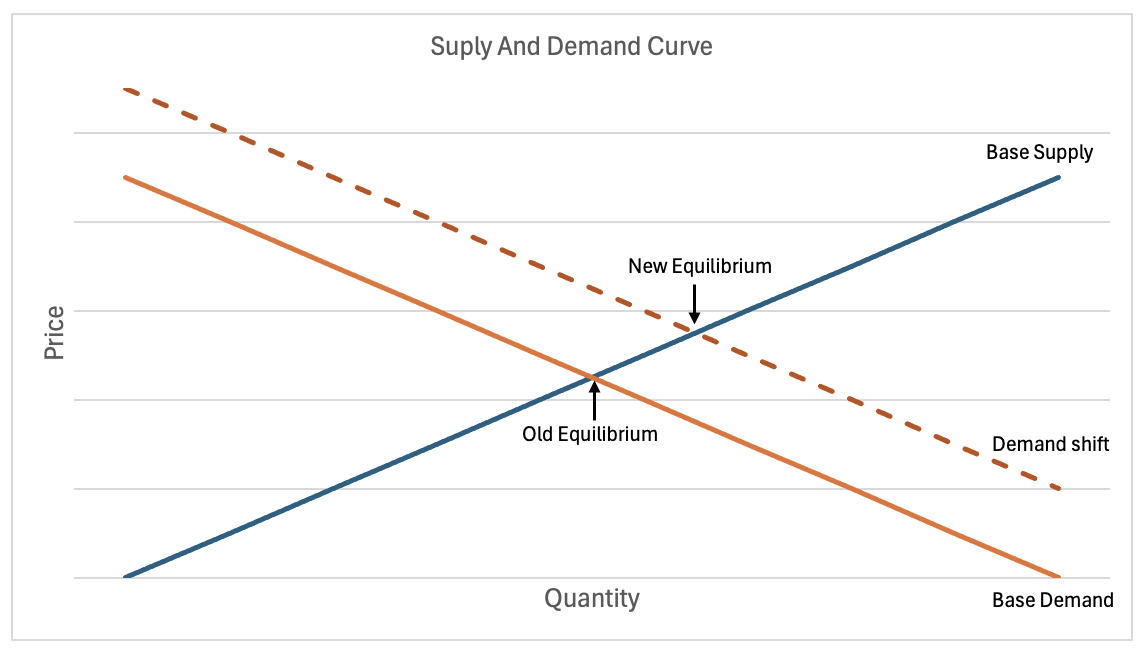
However, sometimes things change the underlying dynamics of a market.
Perhaps a new invention creates a new use for a product, or a change in legislation opens up an entirely new opportunity. When this happens, demand can increase independently of the existing price.
This pushes prices higher and encourages producers to increase supply to meet the new demand. For investors, this can create an attractive combination, companies that are well positioned to supply the growing demand may be able to sell more products at higher prices. If their costs do not rise as quickly as their sales, that can translate into higher profits (and potentially make the company more valuable).
European heat: A demand shift?
Which brings us to the current heatwave facing Europe.
While in many countries, such as the USA, where around 90% of households have air conditioning installed, air conditioning is not common in Europe. In fact, it has one of the lowest rates of air conditioning in the world, with only around 20% of homes having air conditioning installed.
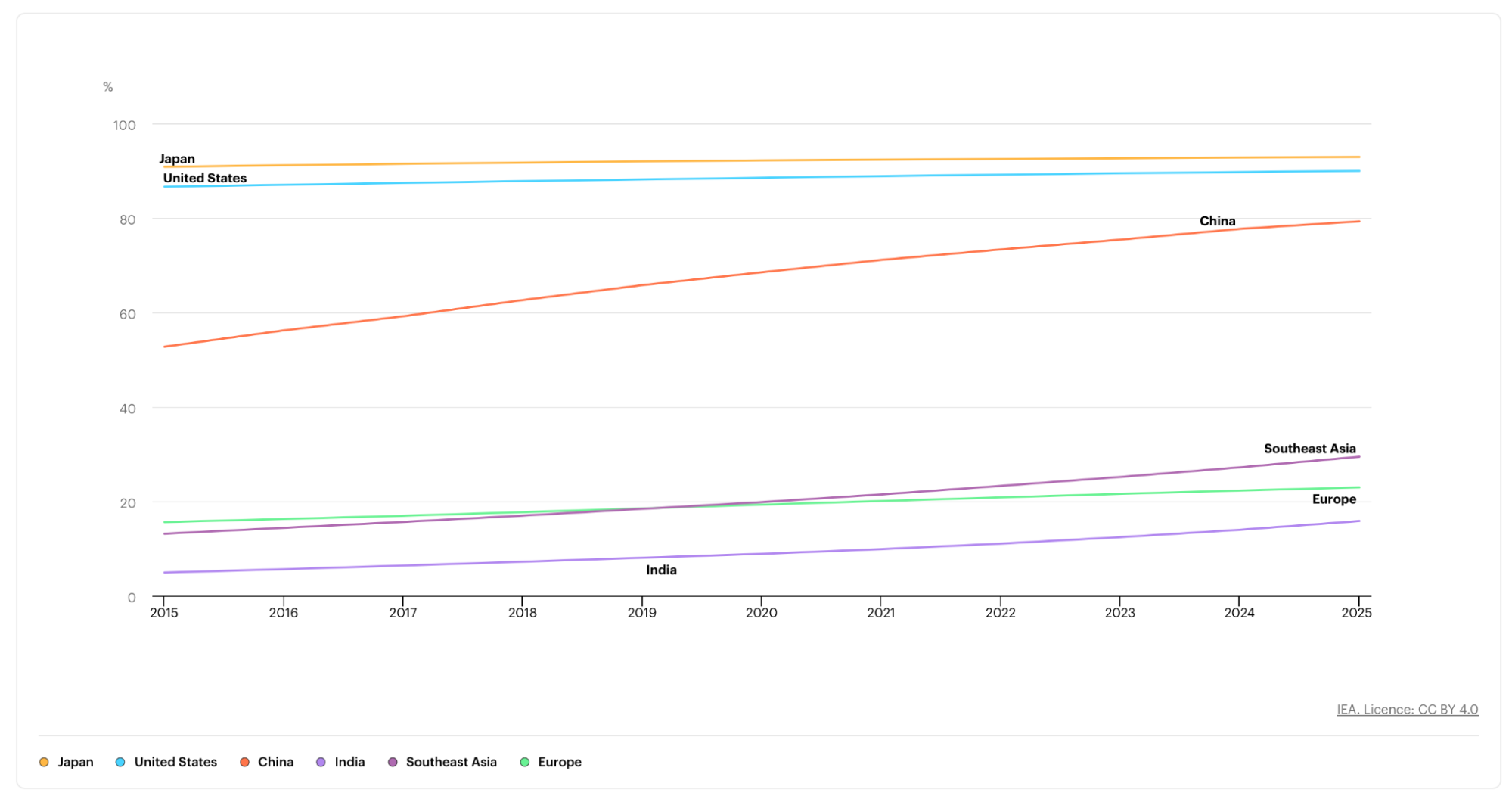
Few places bore the brunt of the recent European heatwave more than England (where only around 5% of homes have air conditioning) and France (where AC is present in less than a quarter of homes).
In late June, England recorded a maximum temperature of 99.9 degrees Fahrenheit (37.7 degrees Celsius). This was a whole 3.6 degrees Fahrenheit (2 degrees Celsius) higher than the previous UK record for June.
France suffered even worse, with temperatures over 95 degrees Fahrenheit (35 degrees Celsius) recorded across 30 days over June and July and over 40% of the country experiencing temperatures of at least 104 degrees Fahrenheit (40 degrees Celsius) at least once during this period.
England and France are again on alert as another heat wave is expected to pass through the region.
Is an AC boom coming?
With Europe getting increasingly hotter, and with the region (particularly England and France) having extremely low levels of air conditioning, one could think that we might be seeing one of those demand shifts we talked about earlier.
Indeed, there’s a trend that is pointing towards more energy being used across Europe for cooling purposes.
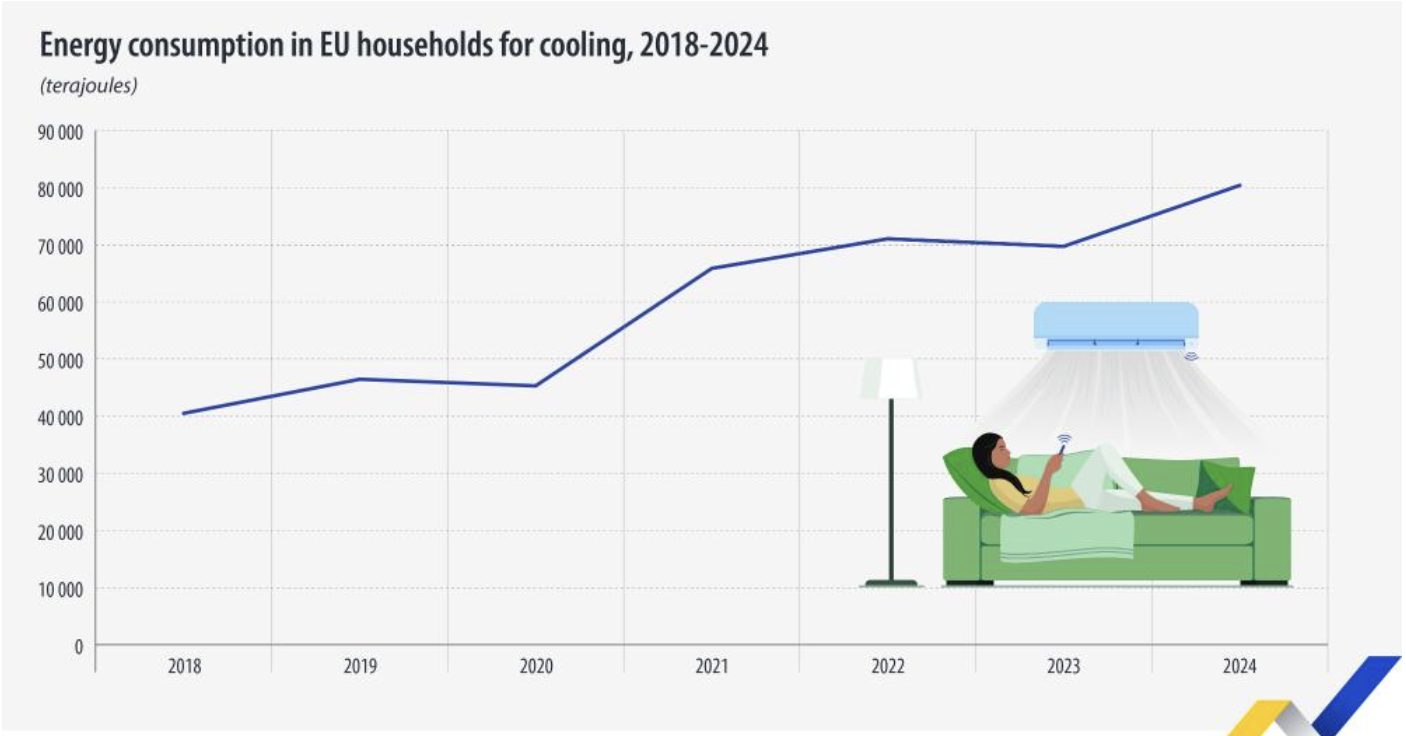
In fact, many companies, such as Johnson Controls (NYSE:JCI), have had their price targets increased by analysts in light of the perceived push for more energy efficient solutions.
As an investor, the easy takeaway is to look at the above and go “buy cooling/HVAC companies in Europe” as you expect a significant boost to demand.
But is it that simple?
Why a catalyst is not always enough
There is no technical reason why Europeans can’t install more air conditioners.
Given that France recorded around 5,700 excess deaths in late June, an excess mortality rate of 36%, they probably should.
There’s clearly a need for increased air conditioning in Europe. There is also demand. The catalyst is there, melting people and designer handbags along Paris’ Champs-Élysées, in plain sight. But there are also real roadblocks that mean, at least in this case, it might not be enough… for now.
Some of the above are still works in progress, while in other cases, there is real change that is already underway.
The revised building-renovation directive had a national transposition deadline this year, and the refrigerant phasedown is tightening now, so “installability” and “refrigerant rules” are not hypothetical somedays; they are constraints visibly starting to lift.
👉 One company that might benefit from lifting constraints could be Swedish refrigeration business, Beijer Ref (OM:BEIJ B), with one member of the Simply Wall St Community calling it “The Green Consolidator”.
It does, however, highlight how the existence of a catalyst and a strong theme does not always equal a sudden shift in the market deserving of investor hype. Instead, sometimes the shift can be more gradual over time or cease to eventuate at all.
The insight: Real shift or hollow promise?
European air conditioning penetration may sound like a niche topic. But it's the perfect example of how investors should think about catalysts and demand shifts.
We have seen what can happen with smartphones, where a clear need for mobile internet connectivity, cameras, and communication upended the mobile phone market. But on the flip side, there was a time when 3D printing companies were the flavour of the month for investors without any real rewards flowing to those who got caught up in the hype.
And that is the key… working out if it is real, or if it is just hype.
So, what are some questions investors should ask if they are jumping onto a theme built around a demand shift?
Is the demand actually being expressed?
In the air conditioning example, people may need it, but are they actually buying it? Are they changing behaviour enough for it to matter?
What, if any, roadblocks are stopping people from taking action?
Maybe the answer is nothing, or, like European cooling, there could be multiple complicated factors like regulations, economic cost and even the underlying culture.
What else needs to happen to support this shift?
Increased demand requires increased supply. How easy is it for that to happen? Are there barriers to entry? Other technology that is available that could fill that need instead?
Who will win from this shift? Will anyone?
The introduction of air travel was a major shift and innovation for the world. But to this day, there are few “winners” from an investment sense. In other markets, there has been a clear winner who has managed to use a competitive advantage to be the undisputed winner. This is critical for investors, as a shift alone doesn’t mean that it will float all boats equally, or float them at all.
Is this shift already priced into the share price?
This is arguably the critical question for investors. If a shift is already priced in, then it may already be too late to benefit from the theme if and when it occurs. On the other hand, if the answer is that the market is still overlooking it, it could become a very rewarding opportunity if you are right.
Key events next week
Wednesday
- 🇬🇧 United Kingdom CPI announcement
- Previous: 2.6%
- Why it matters: Inflation is still running above the Bank of England's 2% target, so this print feeds straight into the rate debate. A hotter reading strengthens the case for holding rates higher for longer.
- 🇪🇺 European Union CPI announcement
- Previous: 2.9%
- Why it matters: With inflation sitting above the ECB's 2% goal, a softer number gives the central bank more room to ease.
- 🇺🇲 FOMC meeting minutes
- Why it matters: The minutes show how split the Fed is on its next move. Investors will comb them for hints on the timing and pace of any rate change.
Thursday
- 🇺🇲 U.S. initial jobless claims
- Forecast: 201,000 , Previous: 209,000
- Why it matters: Claims just rose to 209,000, above forecasts and snapping a long run below 200,000. Continuing claims keep climbing as the jobless take longer to find new work, so another uptick would harden the soft-labor-market read.
Friday
- 🇺🇲 US Manufacturing PMI
- Previous: 53.9
- Why it matters: At 53.9 factories are still growing, but momentum has been cooling for months while war-related shipping delays stretch lead times and push input costs back up.
- 🇺🇲 US Services PMI
- Previous: 54.6
- Why it matters: July's 54.6 was the strongest reading in nine months, but much of it leaned on World Cup and Independence Day spending. The August flash is the tell on whether that demand has legs or was a one-off,
Around the world, companies are still reporting earnings. Some notable companies reporting next week include Home Depot, Estee Lauder, Walmart and Alibaba.
Have feedback on this article? Concerned about the content? Get in touch with us directly. Alternatively, email editorial-team@simplywallst.com
Simply Wall St analyst Andrew Legget and Simply Wall St have no position in any of the companies mentioned. This article is general in nature. Any comments below from SWS employees are their opinions only, should not be taken as financial advice and may not represent the views of Simply Wall St. Unless otherwise advised, SWS employees providing commentary do not own a position in any company mentioned in the article or in their comments.We provide analysis based on historical data and analyst forecasts only using an unbiased methodology and our articles are not intended to be financial advice. It does not constitute a recommendation to buy or sell any stock and does not take account of your objectives, or your financial situation. We aim to bring you long-term focused analysis driven by fundamental data. Note that our analysis may not factor in the latest price-sensitive company announcements or qualitative material.
Comments
Andrew Legget
Andrew Legget is a writer at Simply Wall St. He has more than 20 years of experience as an investor and almost 10 years of experience in equity research and financial publishing. He is passionate about telling the stories of stocks and markets.

