
We’re now more than halfway through the year, and so far, global markets have been good to us.
But amidst all the chatter around AI, space and quantum computing stocks, there’s a sector that journalists have moved to the backburner, leaving its investors to shake their heads in slight disappointment.
Healthcare seems to be 2026’s laggard. As the S&P 500 roared 9% year-to-date, the MSCI Healthcare Index brought only a paltry 2%.
But digging deeper, the story behind the defensive sector’s “underperformance” seems to be more nuanced than you’d first see.
Let’s have a look.
What happened in the markets this week?
⚙️ AMD and Anthropic partner up for AI infrastructure race (AMD)
- What happened: AMD and Anthropic announced a strategic partnership under which Anthropic will deploy AMD’s rack-scale systems from 2027. AMD also committed to invest up to US$5 billion in Anthropic, AMD will adopt Claude to accelerate software development.
- How it impacts investors: This strengthens AMD's position in the AI infrastructure race and shows how companies are partnering up long-term as the race intensifies.
- Next steps: Check out the AMD narratives written by other investors in the community to understand how its story has evolved over time.
✈️ GE Aerospace hits a milestone in hybrid-electric aviation (Reuters)
- What happened: GE Aerospace completed the world's first high-altitude flight using hybrid-electric propulsion, flying an aircraft above 30,000 feet. The project was carried out with NASA and BETA Technologies as part of ongoing work on next-gen commercial aircraft engines.
- How it impacts investors: Commercial adoption may still be years away, but a combination of traditional and electric propulsion can someday help planes go higher, faster, and with less fuel consumption and emissions.
- Next steps: Explore our Aerospace & Defense Investing Ideas to identify companies developing next-generation aviation technologies and those at risk of these changes.
☁️ Microsoft backs Europe's AI ambitions with Mistral (Reuters)
- What happened: Microsoft is investing billions to support Mistral's AI infrastructure expansion in Europe while expanding distribution of the French startup's models through Azure. The partnership also enables Azure customers to build software using Mistral's French data centers.
- How it impacts investors: The deal highlights how demand for regional AI infrastructure is growing, especially as governments and businesses look for more control over where their AI runs. The partnership with Mistral strengthen’s Microsoft’s position in Europe’s AI buildout.
- Next steps: We’ve created an AI Infrastructure Screener to help discover more companies growing in this space.
💊 Novo Nordisk files a lawsuit against Eli Lilly (CNBC)
- What happened: Novo Nordisk filed a lawsuit against Eli Lilly, alleging that advertising for its obesity and diabetes medicines misleads consumers by relying on outdated clinical trial data.
- How it impacts investors: Looks like competition in the GLP-1 market isn't just about launching new drugs anymore. Marketing claims and legal battles are becoming part of the fight too as companies compete for share in one of healthcare's fastest-growing markets.
- Next steps: Compare Novo Nordisk and Eli Lilly on Simply Wall St to assess valuation, growth expectations, and analyst forecasts.
👟 Nike bets on a cleaner digital strategy in China (CNBC)
- What happened: Nike will stop supplying thousands of online distributors in China from 2027 and instead focus sales through its own digital channels and official storefronts on Tmall, JD.com, and Douyin.
- How it impacts investors: Nike is betting that a cleaner, more consistent shopping experience will strengthen the brand over time, even if it means taking a short-term hit to sales.
- Next steps: Check out Nike’s company report, it may be a good move to analyze regional breakdown of its revenues to estimate the potential impact of the decision.
The narrative that’s been making rounds
If healthcare's rough year had a poster, this would be it.
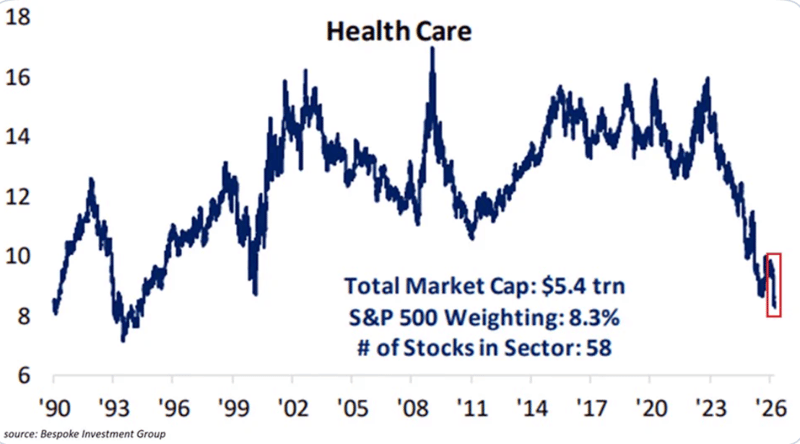
The chart shows healthcare's share of the S&P 500 halving since 2022 to just 8.3%, its lowest since 1994. Even more striking, that's below the roughly 9% share it held at the peak of the Dotcom Bubble, when tech mania was at its most extreme.
One key message seems to radiate from it: "Healthcare is dying. Stay away."
But let me challenge that, because it reminds me of a lesson I brought to you a few weeks ago on dividend yields. Yields rise because the payout either grew or because the price collapsed. Same number, opposite stories.
An index weight works the same way. Healthcare's slice can shrink because healthcare fell apart, or because the rest of the pie got bigger. Both look identical on that chart, and they could not be more different for an investor.
The chart can't tell you which one you're looking at. But earnings can.
So let's ask two questions in order: Did the market actually speed up? And did healthcare actually slow down?
Question one: did the market actually speed up?
The S&P 500's earnings are indeed growing 24.7% year-on-year this quarter. Its own five-year average is 15.2%. The benchmark isn't running its usual pace, it's sprinting at nearly double it.
But the key insight is in who is sprinting.
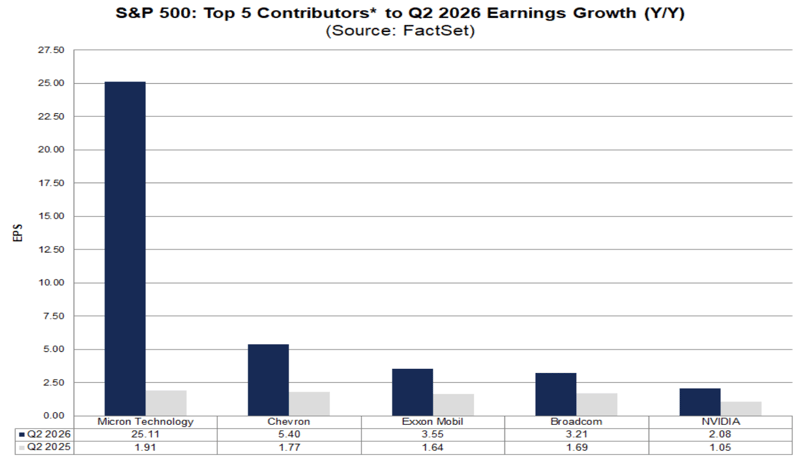
Micron and NVIDIA alone are the top two contributors to that growth. Strip out just those two names and the index's growth rate falls from 24.7% to 16.8%. In other words, a third of the market's acceleration comes from two companies riding the AI buildout.
Similarly, the Mag 7 drove the highest share of earnings growth for the S&P 500 - becoming the biggest driver for the index’s 2026 performance.
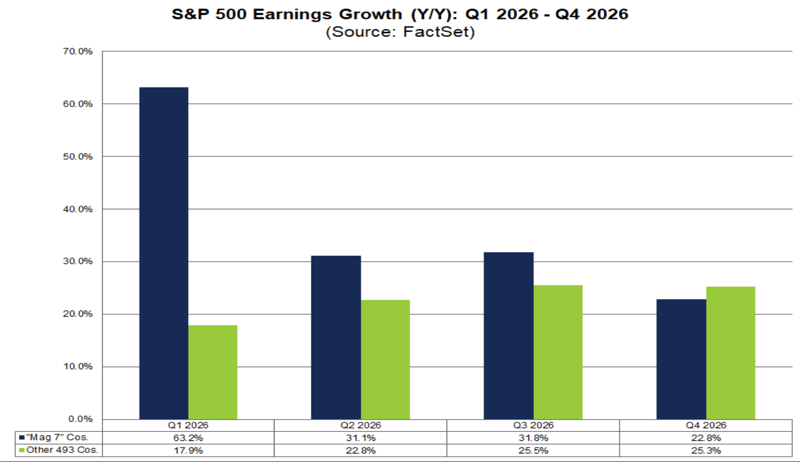
A steady runner looks slow next to someone who breaks into a sprint, even if their pace never changed. That's a large share of healthcare's "underperformance" right there. So yes, the market sped up… narrowly.
Question two: did healthcare actually slow down?
As much as I’d love to have a big “no” here (as I could be making the biggest point on the internet) Healthcare is unfortunately reporting the worst earnings decline of any sector in Q2 2026, down 18.2% year-on-year.
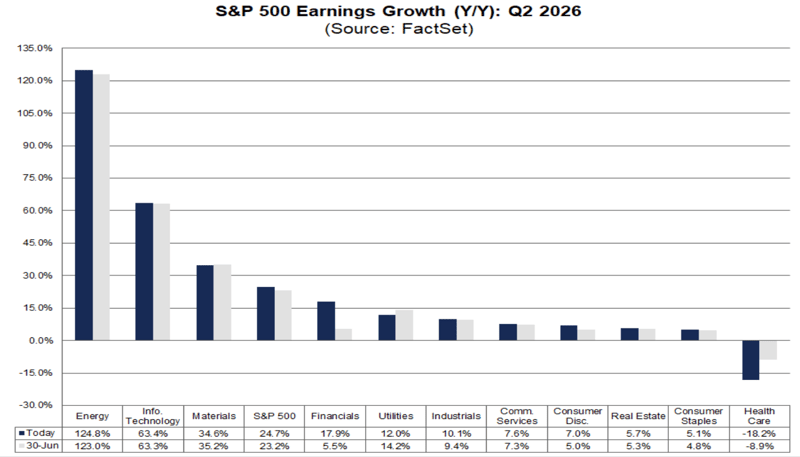
That's a genuinely ugly number. But similar to the Micron and NVIDIA case, let’s look at where it comes from.
Almost all of it traces to (again) two companies, Gilead Sciences and Merck, who are both absorbing large one-off charges this quarter.
Exclude those two and the sector flips from an 18.2% decline to 6.6% growth. The index-level number isn't fake, it's just describing two companies' bad quarter, not a bad year for the roughly 1,400 listed US healthcare companies standing behind them.
Zoom into the six industries inside healthcare and the split sharpens. Percentages are YoY earnings growth/decline:
- Growing: Healthcare providers and services (+18%), health care tech (+11%), medical equipment and supplies (+7%), life sciences and tools (+6%).
- Shrinking: Biotech (-80%) and pharma (-24%).
And this isn't a one-quarter quirk. Last quarter showed the same pattern : pharma earnings fell roughly 30% while equipment and biotech grew. Two consecutive quarters where the same industries were doing the damage, and the same industries kept compounding underneath.
One more detail the "broken sector" story skips. Healthcare companies are beating estimates at a 100% rate this quarter ( so far ), with earnings coming in 11.9% above expectations, the fourth-largest beat of any sector. Deteriorating businesses don't usually make a habit of clearing the bar analysts had set for them.
So here’s my “no”, healthcare didn't slow down. It simply split into the side that’s outperformed, and the side that’s in pain.
And note that these two questions aren't exclusive to the US, they apply to indices and healthcare sectors across the world. We'll meet examples of both later.
A real problem vs. a borrowed one
So is pharma's pain just noise? No, and this distinction is the core of the piece.
Large pharma faces a patent cliff, with roughly $150 billion in annual revenue (about a third of large-cap pharma and biotech's total) losing patent protection by 2030. Big names like Amgen, Merck and Bristol-Myers have more than half their revenues exposed to this potential problem.
It also explains something the sector average hides. Healthcare's earnings have gone sideways for three years while revenues grew about 10% a year. Sales kept climbing, but pricing pressure, patent losses and rising costs ate the difference.
Sector net margins sit at 6.3% this quarter, down from 8.1% a year ago and below their five-year average of 9%. The squeeze is real,but it’s not evenly distributed.
Yet the industry trades at its lowest valuation relative to the broader market in over 15 years, while the drivers of its earnings, an aging population , robotics and diagnostics, all remain intact. And there’s a structural reason for the mispricing. Drugmakers dominate healthcare indices , so pharma's patent-cycle economics set the price for businesses that don't have patent cliffs at all. Put simply, pharma has a real problem impacting the optics of the broader healthcare sector.
And here's the kicker on price. Despite four of six industries growing, healthcare trades at a forward P/E around 18 versus the S&P 500's 20.3. The market is charging a discount for the whole sector based on the problems of a few big members.
Where to look from here
If the split above holds, "healthcare" is the wrong unit of analysis. It’s time to dig deeper, as dedicated investors should do.
1. Watch for sector heavyweights and compounders priced at the broader sector’s discount.
Businesses whose revenue renews through consumables, resupply and procedures are compounding at their usual pace, while carrying valuations set by pharma's problems.
Healthtech also sits in the same bucket, with health care technology earnings up 11% this quarter. That mismatch between price and performance is what a fundamentals-first investor hunts for.
👉 Start with the Undervalued Healthcare Stocks Screener to surface names where the two have drifted apart.
2. Still be on the lookout for gems within the underperforming subsector, but perhaps apply a more cautious lens.
Big pharma yields now look attractive with the lower denominator, but the patent cliff is the line between an income compounder and a yield trap.
So for any name here, the question is: just how much revenue is exposed to expiries before 2030, and does the pipeline replace it? A 6% yield funded by a drug going generic in two years is the same trap we covered in the dividend yield piece.
👉 The Big Pharma, Big Dividends screener gives you a list of candidates to look out for.
3. Watch for opportunities within the “breakthrough”, “growth” and “disruptor” end of the healthcare sector.
Biotech was one of the subsectors compounding straight through the sector's reputational winter, as advancements in trials and development became the tailwind behind the sector.
Within the defensive healthcare sector, Biotech tends to have a name for being the volatile, high-risk, high-reward one.
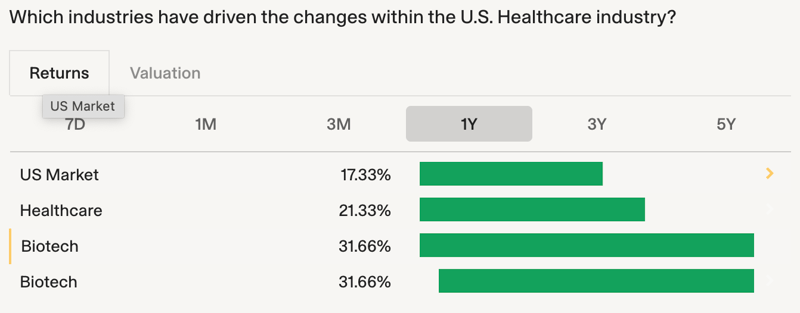
Source: US Healthcare Sector Analysis, Simply Wall St
Similarly, the AI story isn't only specifically a tech-sector story: here’s a story of how AI is also becoming a healthcare play.
👉 Browse Biotech Breakthroughs for the names still putting up numbers.
💡 The Insight: The lag is real. The decline isn't.
Now that we’ve uncovered the bigger story hiding beneath healthcare’s lag, c ount the above three points as mere ideas for your investing playbook.
The sector’s underperformance is genuine, but as shown today, it decomposes into three parts that the headline never really breaks down:
- A benchmark growing at double its normal rate on the back of two AI names.
- One-off charges at two drugmakers, wrecking this quarter's sector average.
- A real patent cliff problem pressuring pharma.
So when any sector spends a year at the bottom of the tables, run it through three questions before accepting the obvious conclusion:
- Did the sector slow or did the benchmark speed up? Compare the sector's earnings to its own history, not just the index.
- Is the damage broad or concentrated? A few names can wreck a sector average. Check the industries and companies underneath.
- Is the pressure structural or borrowed? A patent cliff with a year attached is a real problem. A discount inherited from the company next door could be an opportunity wearing a problem's clothes.
Sectors don't get cheap when everything is fine. They get cheap when terrible headlines take over.
Key events next week
Thursday
- 🇺🇸 Federal Reserve Interest Rate Decision
- Forecast: 3.75%, Previous: 3.75%
- Why it matters: No rate change is expected so investors will focus on whether the Fed signals a September rate cut or maintains a cautious stance on inflation.
- 🇬🇧 Bank of England Interest Rate Decision
- Forecast: 3.75%, Previous: 3.75%
- Why it matters: Markets will be looking for clues on when the Bank of England could begin easing policy, particularly if inflation continues to moderate.
- 🇺🇸 GDP Growth (QoQ, Q2 Advance)
- Forecast : 1.6%, Previous: 2.1%
- Why it matters : The first estimate of Q2 US economic growth. A weaker result could reinforce expectations that the economy is slowing.
Friday
- 🇯🇵 Bank of Japan Interest Rate Decision
- Forecast: 1.0%, Previous: 1.0%
- Why it matters: Investors will watch for any change in the Bank of Japan's outlook after its gradual shift away from ultra-loose monetary policy.
- 🇪🇺 Eurozone Inflation Rate (YoY, July Flash)
- Forecast: 3.0%, Previous: 2.8%
- Why it matters: A hotter-than-expected inflation reading could reduce the likelihood of near-term ECB rate cuts and influence European markets.
Have feedback on this article? Concerned about the content? Get in touch with us directly. Alternatively, email editorial-team@simplywallst.com
Simply Wall St analyst Mitch Lawler and Simply Wall St have no position in any of the companies mentioned. This article is general in nature. Any comments below from SWS employees are their opinions only, should not be taken as financial advice and may not represent the views of Simply Wall St. Unless otherwise advised, SWS employees providing commentary do not own a position in any company mentioned in the article or in their comments.We provide analysis based on historical data and analyst forecasts only using an unbiased methodology and our articles are not intended to be financial advice. It does not constitute a recommendation to buy or sell any stock and does not take account of your objectives, or your financial situation. We aim to bring you long-term focused analysis driven by fundamental data. Note that our analysis may not factor in the latest price-sensitive company announcements or qualitative material.
Comments

Mitchell Lawler
Mitchell Lawler is a Senior Investment Editor at Simply Wall St, where he oversees Market Insights and the platform’s published editorial content. He also leads The Foxhole, a daily forum for contrarian investment ideas and constructive debate, drawing on nearly a decade of personal investing experience and more than five years in professional equity research and financial publishing.
