
For the past few years, the market has been writing the same obituary.
“Visa and Mastercard's era is ending.”
PayPal, Buy-Now-Pay-Later (BNPL), and now Agentic Commerce; each new payment system is the supposed catalyst in taking the card giants’ market share thanks to less fees, ease of use, lower impact to credit ratings, widespread adoption… plus whatever other reasons there are to justify the new payment technologies.
Investors have taken that story seriously. The payments industry now trades at a P/E ratio well below its 10-year average . And yet, Visa’s payment volume just crossed $4 trillion for the first time .
So there has to be more to the payments story than at first glance.
Today, we’ll examine where the money in payments actually goes and how to tell whether the payment businesses you own are the winners collecting it.
What happened in the markets this week?
🇨🇦 US pauses 50% Canada tariffs but the trade risk isn’t gone ( Reuters )
- What happened : Trump paused new 50% tariffs on Canadian goods for three days, saying the two countries had reached a deal subject to final documentation. Canadian Prime Minister Mark Carney said substantial progress had been made but that important work remained, while the proposed tariffs would have covered about US$20 billion of imports.
- How it impacts investors : The pause takes some immediate pressure off Canadian trade-exposed businesses, but uncertainty hasn’t disappeared. Autos, lumber, dairy, and other cross-border industries could remain sensitive to whatever the final agreement looks like.
- Next steps : Use Discover to explore companies and sectors that could be more resilient to shifting trade policy.
🧬 Moderna and Merck’s cancer vaccine clears a major clinical hurdle ( CNBC )
- What happened : Moderna and Merck’s personalized mRNA cancer vaccine, met the main goal of a phase 3 trial involving more than 1,100 patients. The treatment significantly extended the time patients lived without their cancer returning.
- How it impacts investors : The results are an important validation of personalized mRNA cancer vaccines, with especially high stakes for Moderna as it looks beyond its infectious-disease business. Approval is still ahead, and the study is continuing to assess outcomes including overall survival.
- Next steps : Compare Moderna and Merck to see how the vaccine could affect each company’s growth story.
💳 PayPal sale talks put a potential takeover premium in play ( WSJ )
- What happened : PayPal is in talks to sell itself to a group including Stripe and private equity firm Advent International. Stripe and Advent offered US$60.50 a share in July, which PayPal viewed as too low, and the two sides have since been in negotiations.
- How it impacts investors : The talks give PayPal shareholders another possible path to value while the company works through its turnaround. A higher offer could support the stock, but there’s still no guarantee a deal gets done.
- Next steps : Check PayPal’s valuation and growth outlook to see how the current investment case stacks up against a potential takeover.
🤖 Alibaba trims gaming to put more firepower behind AI ( WSJ )
- What happened : Alibaba has agreed to sell its Lingxi Games business to a private equity firm in a deal valuing the studio at more than US$1.5 billion.
- How it impacts investors : Alibaba is making its priorities pretty clear with capital increasingly shifting toward AI and its core commerce business.
- Next steps : Review Alibaba’s valuation, financial health, and growth forecasts to see how the AI pivot fits into the bigger picture.
🚁 Uber wants drones to deliver your dinner in minutes ( WSJ )
- What happened: Uber is partnering with Zipline to launch Uber Eats drone deliveries in the US by the end of 2026. The companies are targeting 1 million drone deliveries a day by the end of 2029, while Uber expects the technology to cut typical delivery times from around 30 minutes to five to 10 minutes.
- How it impacts investors: If drone delivery scales, Uber Eats could get faster while opening up areas that are harder to serve with human couriers. The bigger test is whether the technology can lower delivery costs enough to improve the economics of the business.
- Next steps: Dig into Uber’s growth forecasts and valuation to see how automation could shape the next leg of Eats growth.
💾 SK Hynix puts US$28.6B behind shareholder returns ( Reuters )
- What happened : SK Hynix plans to buy back and cancel 40 trillion won (US$28.6B) of treasury shares and return more than 50% of free cash flow generated between 2025 and 2027 to shareholders.
- How it impacts investors : The huge buyback gives shareholders a more direct share of the cash being generated by booming AI memory demand. But the recent sell-off shows the bigger debate hasn’t changed much: investors still need confidence that today’s AI spending can hold up.
- Next steps : Review SK Hynix to see how the buyback changes the investment case.
How we ended up with so many ways to pay
Not long ago, paying for something was simple. Cash, or a physical card connected to your bank.
Then the internet arrived, and the options multiplied.
Digital wallets like PayPal and Apple Pay put your card behind a login. BNPL services like Klarna and Afterpay split your purchase into instalments. Governments built instant bank-to-bank systems, like India’s UPI and Brazil’s Pix, that skip cards entirely.
Each new arrival was pitched the same way: a cheaper, faster path around the “expensive” card networks. And collectively, they took over. Digital payments went from 34% of everything bought online in 2014 to 66% by 2024 . What used to be the “alternative” payment model has today become the dominant one.
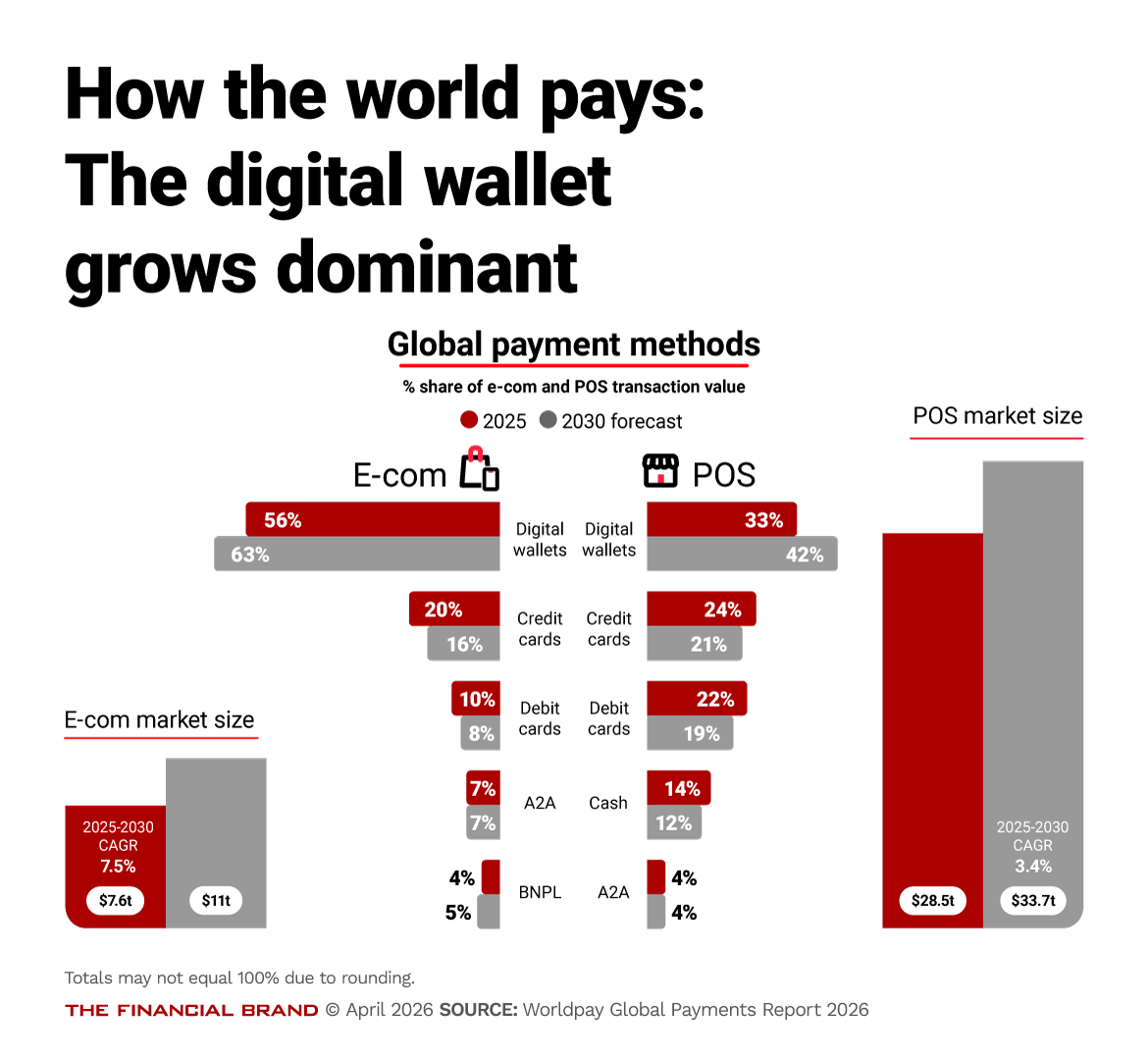
So the conclusion wrote itself. With this many ways to pay, the big wigs of the industry were surely on borrowed time. Analysts called them dinosaurs. The disruptors called their fees a tax.
That’s the story the market has been pricing in. But it skipped one step: checking where the money actually went.
Here’s what actually happened
The card networks didn’t actually shrink, they grew right alongside their challengers.
Visa’s payment volume just crossed $4 trillion and grew 11% year-on-year (YoY), with revenue up 14%. Mastercard grew by double digits too. Both networks are growing revenue faster than their payment volume. Businesses being made obsolete don’t usually manage that.
But wait. Didn’t digital wallets take over the checkout?
They did.
But now, take a peek inside those wallets. Around 70% of US, UK, and Australian users load them with… cards .
So while the screen changed, the network underneath didn’t.
And the latest “card killer” of the bunch shows the same pattern forming in real time: AI agents.
An agent can now buy something for you with nobody at the keyboard. If the disruption story were right, that’s exactly where Visa and Mastercard get cut out. Instead, they’re inside the transaction.
Mastercard now issues agentic tokens that let a verified agent pay without touching your card number. Visa meanwhile built the Trusted Agent Protocol so merchants can tell a real shopping agent from a malicious bot, after seeing a 4,700% surge in AI-driven traffic to US retail sites.
Put simply, both are now charging for something that didn’t exist two years ago. Notice the pattern? Each “disruptor” was supposed to delete the fee. Instead, each one ended up creating a brand new place to charge.
Which raises the real question: what decides where the fee lands… and who gets to collect it?
Separating the winners from the losers in the payments industry
The answer comes down to a single word: friction.
Think about two businesses sitting in the same purchase.
The first owns the checkout button. Remove it and some customers leave without buying.
The second moves the money from the customer’s bank to the merchant’s. Swap it for a competitor, and nobody notices. The money still arrives.
Now imagine both of them renewing their contracts with the merchant. The first can hold its price, because removing it costs the merchant sales. The second gets asked for a discount, and its only real answer is yes.
That’s the pattern hiding under everything we’ve covered today. The money in payments flows toward whoever makes buying easier and moves away from whoever just moves it from A to B. The ones shuffling funds in the background become interchangeable parts of the chain, competing on price alone.
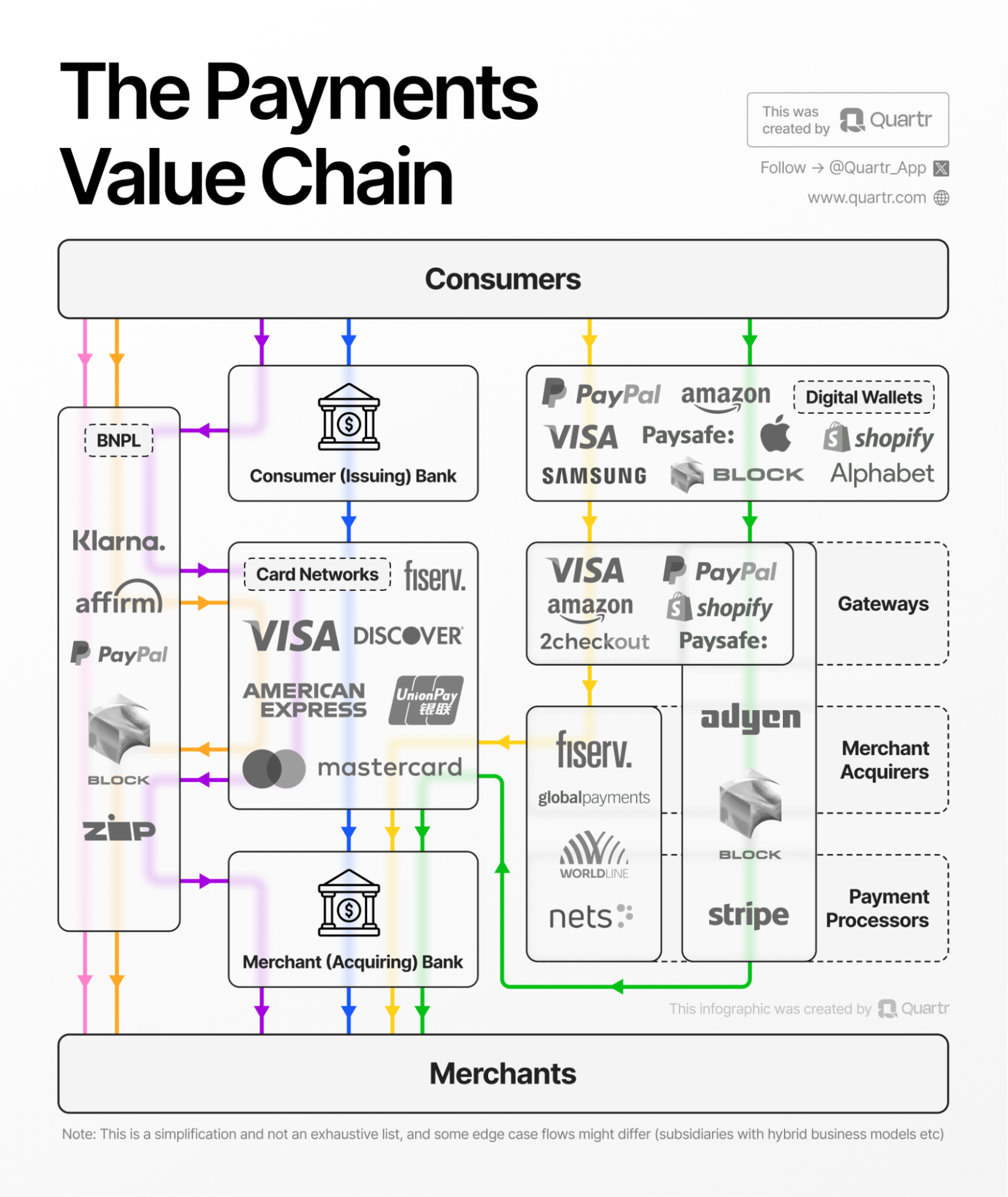
Source: Quartr
It’s why Visa and Mastercard thrived despite “cheaper” challengers multiplying underneath them. They stopped being just money-movers years ago.
Visa’s value-added services revenue (think fraud tools, security and data) grew 28% to $3.8 billion, now roughly a third of its quarterly revenue.
The fee had already migrated off the swipe and inside the very companies everyone assumed lived on it.
How to spot the winners of the next 5 years
If friction decides who collects, the first step is ignoring industry labels.
Fiserv and Adyen are both payment processors, sitting in the same part of the chain. Fiserv just had the worst quarter of the major processors , with revenue down 4% and operating margin down 810 basis points. Adyen just raised its 2028 profit margin target above 55% while taking share from European rivals.
Same label but opposite stories. Here’s what to look at instead.
The winners tend to share three traits
They own the buying moment. Wallets, checkouts and marketplaces (e.g. PayPal, Apple Pay and Mercado Pago) sit exactly where the customer says “yes.” It’s also why the networks are racing to embed themselves into AI agents, the newest front door of them all.
They can hold their prices. Removing them costs the merchant sales so every contract renewal starts from strength.
They earn beyond the payment itself. Fraud tools, security, credit. When the payment fee gets squeezed, they have somewhere else to collect.
The losers tend to share the opposite
They’re swappable. Replace them with a rival and the buyer never notices, so price is the only thing left to compete on.
Someone else owns their customer’s screen. Toast and Shopify (the software running restaurants and online stores) sit on top of processors like Adyen and Stripe, squeezing them. Even Visa has noticed the squeeze happening in the layer below it, with merchants increasingly routing to whichever processor is cheapest.
All their revenue comes from moving money. And that’s all they have. If the payment fee shrinks (and it usually will), there’s nothing behind it.
Put simply, whoever owns the buyer’s screen sets the terms for everyone underneath it.
And that reframes the risk in your portfolio. It probably isn’t that Visa gets dismantled by the latest payment fad. It’s that something you own may say “payments” on the cover, but actually ticks the boxes on the second list.
This table helps provide an illustration of the segmentation of companies within the payments sector:

👉 Our Digital Payment Stocks screener is a good place to start sorting names by which list they belong to.
The catch: sometimes the fee leaves payments entirely
So far, we’ve covered how the fee has only moved between players inside the payments chain. But sometimes it goes further. It leaves payments altogether and reappears in the industries next door such as loans, B2B, foreign exchange, etc.
You’ve already met one example without noticing. BNPL feels free because the consumer pays nothing at checkout. But the fee didn’t vanish, it split in two.
Merchants pay BNPL providers around 4% to 6% of every sale, double the cost of a normal card transaction. And consumers who slip up meet the fee on the other side: Klarna collected $254 million in late fees in 2024, while interest on Affirm’s longer plans brings in about half of its revenue.
Another example is in India. India ran the biggest version of this experiment. UPI was made free by regulation, and it worked spectacularly, now handling around 24 billion transactions a year .
PhonePe, who handles roughly 45% of UPI volume, earns effectively zero payment revenue. Its first ever profit instead came from the lending, float and insurance sold on top, with financial services revenue growing 206%.
And in a twist, India is now working on bringing the fee back. This month, its parliament passed a bill clearing the way for merchant fees on UPI for the first time since 2020. No rate has been set yet and consumers will stay free, but the message is hard to miss: free turned out to be expensive for somebody.
Latin America tells the same story: competition led to payment fees hovering close to zero, and revenue instead moved into credit and banking built on top, which investors have explored through Nu Holdings , PagSeguro and Pagaya .
MercadoLibre, as a specific example, moved into credit cards and grew its loan book 87% to $14.6 billion to become an entirely different revenue stream from payments.
And the biggest adjacent pool of all? B2B payments, worth roughly $1.6 quadrillion a year . Yup, it’s over a thousand trillion dollars, and most of it still runs on bank transfers, invoices and spreadsheets. All that friction and hardly anyone collecting on it yet.
👉 One company is reaching into that pool. Read this narrative on StoneX .
💡 The Insight: Payment’s winners are those who makes buying easiest
Now that we’ve followed the fee across systems, borders and industries, here’s a playbook that could help with your future decisions.
The disruption story asks which payment system wins and which loses, but that’s the wrong question. Nobody pays a premium for something they can swap without noticing.
The better question is which companies will be collecting in five years, and whether what you own sits there.
Three things worth asking about any payments business:
- Does it remove friction at the moment of buying or just move money afterwards? The first sets its price, the second generally negotiates it downward every year.
- If its payment fee went to 0 tomorrow, what would be left? Some companies have moats through lending, insurance and fraud protection. Others have no answer at all.
- If the fee migrates, does it land somewhere the business is actually good at? MercadoLibre’s move into credit is an example to look at.
One last reminder: a moving fee cuts both ways. It can drift toward the businesses you own… or away from them.
That’s the difference between the multiple players in the payments industry, and what we dissected today.
Key events next week
Wednesday
- 🇺🇸 GDP Growth (QoQ, Q2 second estimate)
- Forecast: 1.5%, Previous: 2.1%
- Why it matters: A weaker reading could reinforce concerns that economic momentum is slowing.
Friday
- 🇨🇦 GDP Growth (QoQ, Q2)
- Forecast: 0.6%, Previous: 0.0%
- Why it matters: A rebound in growth would suggest the Canadian economy regained momentum in Q2, potentially influencing expectations for future Bank of Canada rate decisions.
Have feedback on this article? Concerned about the content? Get in touch with us directly. Alternatively, email editorial-team@simplywallst.com
Simply Wall St analyst Mitch Lawler and Simply Wall St have no position in any of the companies mentioned. This article is general in nature. We provide commentary based on historical data and analyst forecasts only using an unbiased methodology and our articles are not intended to be financial advice. It does not constitute a recommendation to buy or sell any stock and does not take account of your objectives, or your financial situation. We aim to bring you long-term focused analysis driven by fundamental data. Note that our analysis may not factor in the latest price-sensitive company announcements or qualitative material.
Comments
Mitchell Lawler
Mitchell Lawler is a Senior Investment Editor at Simply Wall St, where he oversees Market Insights and the platform’s published editorial content. He also leads The Foxhole, a daily forum for contrarian investment ideas and constructive debate, drawing on nearly a decade of personal investing experience and more than five years in professional equity research and financial publishing.

