
In January 2025, the share prices of tech companies fell on the news that Chinese artificial intelligence company, DeepSeek, had built a cost-effective competitor to the leading American AI models like OpenAI’s ChatGPT.
Now, another Chinese AI company,Moonshot AI, is making waves.
Earlier this month, Moonshot released its Kimi K3 model, the largest open-source AI model ever released, which some claim could perform at a level close to that of Anthropic’s latest model but at a fraction of the price.
As with DeepSeek, we are likely to see a new round of debate about who will win the AI race.
But is that the right question for investors to be asking?
Instead, investors should perhaps look at which companies might benefit regardless of who wins, if there is a winner at all.
But before we get to that…
What happened in markets this week?
Here’s a quick summary of some of the main news from the past week:
💳 Visa tops profit estimates on resilient spending and World Cup travel (Reuters)
- What happened: Visa’s third quarter result beat estimates as steady consumer spending and World Cup travel demand boosted payment volumes despite uncertainty due to the conflict in the Middle-East.
- How it impacts investors: Visa’s announcement again highlights its resilience as well as provides evidence of wider, global, economic activity.
- Next Steps: Want to see what people think about Visa? Check out the narratives provided by the Simply Wall St Community.
💻 Meta shares fall as frustration grows over AI spending plans (BBC)
- What happened: Meta released its latest quarterly earnings announcement. The lowest level of free cash flow reported emphasised the increasing investment in artificial intelligence which is expected to rise from $125 billion to as much as $145 billion.
- How it impacts investors: Meta is going all in on artificial intelligence but many investors are concerned about the return on investment.
- Next Steps: See what the Simply Wall St Community is saying about Meta and its AI ambitions.
🪟Microsoft jumps 7% as it boosts capital spending plans citing demand (CNBC)
- What happened: Microsoft outperformed guidance after strong revenue growth, specifically from its Azure business. It also announced a $3.2 billion gain from its investment in AI firm, Anthropic, and announced increased capital investment.
- How it impacts investors: This week’s earnings announcement continues to show Microsoft’s strong performance as well as its future bet on artificial intelligence.
- Next Steps: Compare how Microsoft’s latest results stack up against its historical margins via the company page.
🛢️Oil jumps as US-Iran conflict resumes after a brief pause (CNBC)
- What happened: The price of oil rose sharply in Asia following renewed tensions in the Middle East.
- How it impacts investors: Higher oil prices can increase costs to companies and lead to increased inflation for economies.
- Next Steps: Want to explore what oil companies are out there? Review our US Midstream Oil and Gas Pipeline Operators Screener.
🤖 Asian stock rout deepens on AI worries ahead of tech earnings (Reuters)
- What happened: Asian stocks continue to fall as anxiety about AI valuations, the upcoming announcement of earnings from big tech companies and a policy decision from the US Federal Reserve coming.
- How it impacts investors: The move is an indication of investors around the world starting to take a more conservative view of artificial intelligence and the technology sector.
- Next Steps: The AI Infrastructure Stocks Screener could be worth scanning for potential opportunities in light of the selling pressure.
Breaking down the walls
Ever since DeepSeek fired the first salvo in the battle for AI supremacy, all eyes have been on who is leading the way between the frontier American companies versus those scaling rapidly from within China.
The American large language models (LLMs) were largely built around closed, subscription business models. Companies like OpenAI, Anthropic, or even Google, own the foundational inner workings. But China pivoted to open-source or “open-weighted” models. These models allow users to download, modify, and run it on their own servers for free. It also allows the Chinese companies to avoid some of the costs associated with building an AI business and to overcome some of the restrictions they face on computer chips.
This positions Kimi K3 as a cheaper and more flexible option for many companies and potentially makes it easier to adopt.
When you add the flexibility and affordability with quality, it then poses a huge risk to the incumbents. Many of whom are burning cash and investing hundreds of billions of dollars to grow their platforms.
The Battle For The AI Frontier
When Kimi K3 was launched, the reviews were solid.
Dean Ball, OpenAI’s head of Strategic Futures, called it a “very good model” that is “on par with the best public models”, albeit “token hungry” and that “it’s not obvious to me that this model is actually cheap to run”.
Arena.ai, a community platform built around understanding AI performance, also ranked Kimi K3 highly.
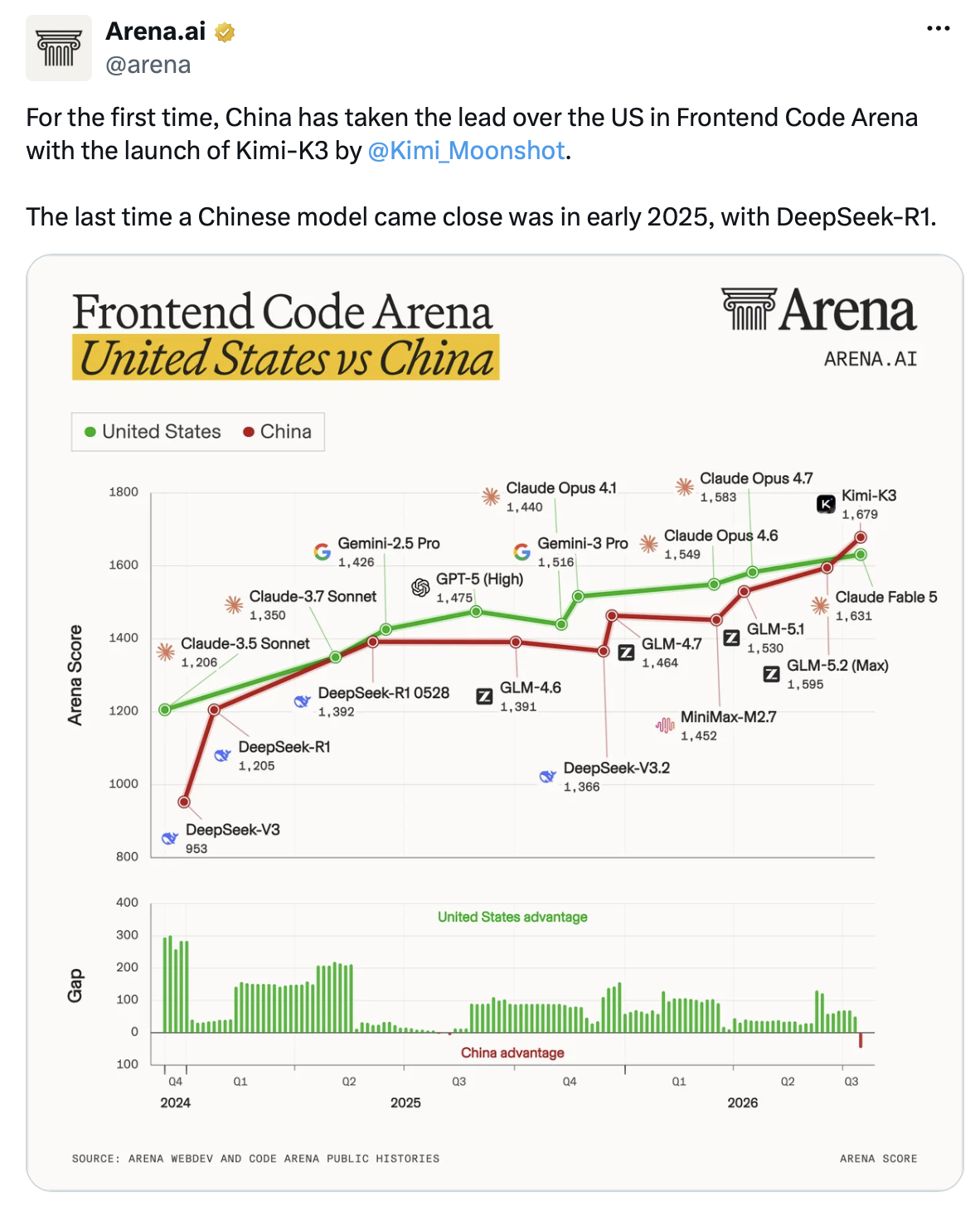
Arena pits two models against each other and uses the Elo scoring method to evaluate them. A user will enter a prompt, and each model will provide their response, and the user will choose which one they thought was best.
On the 17th of July, Kimi K3 outranked Claude’s Fable 5 model, although it has since fallen back below Claude’s Fable 5 and OpenAI’s GPT5.6 Sol.
This shows that Kimi’s performance is clearly competitive to frontier labs.
It also points to another truth. The leader frequently changes, and that the battle for AI supremacy is likely to not be settled any time soon. The best model on any given day could be very different.
The foundation, not the skyscraper
Every year, millions of people visit the Burj Khalifa.
At a height of 2,717 feet, it is still the tallest building in the world, and an impressive architectural marvel.
When people look at the building, they typically look up at the sparkling glass facade. But the magic actually happens below their feet, 164 feet deep into the ground. If it wasn’t for its innovative foundation, there would be no building to look at.
It can be similar with artificial intelligence.
Investors typically like to spot winners, particularly in growing and important industries. While AI is certainly growing and important, the winners tend to keep changing.
But what if you don’t need to pick the winner between open source and private models? What if you could pick companies that are likely to supply the necessary components to whoever the winner will be irrespective of the leading model?
These are the types of questions that can help investors find outperformance when following a theme.
While the likes of Kimi K3, Claude, or ChatGPT get the headlines, these models only exist because of a long list of hardware and service providers.
Why “picks and shovels” might be better
The term “picks and shovels” is likely not a new term to many investors.
It comes from stories of the Californian Gold Rush of the 1850s. While many went west to dig up riches, some took a different approach. Samual Brannan and Levi Strauss were one such case. Brannan, who was the Gold Rush’s first millionaire, decided to simply sell to those with gold fever… picks, shovels, pans, and in the case of Strauss, clothing.
When nobody knew who would be the winner in the Gold Rush, some just bet on profiting from everyone. And so it might be the same with AI.
So, who provides the picks and shovels for artificial intelligence?
Well, it is the data centre providers. Semiconductor companies. Those providing the material to make the necessary chips. Regardless of which, if any, AI model becomes the dominant player, they are likely going to be buying the raw materials required from the same companies.
You only need to look as far as DeepSeek, the previous Chinese AI company that many were predicting might overtake the American AI giants. It has had to suspend its most recent funding round after reports emerged that its founder stated that Chinese AI firms still lag their American counterparts and remain heavily dependent on Nvidia (NASDAQ:NVDA) chips despite US export controls (something at least one Simply Wall St community member expects to continue for some time yet).
According to one article, profit in the AI value chain is concentrated almost entirely on chip design and leading-edge fabrication. The AI labs are largely loss-making despite fast revenue growth. Although use has been increasing, the prices customers are willing to pay are dropping.
To put it simply, whichever AI company is leading on any given day, they are probably using the same chips, like those manufactured by Nvidia or companies like ARM Holdings (NASDAQ: ARM),a company another Simply Wall St community member thinks might become the architecture layer of AI computing.
👉 Interested to see which “picks and shovel” companies exist in the AI supply chain? Check out our “Semiconductor Supply Chain” Screener.
The insight: The winners might not be those on the front line
On any given day, and depending on which AI lab is releasing its newest iteration, the leading AI model tends to change. This, along with the fact that most of these businesses are still privately owned, makes trying to pick a winner in AI a difficult task for investors.
Jevons’ Paradox states that the more efficient something gets, the more it is used. This is likely to be true for AI, especially as the models become both better and cheaper.
But if usage is spread over different models, or regularly shifting from one model to another, the investing thesis for AI providers is less winner-take-all and more like a card game where nobody gets to leave and constantly shuffles money from one player to another.
Instead, the benefit of that increased use is likely to be the providers of the tools needed for those labs to keep playing at the card table.
So, instead of asking “which AI company do I think is better?”, maybe you ask the following questions when looking for opportunities in the AI supply chain:
- What technology do these AI models need to function?
- Is there a dominant name in these niches that is likely to be used by all the players?
Just like the gold rush, there is a lot of excitement around AI, and many are staking their claim to try and lead the way. But, with little evidence of a lead being developed, maybe the best bet is not to try and pick the right plot, but supply them all.
Key events next week
Monday
- 🇺🇲 United States Manufacturing PMI
- 📉 Previous: 53.8
- ➡️ Why it matters: The manufacturing PMI report is a key gauge of factory activity that can help investors assess the health of the industrial economy.
Tuesday
- 🇺🇲 JOLTS Job Openings (Jun)
- 📉 Previous: 7.594m
- ➡️ Why it matters: The JOLTS job opening report offers insights into the strength of the labour market.
Wednesday
- 🇺🇲 United States Services PMI
- 📉 Previous: 53.6
- ➡️ Why it matters: The services PMI report tracks activity in the services sector which makes up the majority of the US economy.
Friday
- 🇺🇲 United States Unemployment Rate
- 📉 Previous: 4.2%
- ➡️ Why it matters: The unemployment rate is one of the most watched metrics for assessing the strength of the U.S. economy and heavily influences decisions about interest rates.
Of course, companies listed on American exchanges continue to release earnings results. These include notable companies like Palantir, SpaceX, Advanced Micro Devices, Eli Lilly, The Walt Disney Company, Shopify, and Berkshire Hathaway, to name a few. Want to share your predictions about what investors might see? Add your own narrative and share with the Simply Wall St Community.
Have feedback on this article? Concerned about the content? Get in touch with us directly. Alternatively, email editorial-team@simplywallst.com
Simply Wall St analyst Andrew Legget and Simply Wall St have no position in any of the companies mentioned. This article is general in nature. Any comments below from SWS employees are their opinions only, should not be taken as financial advice and may not represent the views of Simply Wall St. Unless otherwise advised, SWS employees providing commentary do not own a position in any company mentioned in the article or in their comments.We provide analysis based on historical data and analyst forecasts only using an unbiased methodology and our articles are not intended to be financial advice. It does not constitute a recommendation to buy or sell any stock and does not take account of your objectives, or your financial situation. We aim to bring you long-term focused analysis driven by fundamental data. Note that our analysis may not factor in the latest price-sensitive company announcements or qualitative material.
Andrew Legget
Andrew Legget is a writer at Simply Wall St. He has more than 20 years of experience as an investor and almost 10 years of experience in equity research and financial publishing. He is passionate about telling the stories of stocks and markets.


