
If you had to name the best-performing stock market in the world this year, South Korea probably wouldn't be your first guess.
But it is the answer.
Korea's main index, the KOSPI, doubled in the first half of 2026 and crossed 9,000 for the first time in June. Let that sink in… an index doubled in six months. Imagine the S&P 500 or the Nasdaq doing that.
So it makes sense that a market that was barely even looked at last year is taking all of 2026’s headlines.
But looking deeper, the most interesting thing about the KOSPI isn't how far it has moved. Read on…
What happened in the markets this week?
🚀 SpaceX’s AI spending surge tests investors (BBC)
- What happened: SpaceX reported Q2 revenue of US$7.8 billion, nearly double year-on-year, but spending rose more than 6x to US$18.3 billion (mostly for AI). The company posted a US$143 million quarterly net loss, and shares fell 9% following the news.
- How it impacts investors: SpaceX is asking investors to look past heavy near-term losses as it builds AI infrastructure alongside its space business. Until those investments start producing clearer returns, the shares may remain volatile when spending guidance changes.
- Next steps: Dig into SpaceX’s valuation, risks, and growth forecasts before deciding how much future AI growth is already priced in.
🚕 Uber’s robotaxi push puts near-term profits in the spotlight (Reuters)
- What happened: Uber plans to spend more than US$10 billion on robotaxis over the coming years, mainly through partner investments and support for fleets and vehicle commitments. It also forecast Q3 adjusted EPS of US$0.84 to US$0.88, below the US$0.89 analyst estimate.
- How it impacts investors: Investors now have to weigh Uber’s strong bookings growth against the cost of its robotaxi ambitions.
- Next steps: Review Uber’s financial health to see whether the robotaxi strategy could bring material pain to its margins and bottom line in the near future.
📱 Disney turns to TikTok to bring younger viewers into Disney+ (Reuters)
- What happened: Disney and TikTok agreed to let creators use characters and scenes from Disney films and TV shows in short-form videos. A US pilot is planned in the coming months and financial terms were left undisclosed.
- How it impacts investors: The deal gives Disney another route to turn its well-known franchises into engagement and potentially bring younger viewers onto Disney+. The key question is whether that attention translates into stronger subscriber growth and retention.
- Next steps: Take a look at Disney’s growth outlook to see how the TikTok deal fits into the wider streaming story.
⛏️ Glencore’s ASX listing could open the door to more mining capital (Reuters)
- What happened: Glencore is planning a secondary listing in Australia, targeting investments from the country's large pension funds and strong institutional interest in the mining industry.
- How it impacts investors: An ASX listing could improve liquidity and connect Glencore with more mining-focused pension capital. If Glencore were to push through, it’s likely to enter the country’s ASX 200, which would impact Australian index funds and their holdings.
- Next steps: Keep an eye on Glencore and its listing news over the coming months.
🧩 Chinese chip tools are getting a closer look from neighboring giants (Reuters)
- What happened: Samsung and SK Hynix have tested etching equipment from China’s AMEC as a backup against tighter US restrictions on Western chipmaking tools. Neither company has committed to wider deployment, and both denied testing AMEC equipment for use at their China factories.
- How it impacts investors: The tests suggest semiconductor spending could gradually shift toward lower-cost Chinese suppliers if export controls tighten further. That may give memory producers more flexibility while increasing competitive pressure on established equipment makers.
- Next steps: Explore the Semiconductor Supply Chain to compare the chipmakers and equipment suppliers exposed to this shift.
The world's hottest market for 2026
So what lit the fuse? In a word, AI.
South Korea is home to Samsung and SK Hynix, two of the world's big three chip makers, and the global scramble for memory that powers AI servers sent both to record highs.
But last month, just as quickly as it rose, it fell apart. In late July, the KOSPI dropped so hard it triggered the first back-to-back circuit breakers in its history; the automatic halt that freezes the whole market when it falls too far in too short of time.
At its worst the index had shed roughly a third of its value from June's peak, before snapping back with its biggest one day gain on record.
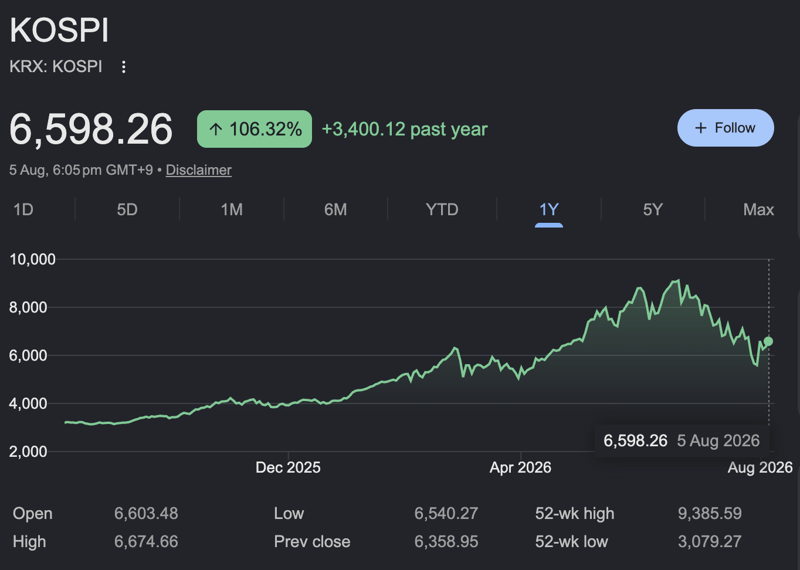
Even after that round trip, it is still up around 53% year to date, ahead of every other major market on earth.
But this is the part worth pausing on: isn’t KOSPI an index? For us investors, isn’t it meant to be the calm average of hundreds of companies, or the boring benchmark you own so you never have to sweat a single stock?
Yet the KOSPI has tripped its circuit breaker a total of nine times this year, with swings running at almost double Japan's Nikkei. Some have even likened its volatility to crypto.
So like always, this is where we have a closer look.
The story behind (or within) the rise
The KOSPI holds hundreds of companies. But this year, only two of them run the show.
As of early 2026, Samsung Electronics and SK Hynix together made up close to 40% of the entire index, and by June that had climbed towards half. On the narrower KOSPI 200, the two companies crossed 50% for the first time ever in May.
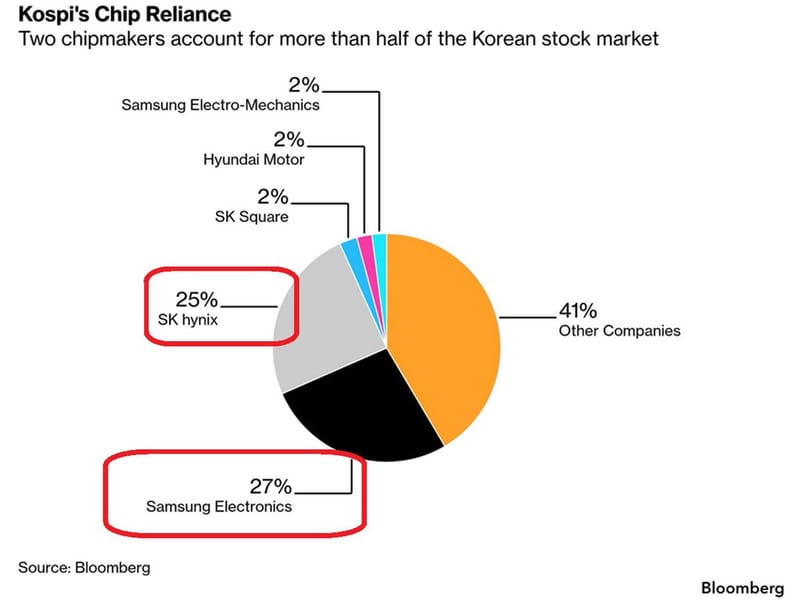
If you own Korea the easy way, through the US-listed ETF EWY, around 43% of your money sits in those same two stocks.
And they weren't just big, they were the whole story. Before the summer sell-off, Samsung and SK Hynix drove about 70% of the KOSPI's 2026 gains.
We saw a smaller version of this recently in the US market. Two weeks ago, when we looked at healthcare, Gilead and Merck made the whole sector's earnings look like an 18% decline, even while the rest of it was actually growing around 7%.
These examples all show how a handful of stocks can set the story for everything around them.
And how lopsided does that get? Over one week this year, the KOSPI rose 12% while the majority of its holdings fell. The index climbed because two giants climbed, not because the market did.
The concentration is now so extreme that Goldman Sachs warned a further one-point rise in the pair's weight could force some foreign funds, bound by US diversification rules, to sell around $2 billion just to stay compliant.
The tell and the danger
For a picture of what this really means, look at the last week of July.
On July 29, SK Hynix posted the most profitable quarter in its history: revenue up 257% from a year earlier, operating profit up 557%, its fifth record quarter in a row.
But the stock fell 9.6%, and the KOSPI hit a circuit breaker.
The result had landed just short of what analysts already expected, and some chip shipments slipped into later months.
But through the index’s crash, analysts' forward earnings forecasts for Korea were still rising. Samsung and SK Hynix still supply most of the world's advanced memory, and AI demand is real.
But the crash of a single stock leading to an index hitting a breaking point is today’s story; how an entire national index can now rise and fall on one trade.
👉 What does the Simply Wall St community think about SK Hynix? This narrative tells the story.
Today’s lesson: An index is not a proxy for diversification
Here is the real lesson: owning an index feels like being diversified. It isn’t. Korea is the most recent and illustrative example of this narrative, and it’s not the only one.
Recall that diversification isn't about how many companies are on the list. It is about how concentrated your money is across them.
And almost every index is cap-weighted: the bigger a company gets, the bigger its slice, so the index slowly becomes a bet on whatever has already won. The more the winners run, the more concentrated your “diversified” fund quietly becomes.
Korea is the extreme version, but the same thing is happening in the index most Western investors actually own.
The S&P 500's top 10 companies now make up around 40% of the whole index, up from just 20% a decade ago. Even at the peak of the dot-com bubble, the top 10 only reached about 27%.
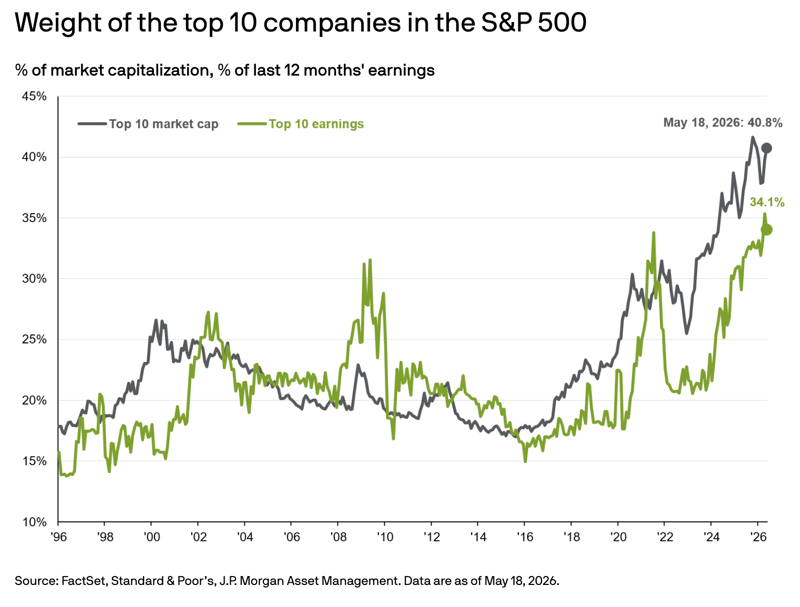
The cause is the same as Korea's: a small group of AI and tech giants, exposed to the same theme, driving most of the moves. An S&P 500 index holder is running a milder version of the same bet a KOSPI holder is.
And it’s not just Korea and the S&P 500. TSMC alone makes up over 50% of the TAIEX’s value. Less than 10 companies make up over half of the Nasdaq 100, Hang Seng, and DAX indices.
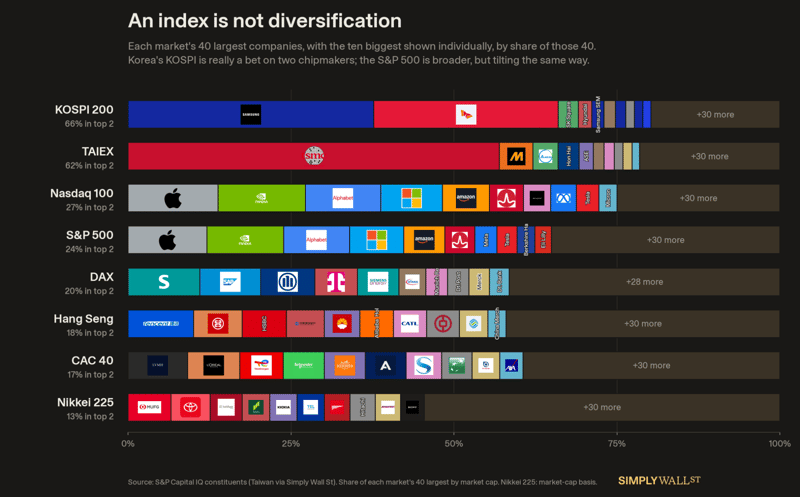
To put numbers on it, sink $1,000 into an S&P 500 fund today and around $400 of it lands in just ten companies. The single biggest name is close to 7% of the index on its own, so about $70 of that $1,000 rides on one stock.
It even survives your attempts to spread out. Own a value fund and a growth fund and you would think you had split the risk, yet several of the same giants could sit in both.
While that doesn't inherently make it dangerous, it makes it a position you should hold on purpose, not by accident.
💡 The Insight: Korea is a real-life example of an undiversified index
None of this is a reason to avoid index funds. They are still one of the best tools most investors have.
The point is to know what is inside the one you own rather than assuming “index” means “safe and spread out.”
A few checks for any index ETF you hold:
- What do the top few holdings add up to? If the top 10 are 40% of the fund, most of your outcome rides on a handful of names.
- Are they exposed to the same theme? Ten stocks riding one trade could be too much concentration, even with ten different companies.
- Is the weight backed by earnings or just price? Always going back to the fundamentals. Rising weight matched by rising profit is a position, but rising weight on hope is something else.
- Do your funds overlap? Two funds holding the same names could give you less diversification than planned.
A few Simply Wall St tools make this concrete:
👉 This KOSPI screener shows exactly how stark the difference in market cap between its stocks really is.
👉 The Semiconductors industry page shows what the index rides on: Korea's chipmakers near 18 times earnings and memory-cyclical, the US sector closer to 25 times.
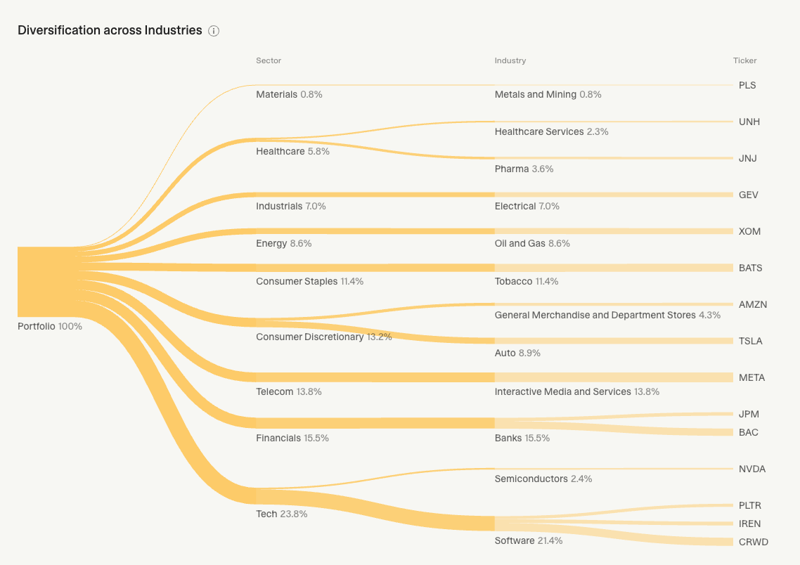
👉 The Portfolio feature runs the same check on your own holdings, and can graphically show you your portfolio’s diversification across stocks, industries, and geographies.
Key events next week
Tuesday
- 🇦🇺 RBA Interest Rate Decision
- Forecast: 4.35%, Previous: 4.35%
- Why it matters: Markets expect the RBA to hold rates after inflation eased.
Wednesday
- 🇺🇸 Inflation Rate (YoY)
- Forecast: 3.4%, Previous: 3.5%
- Why it matters: One of the week's most closely watched releases. A softer inflation reading lessens the chances of a rate hike, which were debated by the Fed's board last month.
Thursday
- 🇬🇧 GDP Growth Rate (QoQ, Q2 Preliminary)
- Forecast: 0.2%, Previous: 0.6%
- Why it matters: The first estimate of Q2 UK economic growth. A weaker reading could reinforce concerns that the economy is losing momentum.
Have feedback on this article? Concerned about the content? Get in touch with us directly. Alternatively, email editorial-team@simplywallst.com
Simply Wall St analyst Mitch Lawler and Simply Wall St have no position in any of the companies mentioned. This article is general in nature. Any comments below from SWS employees are their opinions only, should not be taken as financial advice and may not represent the views of Simply Wall St. Unless otherwise advised, SWS employees providing commentary do not own a position in any company mentioned in the article or in their comments.We provide analysis based on historical data and analyst forecasts only using an unbiased methodology and our articles are not intended to be financial advice. It does not constitute a recommendation to buy or sell any stock and does not take account of your objectives, or your financial situation. We aim to bring you long-term focused analysis driven by fundamental data. Note that our analysis may not factor in the latest price-sensitive company announcements or qualitative material.
Comments

Mitchell Lawler
Mitchell Lawler is a Senior Investment Editor at Simply Wall St, where he oversees Market Insights and the platform’s published editorial content. He also leads The Foxhole, a daily forum for contrarian investment ideas and constructive debate, drawing on nearly a decade of personal investing experience and more than five years in professional equity research and financial publishing.
