
Picture a city with one bridge in and out.
One morning, it closes. Nobody can say for how long.
Within days, the ferry operators are the most profitable business in town. Demand soars. Fares triple. And every investor in the city arrives at the same obvious conclusion: invest in ferry companies.
For months, they’re right.
But while that’s happening, the government is focused on solving the problem - it’s approving three new bridges.
And the day they open, two things happen at once. The ferries lose the only reason anyone was ever paying triple… and the city stops being afraid of that one bridge ever closing again.
That, more or less, is the global energy market right now.
The Strait of Hormuz has been shut since late February. Oil prices spiked, tankers became a key element, and investors have poured into energy stocks in these two spaces.
Meanwhile, the Gulf is building its bridges.
As you read this article, you’ll see why that construction may matter more than the blockage itself, and where the long-term money in energy could be heading instead.
What happened in the markets this week?
🛢️ Oil prices ease as Saudi Arabia finds alternative export routes (CNBC)
- What happened: Oil prices extended their fall as Saudi Arabia offered additional crude cargoes to Asian refiners through ship-to-ship transfers near Oman, easing supply disruption concerns following attacks on its East-West pipeline.
- How it impacts investors: Alternative export routes could reduce pressure on oil supply and price. Persistently high oil prices could also keep inflation and interest-rate risks elevated.
- Next steps: Read today’s full article which goes into export routes and where investors should look from today.
🤖 Huawei’s AI chip demand outpaces supply as Nvidia rivalry grows (Reuters)
- What happened : Huawei can’t produce enough AI chips to meet demand in China and is now limiting overseas sales. The company expects its Ascend 950DT chip to be widely used for AI model training next year and plans to accelerate the release of its next-generation Ascend 960 chips.
- How it impacts investors : Huawei’s capacity constraints point to strong demand for domestic AI infrastructure in China as US export controls restrict access to Nvidia’s most advanced chips. This could intensify competition in AI hardware while accelerating China’s push for a more self-sufficient semiconductor ecosystem.
- Next steps : Explore AI stocks and investment ideas on Simply Wall St to see companies exposed to the expanding AI infrastructure market.
🤖 Nokia leans further into AI with Microsoft partnership (Quartz)
- What happened: Nokia expanded its partnership with Microsoft, combining Nokia Data Suite with Microsoft Fabric to help telecom operators turn network data into usable insights.
- How it impacts investors: Nokia is looking beyond traditional telecom equipment for growth, and AI-powered network automation gives it another way to tap into rising AI spending. The key question for investors is how much this growing AI push can contribute to revenue over time.
- Next steps: See whether Nokia’s AI push shows up in its growth and valuation.
🚕 Lucid teams up with Bolt to launch 25,000 robotaxis in Europe (Financial Times)
- What happened : Lucid signed a deal with European ride-hailing company Bolt to deploy at least 25,000 robotaxis across major European cities, using Lucid’s upcoming midsize platform and Nvidia technology. It’s Lucid’s first robotaxi expansion outside the US and follows a separate deal with Uber earlier this year covering more than 35,000 vehicles.
- How it impacts investors : Robotaxis could give Lucid another way to grow beyond selling EVs directly to consumers. But with the shares still down more than 60% this year, investors will likely want to see these large partnerships turn into actual vehicle deployments and revenue.
- Next steps : Lucid scores 0 of 6 on value. Sort the EV and autonomous Screener for names that score higher.
👟 Nike brings luxury-brand experience into its turnaround (Yahoo Finance)
- What happened : Nike appointed Alexandre Arnault, the son of LVMH CEO Bernard Arnault, to its board as the sportswear company continues its turnaround. Arnault previously held senior roles at Rimowa and Tiffany, while Nike’s latest quarterly revenue slipped 1% to US$11 billion and Nike Direct sales dropped 7%.
- How it impacts investors : Nike is trying to get consumers excited about the brand again, and Arnault brings experience refreshing established brands and connecting them with new audiences. Investors will be watching for signs that those efforts translate into stronger sales, particularly online and in China.
- Next steps : Nike features in Brands at the right price, a 20-stock Watchlist where four companies are more than 40% below the author’s fair value.
What actually broke in energy markets
The Strait of Hormuz is a 21-mile-wide stretch of water between Iran and Oman. As we covered before, 25% of the world’s seaborne oil trade passed through it last year, along with over 110 billion cubic metres of liquefied natural gas.
Since late February, almost nothing has moved through it. The IEA called it the largest supply shock in the history of the oil market, and member countries released 400 million barrels of emergency stocks in response.
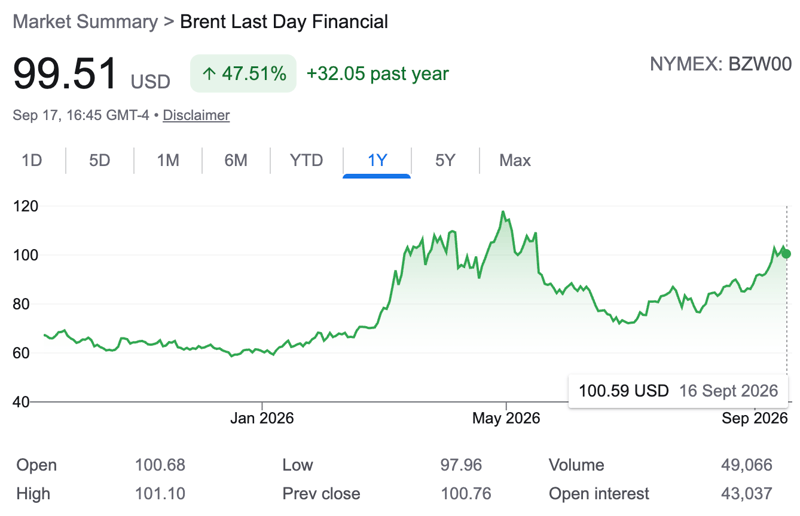
Oil did what you’d expect. Brent ran from the mid-$70s to over $110, and it’s trading around $99 today.
Tanker owners did even better. With cargoes forced onto longer routes, Frontline (NYSE:FRO), one of the world’s largest owners of crude oil tankers (a unique type of energy-adjacent stock), posted a record quarterly profit of $659 million, with revenue up 96.5% year on year.
So far, so obvious. But what’s next is the part the headlines skip.
The Gulf’s response to the bottleneck
Faced with this bottleneck, governments started routing oil past it.
Saudi Arabia’s East-West pipeline, which crosses the country to the Red Sea, is now running at its full 7 million barrels a day (well, that was the case before this week’s drone attack, bringing the pipeline to a complete shutdown).
The UAE is rushing to finish a second line to Fujairah, on the safe side of the strait, which would double its capacity to 3.6 million barrels a day by 2027.
In July, a consortium led by Chevron signed agreements to revive the Kirkuk-Baniyas pipeline, which would carry Iraq’s crude to Syria’s Mediterranean coast at a target of 2 million barrels a day. That route had previously been shut since 2003.
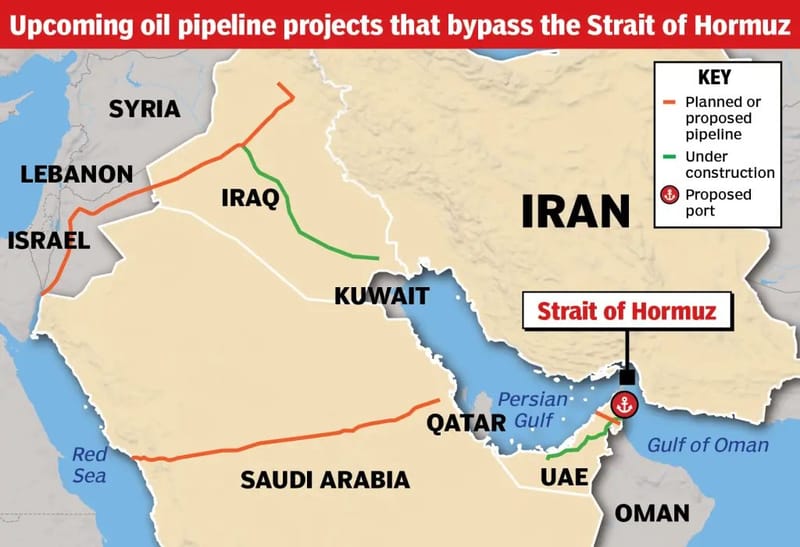
Goldman Sachs counts seven of these projects underway. Together they could push pipeline capacity past 14 million barrels a day by the end of 2028, or ~60% of everything the Gulf exported before the war.
This won’t be a temporary workaround. It’s going to become a permanent change to how the world’s oil gets to market.
Why that could actually make oil cheaper
A chunk of today’s oil price (which underpins many energy stocks) isn’t the cost of producing a barrel. It’s fear, the premium that markets pay for the risk that supply gets cut off. And Hormuz is the single biggest source of that fear on the planet.
Build enough pipelines around it, and you actually can remove the cause behind this fear premium.
We’ve already had a preview of how quickly that premium can vanish. Brent has round-tripped roughly $40 in each direction twice this year, falling below $70 in July when a peace framework was briefly held, then climbing back above $100 when the news changed.
Analysts expect prices to fall by next year. The US Energy Information Administration (EIA) sees Brent averaging $74 in 2027 and around $67 in the second half of that year. JP Morgan has it near $56 by Q4 2027.
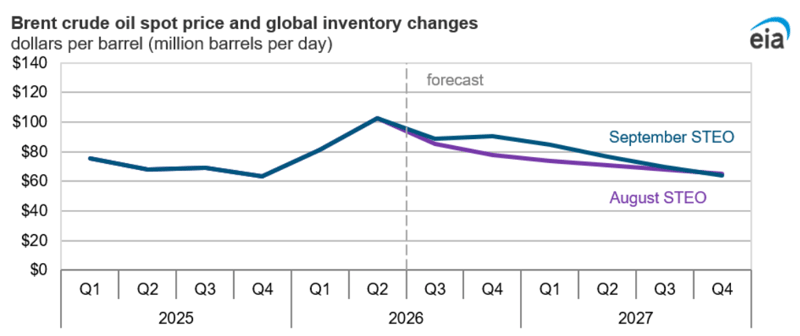
Put simply, the war made oil expensive. The response to the war is designed to make oil boring again, which could pull those less durable energy stocks lower.
The energy stock trade that needs the disruption to last
As mentioned earlier, Frontline’s Q2 2026 revenue nearly doubled last year’s. For Q3, it booked 86% of its supertanker days at $156,900 per day. Its cash breakeven on those vessels is only $23,800 a day.
Earning 6.5x your breakeven is a wonderful position to be in. But it’s also a fragile one, because it exists entirely because of the blockage.
The company isn’t hiding that. Its CEO Lars Barstad has said openly that Hormuz traffic should quickly increase if the US and Iran reach a credible deal. The stock is up over 162% YTD and trades 14% over the analyst fair value estimate of $47, which suggests the good news is broadly acknowledged.
None of that makes it a bad business. It just makes it a bet on one specific thing: that the disruption lasts.
👉 Not everyone agrees it’s cheap. See why one investor calls Frontline 59% overvalued.
So where will the money in energy go instead?
If the premium eventually leaves oil, these are the areas probably worth looking at.
Pipelines that get paid on volume, not price. Midstream operators charge for moving the barrel, regardless of what that barrel sells for. Their revenue tracks how much flows through and not whether crude is $60 or $120.
👉 See the case for the ETF that owns America's largest pipeline operators.
The majors building the new routes. Chevron (NYSE: CVX) is a great example here, because it sits on both sides of the change. It’s a producer exposed to the oil price like any other, but it’s also the lead company on the Iraq corridor, which makes it one of the few large-cap energy stocks with a direct hand in redrawing the map rather than just reacting to it.
👉 This Chevron narrative walks through how the company is investing in Venezuela to double its oil production.
The one thing that can’t be rerouted
While oil takes the bulk of the headlines, there’s another commodity whose movement can’t quite be solved by just adding new routes.
Liquefied natural gas needs to travel at -162 degrees celsius in purpose-built ships. No pipeline can carry it and no Gulf terminal can route around Hormuz at any meaningful scale. This means that while Crude has detours available, gas does not.
Roughly a fifth of global LNG trade normally passes through that strait. Qatar’s Ras Laffan, the largest LNG complex in the world, was struck by Iranian missiles earlier this year, and around 17% of the country’s export capacity is now offline with repairs expected to take 3 to 5 years.
The clearest signal of what that means: QatarEnergy is now shopping for American LNG, talking to companies like Cheniere and Woodside Energy. While not a change in routes, this could also morph the LNG market long term.
The energy demand that has nothing to do with the war
While all of that plays out, something unrelated is happening to electricity.
Data center power consumption rose 17% in 2025, versus a 3% growth for overall global electricity demand, with AI-specific demand up 50%. The IEA expects data centre consumption to double by 2030. The five biggest operators now spend more than every oil and gas producer on earth combined.
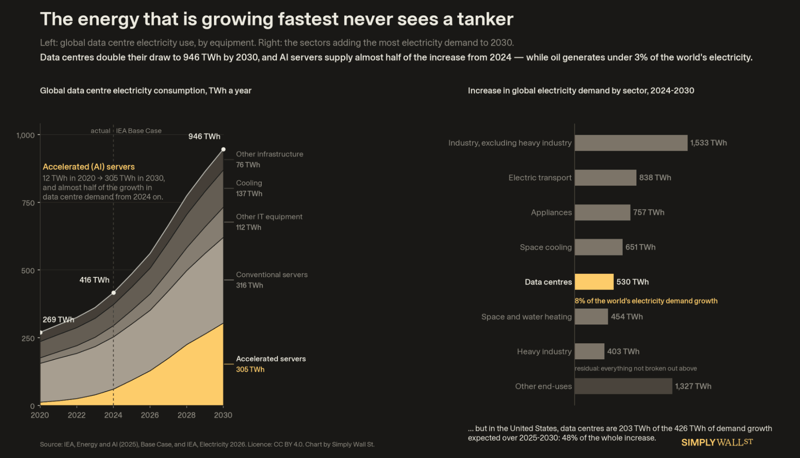
Two details in that chart are worth pausing on.
The first is where the growth comes from. Accelerated servers, the specialised chips doing the AI work, go from consuming 12 TWh in 2020 to 305 TWh by 2030. That's almost half the entire increase in data centre demand from 2024 onward coming from just one category of equipment.
The second is the one that matters for this article. Oil generates under 3% of the world's electricity. Yup, the fastest-growing energy demand on the planet barely touches the commodity everyone is watching.
The spending behind it has crossed a threshold too. The five biggest data centre operators now spend more on building them than every oil and gas producer in the world spends on production combined. That is a genuinely strange sentence to be able to write, and it's a reasonable summary of where capital is going.
And there, the US and China take 79% of the world's data centre demand growth between 2020 and 2030.
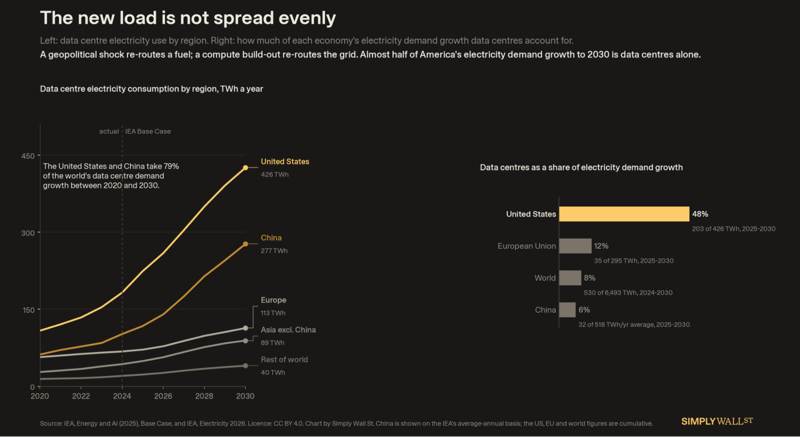
And within the US, data centres account for 203 of the 426 terawatt hours of demand growth expected by 2030. Just under half of everything the country adds.
That tells you where the power physically has to be built.
In the near future, all of it has to come from somewhere, and the timelines differ sharply. Nuclear takes years to build. Gas turbines take months. Which is why orders for gas-fired plants hit a 25-year high last year.
That brings the two halves of this story together. Gas is the supply that can't be rerouted, and it's the fuel that can be deployed fastest to meet the new demand.
👉 If you want the wider view of who gets paid if the map is redrawn, the community has built a watchlist of energy stocks for exactly that: The New Energy Flow Watchlist.
💡 The Insight: Ask what the crowd might have backwards
The useful skill here isn’t predicting the war.
The skill is asking a deeper question: what is everyone assuming that might turn out to be wrong?
Right now the assumption is straightforward. Conflict in the Gulf means expensive oil, so own oil and own tankers. It’s reasonable, and it’s been right for six months.
But the response to that conflict points somewhere else entirely. If the new routes, the fear premium leaves the barrel, and the value settles into other areas: the infrastructure, the gas that can’t be rerouted, and the power build needs to happen.
Three questions worth considering moving forward:
- Does this investment need the disruption to continue? If yes, you’re not investing in energy, you’re investing in the crisis lasting.
- Does it get paid on price or on volume? Producers care what the barrel sells for. Pipelines care how much of it moves. Those are different businesses in different weather.
- What would have to be true for the crowd to be wrong? Understand different scenarios and make your call.
👉 It’s worth checking what you already own. Almost half of America’s electricity demand growth to 2030 is data centres alone, which means an AI-heavy portfolio is discreetly long the demand side of this story and short energy security, whether that was the intention or not.
The map is being redrawn either way, but where does your portfolio sit within these emerging dynamics?
Key events next week
Monday
- 🇨🇳 Loan Prime Rate (PBoC)
- Forecast: 3.00% (1-yr) / 3.50% (5-yr), Previous: 3.00% / 3.50%
- Why it matters: The PBoC has held for months despite soft data. A surprise cut, especially to the 5-year rate that anchors mortgages, would signal Beijing is finally leaning harder into property and consumption support.
- 🇨🇦 BoC Governor Macklem Speech
- Why it matters: Markets will listen for how the Bank of Canada reads a slowing economy and easing inflation, and for any steer on the next rate move.
Tuesday
- 🇦🇺 RBA Governor Bullock Speech
- Why it matters: With inflation still sticky, any hint on the RBA's rate path could move the Aussie dollar and rate-sensitive domestic sectors. However, expectations are already pointing to an increase later this month.
Wednesday
- 🇩🇪🇪🇺 Germany & Eurozone Flash PMIs
- Why it matters: The first read on September activity. A composite above 50 signals expansion; a slip back below would revive eurozone growth worries and weigh on the euro.
- 🇬🇧 UK Flash PMIs
- Why it matters: Services drive ~75% of UK GDP, so this is a timely gauge of momentum and feeds into the Bank of England easing debate.
- 🇺🇸 US Flash PMIs
- Why it matters: An early, market-moving snapshot of US activity ahead of the heavier data the following week.
Thursday
- 🇦🇺 Unemployment Rate (Aug)
- Forecast: 4.5%, Previous: 4.5%
- Why it matters: The last major labour read before the RBA's next meeting. A softer print strengthens the case for cuts; resilience keeps the RBA cautious.
- 🇺🇸🇨🇳 Trump–Xi Summit (Washington)
- Why it matters: The leaders' second summit of 2026. Trade, tariffs, tech/semiconductor controls, rare earths and AI are all on the agenda — the key swing factor for tariff-exposed sectors and China plays.
Have feedback on this article? Concerned about the content? Get in touch with us directly. Alternatively, email editorial-team@simplywallst.com
Simply Wall St analyst Mitch Lawler and Simply Wall St have no position in any of the companies mentioned. This article is general in nature. Any comments below from SWS employees are their opinions only, should not be taken as financial advice and may not represent the views of Simply Wall St. Unless otherwise advised, SWS employees providing commentary do not own a position in any company mentioned in the article or in their comments.We provide analysis based on historical data and analyst forecasts only using an unbiased methodology and our articles are not intended to be financial advice. It does not constitute a recommendation to buy or sell any stock and does not take account of your objectives, or your financial situation. We aim to bring you long-term focused analysis driven by fundamental data. Note that our analysis may not factor in the latest price-sensitive company announcements or qualitative material.
Comments

Mitchell Lawler
Mitchell Lawler is a Senior Investment Editor at Simply Wall St, where he oversees Market Insights and the platform’s published editorial content. He also leads The Foxhole, a daily forum for contrarian investment ideas and constructive debate, drawing on nearly a decade of personal investing experience and more than five years in professional equity research and financial publishing.
