
The Treachery of Images is a famous surrealist painting by the Belgian artist René Magritte.
As you can see below, it is simply a picture of a pipe, with the words “Ceci n’est pas une pipe”, which translates to “This is not a pipe”.

And Magritte is correct. It is not a pipe… it is a picture of a pipe.
It’s an example of how our brain perceives information differently and how, when you take a step back and really analyse something, you can get a very different (but more accurate) picture.
It is with this idea that we decided to take a look at the most recent earnings season.
We ask the question: Are the earnings really earnings, or is it another example of the Treachery of Images?
But first, let’s catch up on some news.
What happened in markets this week?
Here’s a quick summary of some of the main news from the past week:
🇨🇦 United States imposes new tariffs on Canadian goods amid rising tensions (AP)
- What happened: Over the weekend, new tariffs aimed at Canada were implemented as trade negotiations between the US and Canada fell through. These tariffs are set to impact around 5% of Canada’s annual exports to the US. Canada has threatened retaliatory tariffs on a “dollar for dollar” basis starting September.
- How it impacts investors: Tariffs increase business costs for importers, which are then typically passed onto consumers by higher prices. This can lead to increased inflation and more volatile economic activity.
- Next Steps: Follow how the US market is reacting and how it has performed over historical periods via the US market analysis and valuation page.
📱 New Zealand to introduce bill banning social media for children under 16 (Reuters)
- What happened: New Zealand has announced new laws aimed at preventing children under the age of 16 from accessing social media. The bill would require social media platforms to take ‘reasonable steps’ to verify users' ages and propose fines of up to 10% of a platform’s global revenue for non-compliance. This follows similar laws passed by the Australian government as well as those being discussed across Europe.
- How it impacts investors: Increased restrictions on social media use are a threat to the growth and profitability of social media platforms, as well as increasing the regulatory risk attached to such businesses. This can make operating more difficult, as the onus is on the platforms and not the government to enact appropriate safeguards.
- Next Steps: Share your Narrative on companies like Meta with the Simply Wall St Community.
📺 Paramount is stuck at the final gate to acquiring Warner Bros (CNBC)
- What happened: For over a year, entertainment company Paramount Skydance (NASDAQ:PSKY), has been trying to acquire Warner Bros. Discovery (NASDAQ:WBD). While there remain opponents to the deal, the biggest hurdle is arguably the antitrust lawsuit from the California attorney general, where discussions again broke down after the attorney general accused Paramount of leaking details.
- How it impacts investors: Mergers and acquisitions can be messy and expensive transactions even if the deal doesn’t go through. With the long-running saga still showing no signs of ending soon, it is likely that Paramount will continue facing increased legal costs as well as less attention that can be spent on its core business with no promise that the company will be rewarded.
- Next Steps: See why bullish analysts think Paramount Skydance could almost double from here.
🚀 Musk sees SpaceX’s orbital data centre launch near end of 2027 (Bloomberg)
- What happened: SpaceX founder and CEO, Elon Musk, expects the company’s first AI satellites to be launched in the fourth quarter of 2027, with significant scale being reached by 2028. SpaceX has filed for approval to launch a network of as many as 1 million satellites that conduct computing in orbit, which the company says will be both lower-cost and more environmentally friendly than if it were done on Earth. The satellites will use Nvidia chips.
- How it impacts investors: SpaceX’s orbital data centre ambition was one of the key stories it sold in its recent IPO. This is also occurring at a time when considerable investment continues into AI and data centre technology while some complaints begin to emerge about the potential environmental impact of data centres on the communities around them. SpaceX’s ability to meet Musk’s promises could be key to how investors view the value of SpaceX stock.
- Next Steps: Explore the stocks racing to lead the new space economy.
💾 Broadcom credit risk soars on mega AI debt financing backstops (Yahoo! Finance)
- What happened: Yields on the bonds for semiconductor and tech infrastructure company Broadcom (NASDAQ:AVGO) have increased as bond traders have seen increased credit risk following the company’s recent talks to raise more than $60 billion in debt for a recent AI chip financing deal. This comes on top of a recent decision to backstop a $35 billion debt package.
- How it impacts investors: Recent deals, like Broadcom’s, essentially see companies use their balance sheet strength to help boost their client’s purchasing ability, meaning that the debt risk remains with Broadcom. Some in the market consider this to be a form of ‘phantom leverage’ which could backfire in the event of a market downturn.
- Next Steps: Find out what the community makes of Broadcom's valuation right now.
🛢️ US threatens severe sanctions against countries with ties to Iran (The Guardian)
- What happened: US Treasury Secretary Scott Bessent has threatened to impose sanctions against any country or entity that maintains ties with Iran. The hope is that such a threat includes removing entities from the US dollar system. One such entity that the market is focused on is China, which, apart from being an economically powerful country, is also Iran’s largest trading partner.
- How it impacts investors: Like the tariffs on Canada, sanctions also raise the economic risks and costs that could impact consumer and market sentiment as well as potentially increase inflation. At the very least, it raises economic uncertainty, which markets tend to take a dim view of.
- Next Steps: If you want energy exposure without the crude-price whiplash, see the US pipeline operators built on toll-road economics.
Earnings season on the surface
Looking at nothing but the headlines, the most recent earnings season was pretty good. In fact, some commentators have called it the strongest US earnings season in five years.
When you consider this occurred in an environment filled with global conflicts, high energy prices, stubborn inflation and slowing economic growth, it looks even more impressive and a sign of how resilient the US economy can be.
It was also better than most people expected.
According to BlackRock, earnings growth for the second quarter of 2026 is tracking around 5% ahead of pre-season estimates. 78% of companies beat estimates, with the aggregate beat currently standing at around 8%.
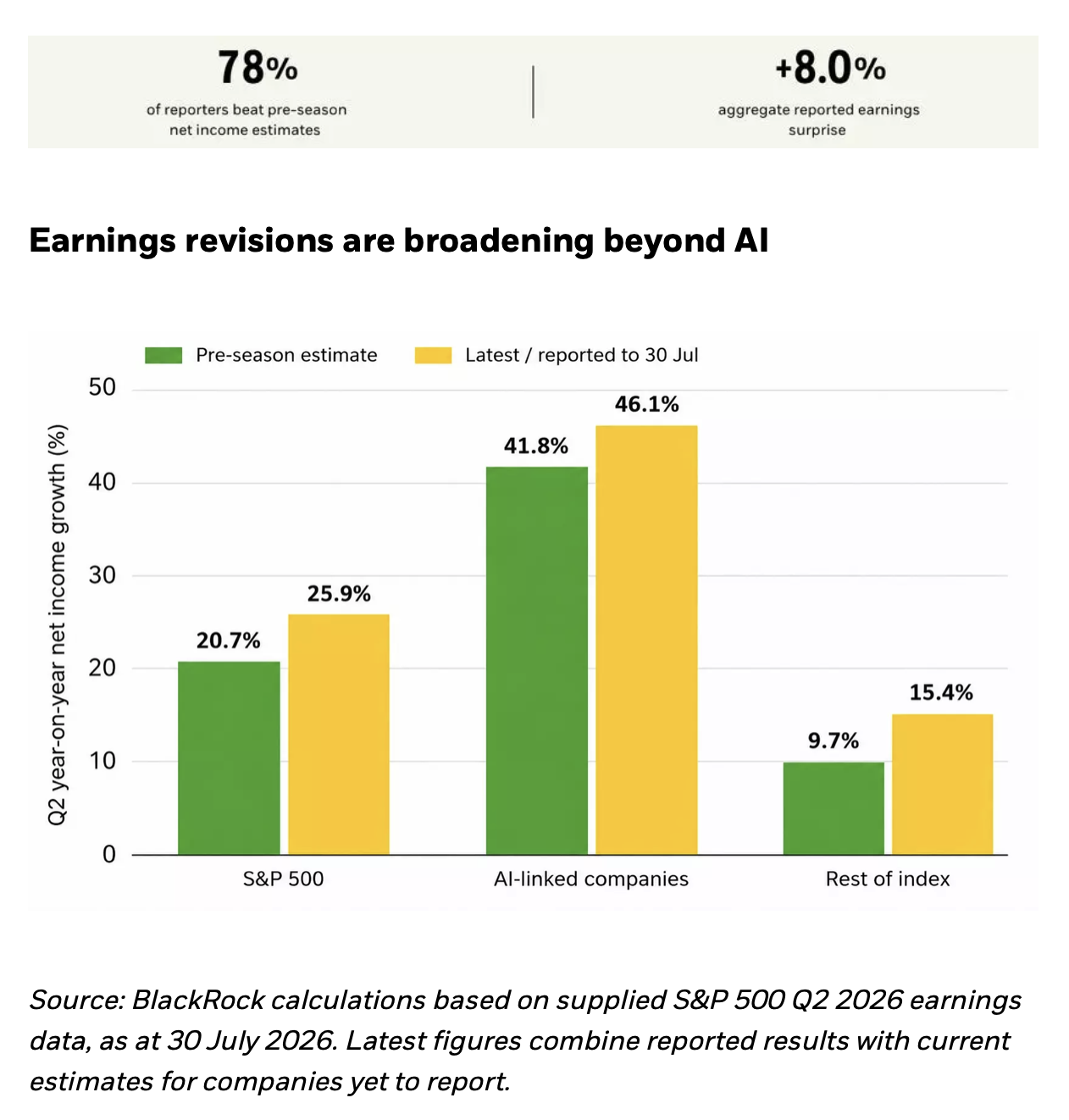
The simple way to read this is that things aren’t as bad as people thought they’d be.
But if we look under the hood, as all good investors do, is this really the story?
Not all earnings growth is created equal
Investors want the companies they invest in to grow earnings.
But it’s important to know how that earnings growth is generated.
Take tech giants, Alphabet (NASDAQ:GOOGL) and Amazon (NASDAQ:AMZN).
Alphabet increased earnings per share by 296% for the second quarter compared to the prior corresponding period, and earnings per share for the full half were up 179% compared to the first half of last year. Amazon also produced some big numbers, with earnings per share for the quarter up 240% and earnings per share for the half up 160%.
But a deeper look shows something different.
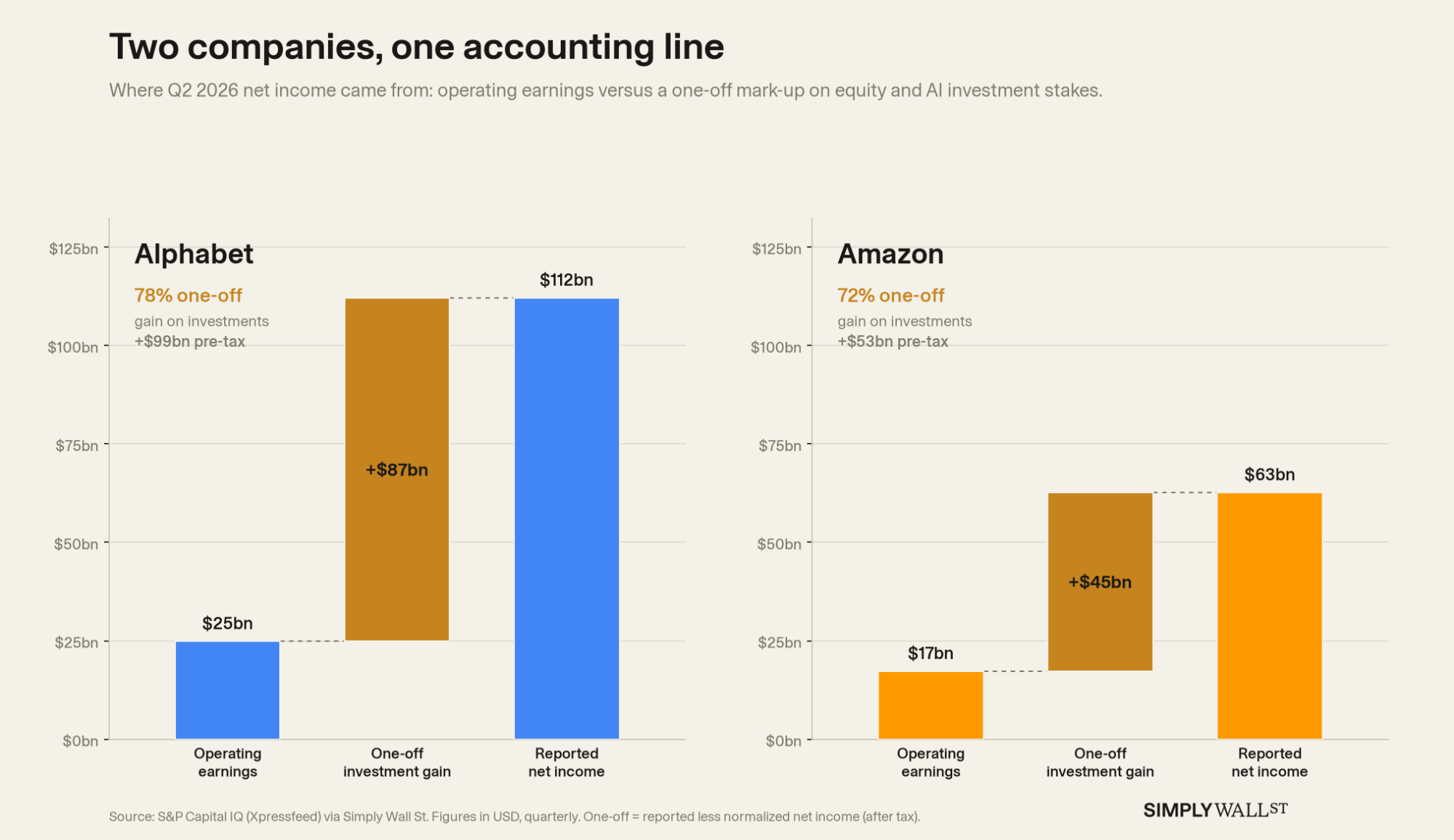
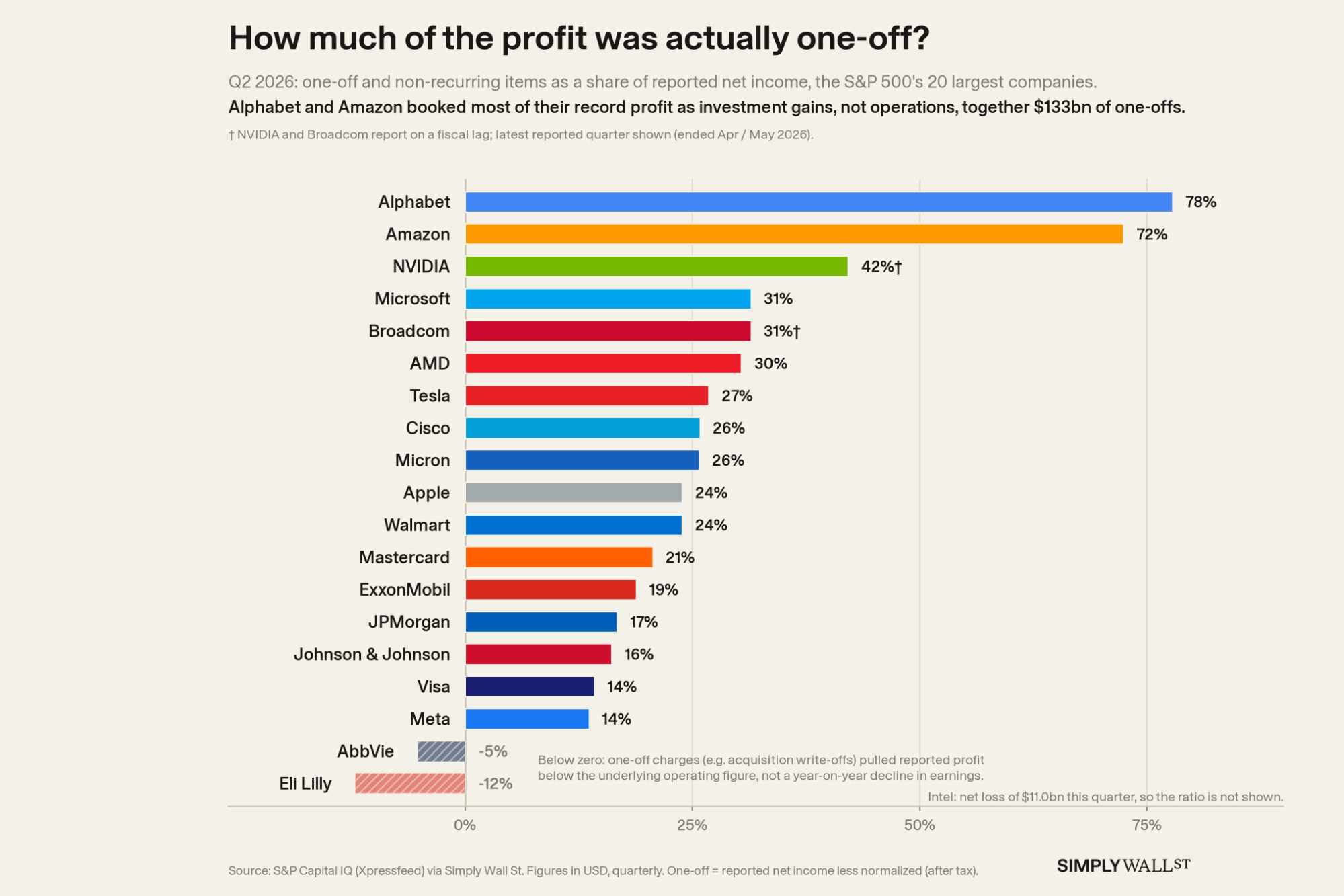
Around 78% of Alphabet’s earnings and 72% of Amazon’s earnings came from one-off gains related to artificial intelligence (such as Amazon’s investment in Anthropic). From this, some investors might argue that the reported results aren’t as good as they first appeared.
In fact, if you strip out these two one-off fuelled results, the overall earnings surprise so far roughly halves.
And it isn’t just Alphabet and Amazon where one-off gains were a major story. As highlighted in a recent narrative, Microsoft’s (NasdaqGS:MSFT) earnings benefitted from its investment in OpenAI.
👉 Check out our rewards and risk analysis for Alphabet and Amazon for company analysis beyond the headlines.
AI spending: The driveshaft of earnings
Technology was the standout industry, with many analysts estimating that over 90% of companies actually beat market expectations.
The key driver in these markets was, again, artificial intelligence. But rather than one-off gains from investments in AI companies, spending on AI infrastructure was arguably the key driver.
The four main hyperscalers, Alphabet, Amazon, Microsoft, and Meta, have now collectively invested more than $1 trillion in AI-related capital expenditure since 2023. This year alone saw around $745 billion on AI-related spending by these companies.
That is a lot of money flowing through providers of semiconductors, data centres and other AI-related services. But questions are starting to be asked about the sustainability of this spending.
As shown below, the capital expenditure of many of the hyperscalers is growing faster than their own revenue.
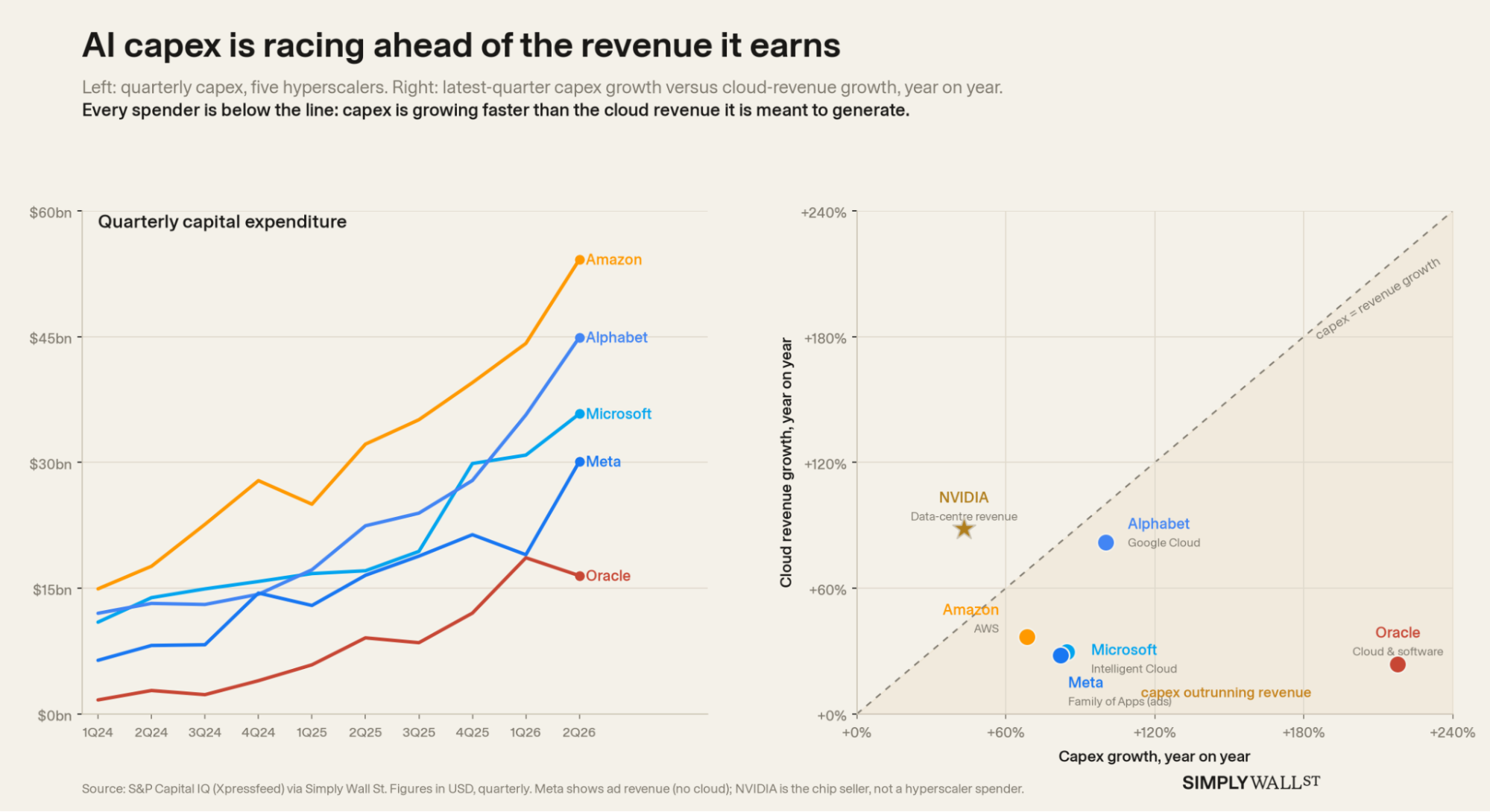
When companies invest, they usually do so with the idea that it will come with a commensurate benefit to revenue and profitability, but only Nvidia, which is one of the key beneficiaries of AI spending as its line of chips are critical to the technology, has seen revenue grow faster than capital expenditure.
The question for investors is whether the ever-growing capital expenditure in artificial intelligence will pay off, or will it continually offer more promise than actual return on investment in the years ahead. Furthermore, what happens to companies' earnings if the hyperscalers cut back?
👉 Investors are taking both sides of this in The Foxhole. See how the Nvidia debate is shaking out.
But what about the rest?
While the tech sector is riding the wave of AI spending, it’s also worth looking to see if the optimistic commentary matches what is happening elsewhere.
Take Walmart (NASDAQ:WMT), for example.
While many companies beat analyst expectations, Walmart was one of the few that disappointed. Same-store sales, a measure that compares sales from stores open in both the current and previous period, increased 2.6%, but analysts expected growth of 3.8%.
It’s an example of how, while corporate spending, particularly on AI, is growing, there remains a weakness in relation to consumer spending as inflation, energy costs and fuel prices put pressure on wallets and purses.
Walmart wasn’t the only retailer to have not shown the bright sparkling results of listed companies in other industries. Home Depot (NYSE:HD) beat estimates, but management commentary about weak demand for home improvement projects sent its share price lower. The same was true for Lowe's (NYSE:LOW).
It is an example of how, despite the superlative headlines, the rising tide is not lifting all boats, especially if those companies are dealing with the end consumer rather than corporate customers.
The Insight: Look under the hood
The key lesson is that, like an iceberg where the majority of its size is hidden under the water, the real story of a company’s earnings can often lie underneath the main headlines.
Also, a good “earnings season” and “good earnings” are not the same thing.
While some companies delivered real, impressive results. Others produced results that provided more questions than answers.
So, how should an investor look at earnings? It comes down to three core categories.
Earnings quality
There is a difference between growing operational earnings and earnings growth artificially fueled by one-off items such as what we saw in the tech sector with their AI equity investments.
Earnings driver
What are the drivers of earnings growth? Is this something that benefits all, or just some companies or industries? Is this a temporary trend or something that is likely to be more durable?
Earnings breadth
Is the rising tide raising all boats or just some? What industries are accelerating? Which industries are struggling?
👉 This is what all three checks look like at the portfolio level. Get the same view of your own.
Key events next week
Monday
- 🇩🇪 German inflation rate
- 📈 Forecast : 3.0%, Previous: 2.8%
- ➡️ Why it matters: Germany is a key European economy. An increase in inflation not only adds pressure to consumers as products get more expensive but also increases the chances of an interest rate increase.
Tuesday
- 🇪🇺 European Union inflation rate
- 📈 Forecast : 3.1%, Previous: 2.9%
- ➡️ Why it matters: The EU is a major economic region and an increase in inflation could increase the risk of further interest rate hikes in the region.
Wednesday
- 🇦🇺 Australian GDP growth rate
- 📈 Forecast : 0.0%, Previous: 0.3%
- ➡️ Why it matters: The GDP growth rate announcement will offer a strong picture of how successful the Australian economy has been performing, or, not performing.
- 🇺🇲 US JOLTS job openings
- 📈 Forecast : 7.32m, Previous: 7.359m
- ➡️ Why it matters: Job openings can provide insight into the strength of the economy and labour market. High job openings combined with low unemployment can signal a tight labour market, potentially increasing wage growth and inflationary pressures.
Friday
- 🇺🇲 U.S. unemployment rate
- 📈 Forecast : 4.2%, Previous: 4.1%
- ➡️ Why it matters: The unemployment rate is a key indicator of the economy. Economists largely expect the rate to stay relatively unchanged but are watching for potential impacts from the Iran war, among other factors.
With the current earnings season nearing an end, the number of notable companies releasing results is starting to decline. However, the likes of Dell Technologies, MongoDB, Broadcom, Snowflake, Zscaler, and Lululemon are some of the names that we can still expect announcements from.
Have feedback on this article? Concerned about the content? Get in touch with us directly. Alternatively, email editorial-team@simplywallst.com
Simply Wall St analyst Andrew Legget and Simply Wall St have no position in any of the companies mentioned. This article is general in nature. Any comments below from SWS employees are their opinions only, should not be taken as financial advice and may not represent the views of Simply Wall St. Unless otherwise advised, SWS employees providing commentary do not own a position in any company mentioned in the article or in their comments.We provide analysis based on historical data and analyst forecasts only using an unbiased methodology and our articles are not intended to be financial advice. It does not constitute a recommendation to buy or sell any stock and does not take account of your objectives, or your financial situation. We aim to bring you long-term focused analysis driven by fundamental data. Note that our analysis may not factor in the latest price-sensitive company announcements or qualitative material.
Comments
Andrew Legget
Andrew Legget is a writer at Simply Wall St. He has more than 20 years of experience as an investor and almost 10 years of experience in equity research and financial publishing. He is passionate about telling the stories of stocks and markets.

