
In the 1990s, governments around the world went after Big Tobacco.
Lawsuits were filed. Regulations were tightened. Billions of dollars were paid in settlements.
But tobacco stocks didn’t die.
Quite the opposite. Philip Morris, now part of Altria, became one of the best-performing stocks in history, despite the long-term decline in cigarette consumption and the increased shots being fired at it by governments.
Now, a new target has arrived that is, in a lot of ways, mirroring the tobacco fight of the 90s: Social media stocks.
The simple view is to see rising regulation as bad for business, and to stay away from social media companies. However, as the tobacco precedent suggests, maybe the investment story isn’t over; maybe it has just shifted.
We’ll get into that after looking at some of the news of the week.
What happened in markets this week?
Here’s a quick summary of some of the main news from the past week:
🛢️ Ship fuel shortage looms as war-strained refiners favour other products (Reuters)
- What happened: As wars in Europe and Iran impact oil supply, access to fuel used by container ships and power plants is starting to become increasingly tight.
- How it impacts investors: With supply tightening, the price of fuel could increase, which would then need to be passed on to consumers, which could lead to increased inflation.
- Next Steps: Looking for opportunities in the oil industry? Try our US Midstream Oil and Gas Pipeline Operators screener.
💲 Investors to pore over inflation data for rate trajectory signals (Yahoo Finance)
- What happened: With the US Federal Reserve due to meet soon to decide on whether to make changes to interest rates, many investors are looking at data to decide which way they will go and what this means for assets. Many commentators consider it a coin flip as to whether the Fed will hike interest rates.
- How it impacts investors: The Fed’s decision on interest rates is one of the most followed economic announcements in the world. Its decision can have a significant impact on how assets are valued.
- Next Steps: With interest rates impacting asset values, check out our US market Analysis and Valuation page.
🤖 Nvidia to acquire Hugging Face for nearly $13 billion (Fox Business)
- What happened: Global chip powerhouse, Nvidia, announced that it will acquire Hugging Face, an open-source artificial intelligence platform, for just under $13 billion. A move some say will help reduce the impact on large customers investing in their own AI computing capabilities.
- How it impacts investors: This move arguably highlights the continued focus on the investment case of artificial intelligence, as well as how one of its leaders is looking at the market, in particular the open-source artificial intelligence segment.
- Next Steps: Deploying US$13 billion could change the math on Nvidia. Compare its price to the fair value estimate in Nvidia’s Company Report.
🖥️ Tim Cook warns of memory chip prices in final address as CEO (Yahoo Finance)
- What happened: In his final earnings call as Apple CEO, Tim Cook warned of soaring prices for computer chips and the issues this had for pricing decisions at Apple. Tesla CEO Elon Musk echoed his thoughts and added his fears about what it could mean for inflation.
- How it impacts investors: Cook’s views are a rare discussion of the risks many are seeing in the rise of artificial intelligence. Musk’s views on inflation also could highlight the impact it may have on interest rate decisions and affordability for things like energy.
- Next Steps: Analysts are expecting a very different Apple by 2029. Weigh the growth and margins behind their fair value.
🇨🇳 China’s EV makers shift gears from cars to focus on humanoids (CNBC)
- What happened: Chinese EV makers are pivoting into humanoid robots as increased competition and slowing growth in the electric vehicle market put pressure on profitability and company share prices.
- How it impacts investors: With Chinese EV companies' share prices falling, many are looking at new ways to shift the narrative. It also points to the wider industry dynamics of the electric vehicle market, which may also be impacting the likes of Tesla.
- Next Steps: Bullish on electric vehicles? Use our EV Stocks screener to find attractive opportunities.
What is happening to social media stocks?
In August, as many as 47 states, as well as other US territories, sued Meta Platforms (NASDAQ: META), accusing the social media giant of violating child privacy laws and intentionally designing an addictive platform.
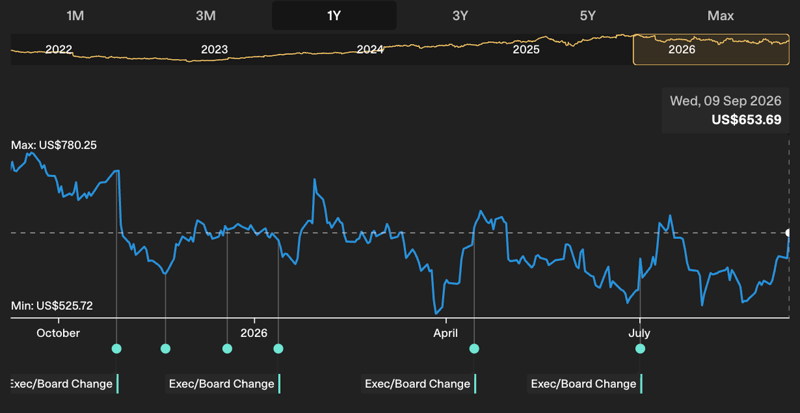
The states allege that Meta knew that features across its platform (Facebook, Instagram, etc.) posed harm to the mental health of children, and concealed this to maximise revenue and user engagement. Meta disputed this allegation but still decided to settle the lawsuit, which will see it pay US$18 billion to the states over ten years and will agree to change aspects of how its platform works.
This is the latest in a series of increased regulatory actions focused on social media and its impact on children.
In December 2025, Australia fired the first shot with legislation banning children under 16 from accessing social media platforms. Similar legislation would either be proposed or enacted across Europe, including Spain and the United Kingdom, while France’s top court blocked a bill saying it infringed on freedom of expression.
While hardly the only story affecting Meta over the past year, the increased regulatory risk has likely played its role, with Meta’s share price falling almost 13% over the past year.
👉 Explore why this community author has flipped from bullish to bearish on Meta.
Is regulation a problem for social media stocks?
The regulation being forced on social media echoes a similar large-scale government level crack down: The fight against Big Tobacco in the 1990s.
Like social media, governments around the world claimed not just that the product was harmful, but that the companies knew it and hid the evidence. The outcome was similar: large fines as well as tougher rules on how those businesses could operate.
For big tobacco, a lot of the rules focused on how it could advertise, especially in ways that could be seen as making smoking attractive to children. For social media, which is less of a physical product, it is about making it harder for children to get access and, when they do, how much time they can spend on the platform and what they see.
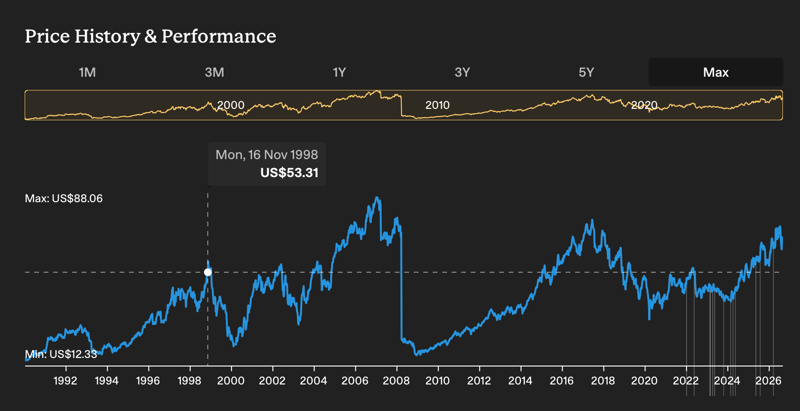
Curiously, however, these restrictions didn’t make tobacco companies bad investments.
In fact, Phillip Morris, which would eventually be renamed Altria (NYSE:MO) in 2003, would be called one of the best-performing stocks of all time, compounding at 17% per year between 1927 and 2007, for example. It has also generated a total return for investors of around 2,500% since the 1998 Master Services Agreement (MSA), which imposed heavy restrictions on the tobacco industry.
As shown above, while the share price has not materially changed since the Master Services Agreement was implemented in November 1998, dividends and other corporate actions have generously rewarded investors who stayed the course.
Clearly, massive global regulation on big tobacco didn’t hurt the investors of one of the biggest tobacco companies in the world.
👉 The same regulatory fear now hangs over Reddit’s ad model. See what the most bearish analysts expect for Reddit.
Folding to regulation
Of course, while regulation didn’t critically hurt Altria/Phillip Morris, other industries weren’t so lucky.
Take the online poker industry. After the poker boom of the early 2000s, online poker exploded. That was, at least, until the Unlawful Internet Gambling Enforcement Act (UIGEA) fundamentally changed the economics of the industry.
While UIGEA didn’t outright make online poker illegal, it placed significant restrictions on online gambling payments. The practical effect was that banks and payment processors became increasingly reluctant to process transactions for online poker operators, which made it harder for these operators to move money to and from US customers. Already reeling after UIGEA, in 2011, the Department of Justice seized the websites of the US-facing operations of the largest online poker sites.
Today, online poker in the US is a fraction of the size it used to be, or arguably could still be. Regulated, legal online poker is only available in a small number of states, and other gamblers have moved to unregulated sites that largely use crypto to get around restrictions but pose significant risk to players.
The distinction between online poker platforms and Big Tobacco is important.
Unlike the tobacco industry's 1998 Master Settlement Agreement, which restricted how tobacco companies could advertise and promote their products, UIGEA targeted a critical dependency of the online poker business model: its ability to move money.
Altria found a way to survive the advertising restrictions, but there was no substitute for cash flow for the online poker sites, making one far more devastating than the other for both the business and its investors.
👉 See the media giants potentially facing the same regulatory risk.
The Insight: Roadblock or speed hump?
History has shown that increased regulation can break industries and the companies inside them in some cases, while entrenching the strength of existing companies in other situations. As such, it remains to be seen what the recent pushback against social media companies might mean in the future.
So, how might investors form a view on the crackdown on social media, or any other industry that might find itself the target for regulation in the future?
Here are five things to consider:
What exactly is actually being regulated?
What is being restricted? What is the impact likely to be on a company's ability to operate? What impact will it have on an industry's growth rates and total addressable market? If the market is likely to shrink, will it be gradual or sudden? Is there more regulation to come?
Can customers go elsewhere?
Will restrictions and regulations make another product more attractive? Is there anywhere else for customers to go? Is it easy for customers to switch?
Who bears the cost?
Will the regulations add significantly to a company's ongoing operating costs? What are the penalties for non-compliance versus company profitability? Can a company pass costs onto consumers? Will a company need to invest significant capital to adhere to regulations? Will regulation significantly shift a company’s profitability, such as its return on capital?
Does regulation change the competitive landscape?
Is it likely that regulation impacts all companies equally, or will it be felt more by some while others can absorb it? Does it raise barriers to entry for new competitors to enter the industry? Will some players have an advantage over others due to scale, network effects or some other competitive advantage?
What does it do to the investment case, and is it priced in?
Is the market pricing in the impact of regulations? Has the market overreacted to the impact of regulations? Will regulations significantly change a company’s profitability or growth potential? Does the investment thesis materially change because of this news?
👉 Check out our Demo Portfolio to see how you can track these risks across the companies you own.
Key events next week
Monday
- 🇨🇦 Canadian inflation rate YoY
- 📈 Forecast : 3.0%, Previous: 3.0%
- ➡️ Why it matters: The 11th largest economy in the world and one of America’s largest trading partners, the inflation rate provides an indication of Canadian cost-of-living and growth, which could be a key question as tariffs between it and the U.S.A continue.
Wednesday
- 🇬🇧 UK inflation rate YoY
- 📈 Forecast : 3.1%, Previous: 2.9%
- ➡️ Why it matters: Many are forecasting inflation in the United Kingdom to increase, which could lead to the Bank of England feeling pressure to increase interest rates.
Thursday
- 🇺🇲 Federal Reserve interest rate decision
- 📈 Forecast : 4.0%, Previous: 3.75%
- ➡️ Why it matters: Forecasts continue to point to the US Federal Reserve increasing interest rates, which will impact asset pricing and could put extra pressure on the US consumer.
- 🇬🇧 Bank of England interest rate decision
- 📈 Forecast : 3.75%, Previous: 3.75%
- ➡️ Why it matters: Although it is expected that inflation will come in higher, many predict the Bank of England will keep rates unchanged. However, if this is the case, many will be watching its commentary for what might happen in the future.
Friday
- 🇯🇵 Japan’s inflation rate YoY
- 📈 Previous: 2.0%
- ➡️ Why it matters: With inflation an increasing concern in much of the world, the Japanese inflation rate will help highlight how the Asian region is faring and where interest rates might go in this part of the world.
- 🇬🇧 UK retail sales
- 📈 Previous: -0.5%
- ➡️ Why it matters: Retail sales activity is a strong indicator of the strength of a country's economy and consumer confidence. A rising sales figure can indicate that consumers feel comfortable spending, while a falling figure could indicate that consumers are tightening their belts.
Have feedback on this article? Concerned about the content? Get in touch with us directly. Alternatively, email editorial-team@simplywallst.com
Simply Wall St analyst Andrew Legget and Simply Wall St have no position in any of the companies mentioned. This article is general in nature. Any comments below from SWS employees are their opinions only, should not be taken as financial advice and may not represent the views of Simply Wall St. Unless otherwise advised, SWS employees providing commentary do not own a position in any company mentioned in the article or in their comments.We provide analysis based on historical data and analyst forecasts only using an unbiased methodology and our articles are not intended to be financial advice. It does not constitute a recommendation to buy or sell any stock and does not take account of your objectives, or your financial situation. We aim to bring you long-term focused analysis driven by fundamental data. Note that our analysis may not factor in the latest price-sensitive company announcements or qualitative material.
Comments

Andrew Legget
Andrew Legget is a writer at Simply Wall St. He has more than 20 years of experience as an investor and almost 10 years of experience in equity research and financial publishing. He is passionate about telling the stories of stocks and markets.
