Advertisement
- United States
- /
- Software
- /
- NYSE:ORCL
Reassessing Oracle (ORCL) After The Recent Share Price Pullback

Reviewed by Bailey Pemberton
- If you are wondering whether Oracle's share price still reflects solid value or if optimism has gone too far, starting with a clear look at what you are paying for each dollar of the business can help frame that question.
- Oracle's stock last closed at US$146.67, with returns of a 15.1% decline over 7 days, a 23.8% decline over 30 days, a 25.1% decline year to date, a 13.7% decline over 1 year, 75.4% over 3 years and 148.2% over 5 years, which gives a mixed picture of recent price moves and longer term performance.
- Recent headlines around Oracle have focused on its position in software and cloud services, and how that positioning fits into broad market themes. This news context matters because it often shapes how investors are thinking about growth potential, competitive strength and risk, which can influence how far the share price moves away from underlying value.
- On our valuation checks, Oracle scores 3 out of 6 for being undervalued, which suggests some measures hint at value while others are more cautious. Next, we will compare several valuation approaches and then finish with a way to connect the numbers to a fuller picture of the stock.
Find out why Oracle's -13.7% return over the last year is lagging behind its peers.
Approach 1: Oracle Discounted Cash Flow (DCF) Analysis
A DCF model takes estimates of the cash a company could generate in the future and discounts those cash flows back to today, to arrive at an implied value per share.
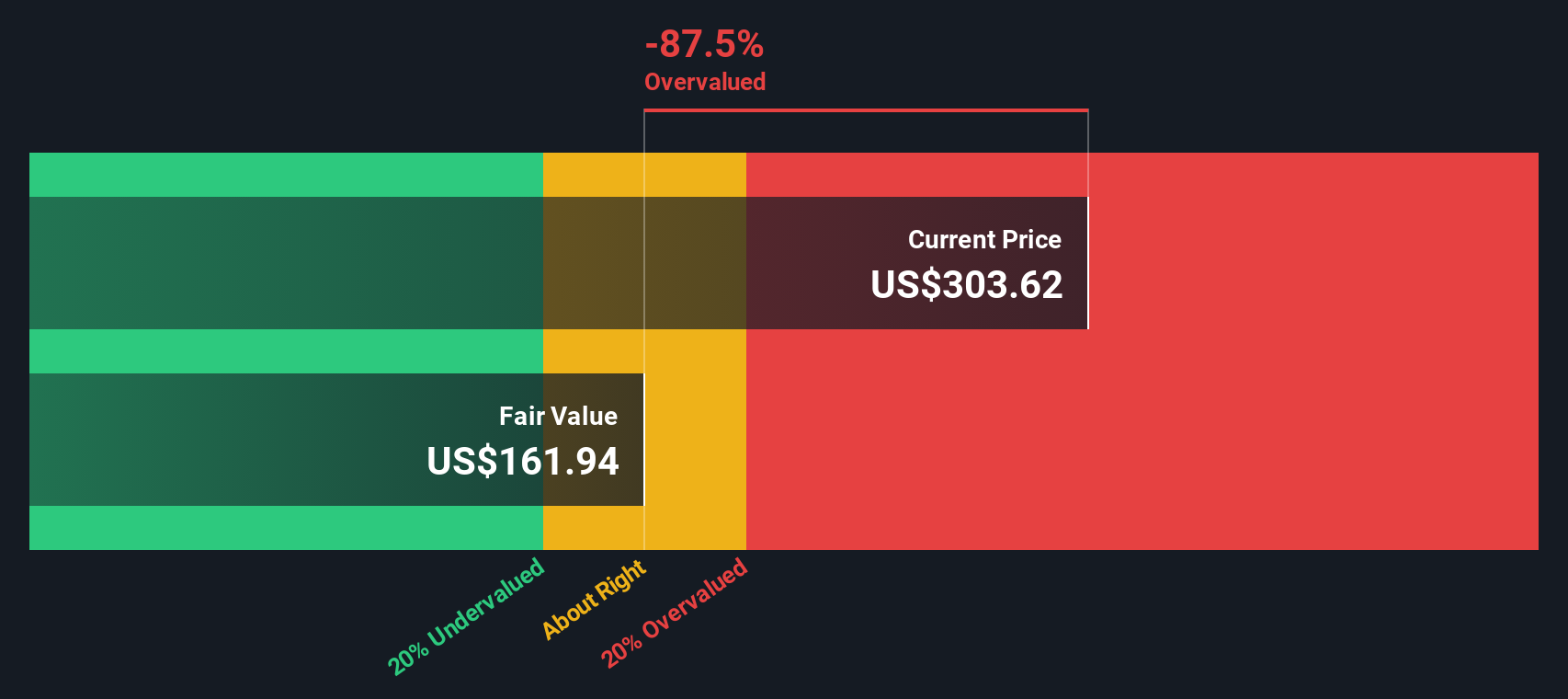
For Oracle, the model here uses a 2 Stage Free Cash Flow to Equity approach based on cash flow projections. The latest twelve month free cash flow is about $2.94b. Analyst inputs and extrapolated figures feed into a ten year path where projected free cash flow in 2030 is $22.71b, with intermediate years including both positive and negative values as expectations shift over time.
Using these projected cash flows, Simply Wall St estimates an intrinsic value of US$159.47 per share. Compared with the recent share price of US$146.67, this suggests the stock trades at roughly an 8.0% discount to this DCF estimate, which sits in a fairly tight band rather than an extreme gap.
Result: ABOUT RIGHT
Oracle is fairly valued according to our Discounted Cash Flow (DCF), but this can change at a moment's notice. Track the value in your watchlist or portfolio and be alerted on when to act.
Approach 2: Oracle Price vs Earnings
For a profitable company, the P/E ratio is a useful shorthand for what investors are currently paying for each dollar of earnings. This makes it a practical way to compare Oracle with other listed businesses.
What counts as a "normal" or "fair" P/E depends on how the market views a company’s earnings growth potential and risk. Higher expected growth and lower perceived risk usually support a higher P/E, while slower growth or higher risk often equate to a lower one.
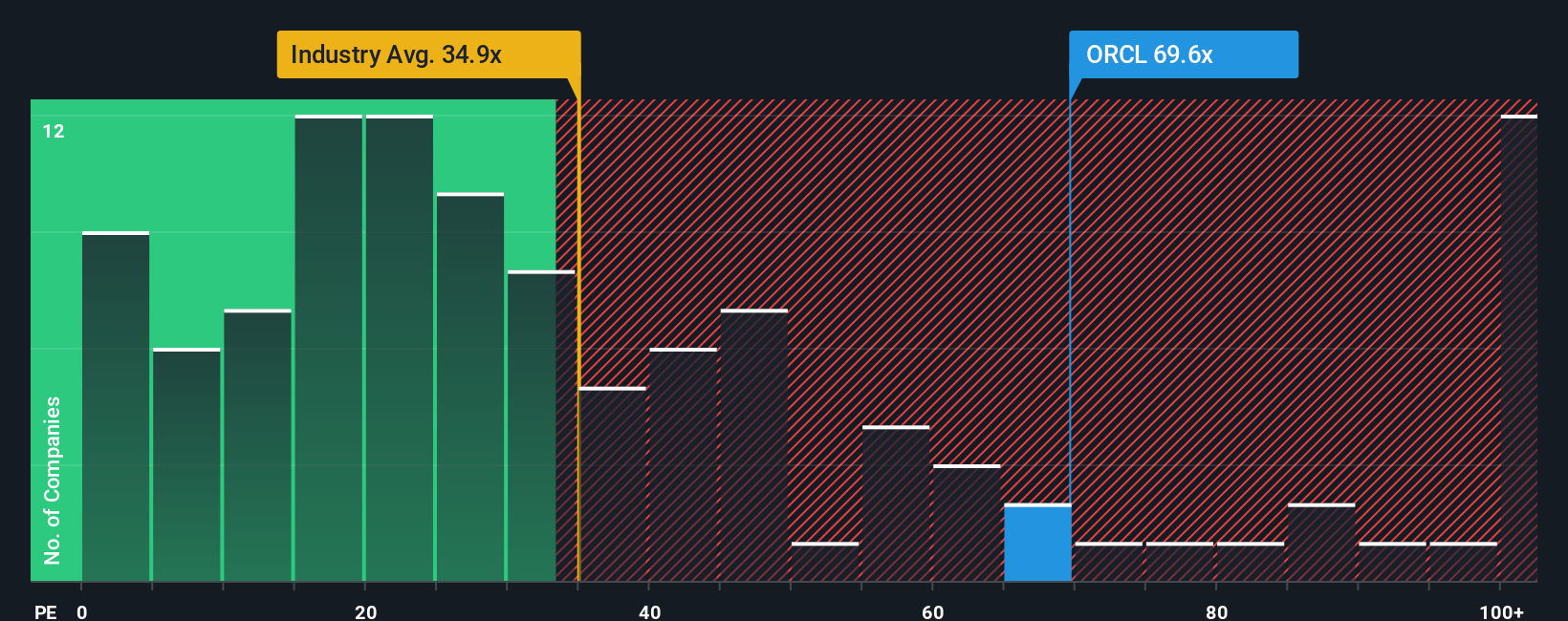
Oracle currently trades on a P/E of 27.33x. That sits close to the broader Software industry average of 26.25x and well below the selected peer group average of 57.12x. Simply Wall St’s Fair Ratio for Oracle is 52.73x, which is a proprietary estimate of what the P/E might be given factors such as earnings growth, profit margins, industry, market cap and risk profile.
Because the Fair Ratio is tailored to Oracle’s own characteristics, it can offer a more company specific yardstick than raw peer or industry comparisons. Compared with this Fair Ratio, the current P/E of 27.33x points to the shares trading on a lower multiple than that model suggests.
Result: UNDERVALUED
P/E ratios tell one story, but what if the real opportunity lies elsewhere? Discover 1433 companies where insiders are betting big on explosive growth.
Upgrade Your Decision Making: Choose your Oracle Narrative
Earlier we mentioned that there is an even better way to understand valuation, so let us introduce you to Narratives.
A Narrative is simply your story about Oracle, written in numbers, where you set your own view of fair value and expectations for future revenue, earnings and margins instead of only relying on standard ratios.
On Simply Wall St, Narratives sit on the Community page and help you link that story to a full financial forecast and then to a fair value estimate, in a format that is quick to set up and easy to revisit.
Once you have a Narrative, you can compare its Fair Value to Oracle’s current share price and use that gap to help you decide whether the stock looks attractive or stretched relative to your assumptions.
Narratives update automatically when new information such as news or earnings is added, so your fair value view reflects what is happening without you rebuilding the whole forecast.
For example, one Oracle Narrative on Simply Wall St might assume a much higher fair value based on stronger long term margin expectations, while another uses more conservative revenue growth and arrives at a lower fair value.
Do you think there's more to the story for Oracle? Head over to our Community to see what others are saying!

This article by Simply Wall St is general in nature. We provide commentary based on historical data and analyst forecasts only using an unbiased methodology and our articles are not intended to be financial advice. It does not constitute a recommendation to buy or sell any stock, and does not take account of your objectives, or your financial situation. We aim to bring you long-term focused analysis driven by fundamental data. Note that our analysis may not factor in the latest price-sensitive company announcements or qualitative material. Simply Wall St has no position in any stocks mentioned.
New: AI Stock Screener & Alerts
Our new AI Stock Screener scans the market every day to uncover opportunities.
• Dividend Powerhouses (3%+ Yield)
• Undervalued Small Caps with Insider Buying
• High growth Tech and AI Companies
Or build your own from over 50 metrics.
Have feedback on this article? Concerned about the content? Get in touch with us directly. Alternatively, email editorial-team@simplywallst.com
About NYSE:ORCL
Oracle
Offers products and services that build, run and support enterprise information technology frameworks worldwide.
Exceptional growth potential, undervalued and pays a dividend.
Similar Companies
Market Insights



Advertisement
Weekly Picks
CE


Ceazar on Sparc AI ·
When GPS fails: this small cap is fixing a $54B drone problem
Fair Value:CA$5.2537.3% undervalued
139 followersusers have followed this narrative
0 commentsusers have commented on this narrative
26 likesusers have liked this narrative
HA


HarishPK on Amdocs ·
Why Amdocs is a high conviction Buy for me?
Fair Value:US$82.0330.9% undervalued
11 followersusers have followed this narrative
1 commentusers have commented on this narrative
3 likesusers have liked this narrative
IV

Ivoed on SBM Offshore ·
Why SBM Offshore’s €30 Share Price May Be Too Harsh On Its Backlog
Fair Value:€44.528.6% undervalued
6 followersusers have followed this narrative
0 commentsusers have commented on this narrative
1 likeusers have liked this narrative
CL


Clive_Thompson on Green Tea Group ·
One of China's Fastest-Growing Restaurant Chains Trades on Just 7x Earnings and an 8% Dividend
Fair Value:HK$8.725.6% undervalued
8 followersusers have followed this narrative
3 commentsusers have commented on this narrative
11 likesusers have liked this narrative
Recently Updated Narratives
RC

rcb9 on DocuSign ·
Strip The Tax Benefit And Earnings Grew 36%
Fair Value:US$60.995.7% undervalued
1 followerusers have followed this narrative
0 commentsusers have commented on this narrative
0 likesusers have liked this narrative
RC

rcb9 on Boeing ·
The Operations Turned Profitable, The Balance Sheet Has Not
Fair Value:US$160.0148.2% overvalued
1 followerusers have followed this narrative
0 commentsusers have commented on this narrative
0 likesusers have liked this narrative
BE

benjamin_lvieq on PayPal Holdings ·
PayPal: PayPal Doesn't Need to Grow – It Needs to Stop Falling – A Mispriced Cash Machine With a Cannibal Buyback
Fair Value:US$6813.9% undervalued
82 followersusers have followed this narrative
2 commentsusers have commented on this narrative
0 likesusers have liked this narrative
Popular Narratives
OS


oscargarcia on NVIDIA ·
The company that went from selling GPUs to gamers to becoming the AI arms dealer of the 21st century.
Fair Value:US$28024.3% undervalued
247 followersusers have followed this narrative
9 commentsusers have commented on this narrative
16 likesusers have liked this narrative
CU

CubanEros on Microsoft ·
A wonderful business at reasonable price.
Fair Value:US$419.9117.4% overvalued
117 followersusers have followed this narrative
0 commentsusers have commented on this narrative
7 likesusers have liked this narrative
TR


tripledub on Alphabet ·
Warren Buffett Just Bet $10 Billion on Google. The Catch? You May Already Be Too Late.
Fair Value:US$202.6286.4% overvalued
132 followersusers have followed this narrative
1 commentusers have commented on this narrative
18 likesusers have liked this narrative
Trending Discussion
GR

greg_xasak on Fiserv ·
As someone who has dealt directly with them as a CTO for a credit union, I have 8 years of horror stories about doing business with them. If there was any other competitor than could deliver 80% of Fiserv services, there would be a mad rush to migrate to them. They should thank their lucky stars they are a near monopoly. this industry is so ripe for a well funded competitor. Their integration of technology is awful, their ability to fix their own implementation screwups is sadly tragic. Sometimes they just silently kill support tickets without resolution and you never find out until you do a follow up inquiry. Why, because sometimes no one you are dealing with knows how to fix it and knows no one to ask for help. They can not meet their own implementation deadlines and sometimes there is no one on a technical team dealing with you that has any banking or credit union experience. The is an industry insider phrase when you meet other Fiserv customers called being "Fiserved". It means telling others of your worst stories of dealing with them. Ask around, all CTO's have some doozies.
4
|0
YA


Yash_Upadhyaya on Reddit ·
Steve blamed "choppy" Google referral traffic for the miss on US daily active user (DAU) WHILST being in a standoff with Google on the AI licensing deal... hmm 🤔 One way or another a deal is happening. What's gonna be interesting is to see how good or bad (which the market is pricing in) would it be. PS - I don't own the stock but like the company.
1
|0
