Advertisement
- United States
- /
- Software
- /
- NYSE:ORCL
Oracle (ORCL): Evaluating Valuation After Record AI Cloud Contracts and New Co-CEOs Spark Growth Optimism
SI

Reviewed by Kshitija Bhandaru
Oracle’s (ORCL) latest surge in market value can be traced to a blend of headline-making AI and cloud contracts, record-setting increases in future revenue commitments, and fresh leadership at the top. With new co-CEOs in place, the company is positioning itself to capture the growing wave of AI spending. At the same time, some market watchers weigh the risks around its ambitious outlook.
See our latest analysis for Oracle.
A string of major events has kept Oracle in the headlines this year, from its $300 billion OpenAI cloud deal and multi-billion-dollar bond offerings to high-profile AI launches and executive shakeups. Even after such a strong run, momentum is holding firm; Oracle’s one-year total shareholder return is up over 69%, and longer-term investors have seen healthy multi-year gains as the company leans further into cloud and AI opportunities. With continued contract wins and fresh leadership, optimism remains high that this stock’s growth story is far from over.
If Oracle’s bold moves in AI and cloud are catching your attention, it might be the perfect time to see what other tech and AI disruptors are gaining steam. See the full list for free.
Yet with Oracle shares already up nearly 70% this year and trading near all-time highs, investors are now left weighing whether the optimism has gone too far or if there is still room to run from here. Is this a legitimate buying opportunity, or has the market already priced in years of future growth?
Most Popular Narrative: 14.2% Undervalued
With Oracle last closing at $286.14 and the most popular narrative assigning a fair value of $333.49, the narrative points to notable upside potential based on soaring cloud and AI momentum. Market-watchers have set a higher bar for long-term growth after the company’s recent run, sparking new debate over just how much future growth and profit the current price really bakes in.
Major AI contracts, including several multi-billion-dollar and a $30B+ annual revenue agreement, have fundamentally altered Oracle's long-term growth trajectory and fortified its positioning as a leading global hyperscaler.
What’s driving this bold valuation call? It hinges on blockbuster gains that few expected. The outlook rests on aggressive jumps in revenue, expanding profit margins, and a premium future multiple that signals serious confidence. Want a peek behind the curtain and see precisely which numbers underpin this punchy price target?
Result: Fair Value of $333.49 (UNDERVALUED)
Have a read of the narrative in full and understand what's behind the forecasts.
However, Oracle’s outlook still hinges on continued explosive AI demand and flawless execution. Both factors could falter unexpectedly and challenge current bullish assumptions.
Find out about the key risks to this Oracle narrative.
Another View: What Do Earnings Ratios Say?
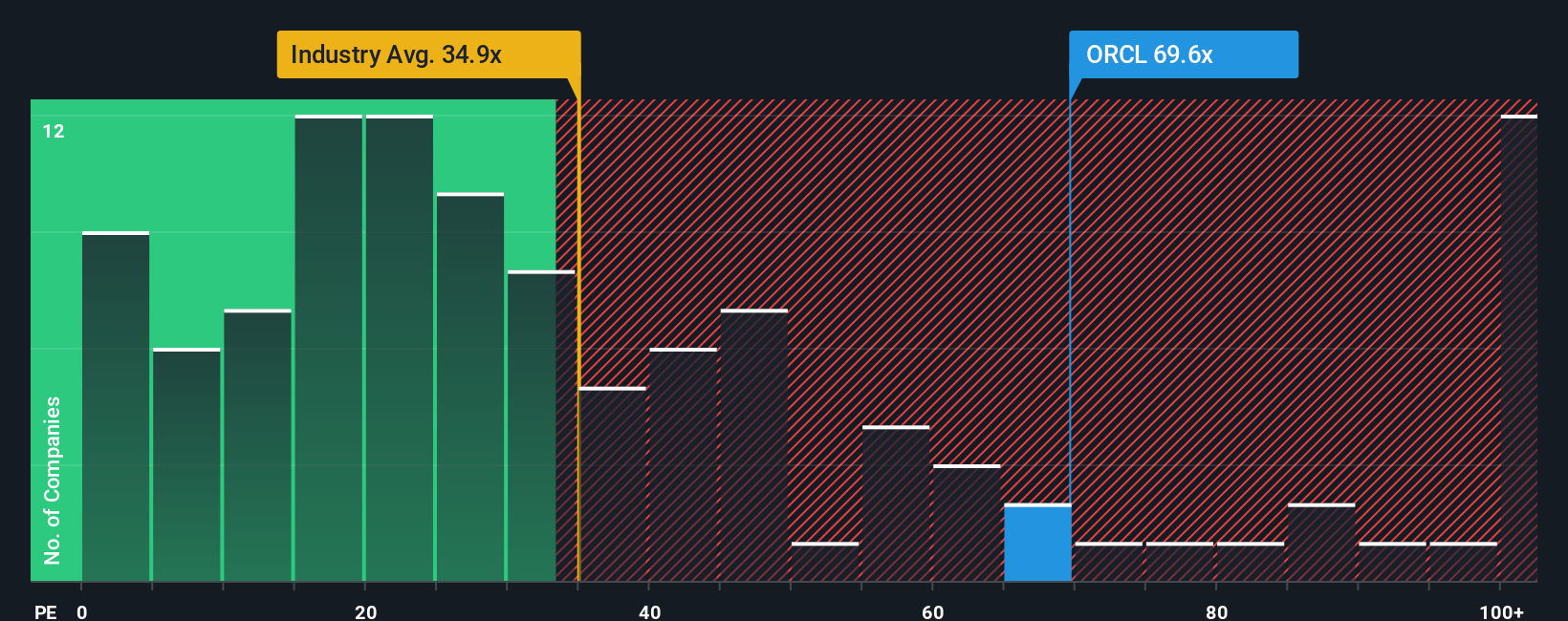
Looking at Oracle’s price-to-earnings ratio provides a different perspective. Shares currently trade at 65.4 times earnings, which is significantly pricier than both the US software industry average (35.7x) and even our fair ratio estimate (61.1x). This premium suggests the market expects exceptional growth, but it also raises questions about valuation risk if expectations slip. Could momentum alone justify this much optimism, or is there a risk of disappointment if the narrative changes?
See what the numbers say about this price — find out in our valuation breakdown.
Build Your Own Oracle Narrative
If you see things differently or want to dig deeper into the data yourself, you can craft a personal narrative in just a few minutes, your way. Do it your way
A great starting point for your Oracle research is our analysis highlighting 2 key rewards and 3 important warning signs that could impact your investment decision.
Looking for more investment ideas?
The next breakout stock could be just around the corner, so broaden your search and upgrade your investing toolkit with these exclusive opportunities from Simply Wall Street:
- Unlock cash flow potential by targeting undervalued companies with robust earnings using these 896 undervalued stocks based on cash flows.
- Supercharge your portfolio with high-yield picks by tapping into these 19 dividend stocks with yields > 3% to spot reliable dividend payers exceeding a 3% yield.
- Get ahead of tomorrow’s digital transformation by seeking out next-generation innovators among these 24 AI penny stocks.
This article by Simply Wall St is general in nature. We provide commentary based on historical data and analyst forecasts only using an unbiased methodology and our articles are not intended to be financial advice. It does not constitute a recommendation to buy or sell any stock, and does not take account of your objectives, or your financial situation. We aim to bring you long-term focused analysis driven by fundamental data. Note that our analysis may not factor in the latest price-sensitive company announcements or qualitative material. Simply Wall St has no position in any stocks mentioned.
New: AI Stock Screener & Alerts
Our new AI Stock Screener scans the market every day to uncover opportunities.
• Dividend Powerhouses (3%+ Yield)
• Undervalued Small Caps with Insider Buying
• High growth Tech and AI Companies
Or build your own from over 50 metrics.
Have feedback on this article? Concerned about the content? Get in touch with us directly. Alternatively, email editorial-team@simplywallst.com
MI

The Foxhole
A landmark settlement is meant to punish Meta (META). If the 1998 tobacco deal is any guide, it might protect it.
199
ZO
zoe_vi5fn
Any moat with an opt-out clause for your competitors is just a fence around your own garden.
CO
connor_iwn1g
Worth looking at what previous legal action actually did to Meta rather than reaching for tobacco. The FTC's record five billion dollar privacy fine in 2019 was met with the stock rising, because it came in below fears and removed an open question. GDPR was designed to constrain large platforms and increased their share of the European ad market, because compliance cost fell hardest on small intermediaries. The FTC's antitrust case, the one that could genuinely have broken the company up, was decided in Meta's favour last November. The only thing that ever meaningfully hurt the business was Apple changing a tracking default, and Meta out-spent that too, while the ad-tech firms that could not afford to rebuild disappeared. The pattern is not that Meta survives regulation. It is that regulation keeps costing its smaller competitors more.
 Andrew Legget
Market Insights
Great earnings season, but are the earnings real?

At first glance, this was the strongest earnings season in years. But when you look at where the growth actually came from, the story splits into two very different pictures.
20
About NYSE:ORCL
Oracle
Offers products and services that build, run and support enterprise information technology frameworks worldwide.
Exceptional growth potential, undervalued and pays a dividend.
Similar Companies
Market Insights


Advertisement
Weekly Picks
LO


Lou_Basenese on Oncolytics Biotech ·
The Team Behind a $2 Billion Johnson & Johnson (JNJ) Deal Just Took Over This $105 Million Cancer Biotech
Fair Value:US$3.575.5% undervalued
39 followersusers have followed this narrative
0 commentsusers have commented on this narrative
11 likesusers have liked this narrative
TR


tripledub on Meta Platforms ·
The $135 Billion Bet That Should Make Every Shareholder Nervous
Fair Value:US$5861.4% undervalued
62 followersusers have followed this narrative
3 commentsusers have commented on this narrative
34 likesusers have liked this narrative
TA


Talos on Voyager Technologies ·
The "Landlord of Orbit" – A Deep Value Play Ahead of the Starlab Era
Fair Value:US$385.291.1% undervalued
66 followersusers have followed this narrative
0 commentsusers have commented on this narrative
6 likesusers have liked this narrative
IV

Ivoed on Uber Technologies ·
Uber’s Valuation Depends On Who Captures The Economics Of Driverless Rides
Fair Value:US$11632.1% undervalued
14 followersusers have followed this narrative
0 commentsusers have commented on this narrative
3 likesusers have liked this narrative
Recently Updated Narratives
ES

Esteban on NVIDIA ·
NVIDIA is the toll booth on the largest infrastructure build-out in commercial history
Fair Value:US$99.52118.6% overvalued
2 followersusers have followed this narrative
0 commentsusers have commented on this narrative
0 likesusers have liked this narrative
LI

Lijo on Accenture ·
A value stock that's undervalued.
Fair Value:US$27029.8% undervalued
8 followersusers have followed this narrative
0 commentsusers have commented on this narrative
0 likesusers have liked this narrative
AR

ariz_scribe on Marti Technologies ·
$MRT at Roth - Pick of the Panel
Fair Value:US$1.9615.3% overvalued
7 followersusers have followed this narrative
0 commentsusers have commented on this narrative
0 likesusers have liked this narrative
Popular Narratives
OS

oscargarcia on NVIDIA ·
The company that went from selling GPUs to gamers to becoming the AI arms dealer of the 21st century.
Fair Value:US$28022.3% undervalued
363 followersusers have followed this narrative
9 commentsusers have commented on this narrative
16 likesusers have liked this narrative
CU

CubanEros on Microsoft ·
A wonderful business at reasonable price.
Fair Value:US$419.9122.3% overvalued
211 followersusers have followed this narrative
0 commentsusers have commented on this narrative
9 likesusers have liked this narrative
JO


John_Eric on MercadoLibre ·
MercadoLibre and the Spreadsheet Trick That Decides Everything
Fair Value:US$7.31k73.1% undervalued
125 followersusers have followed this narrative
3 commentsusers have commented on this narrative
17 likesusers have liked this narrative
Trending Discussion

MA

max_profit on Happiest Minds Technologies ·
sold all my happiest mind , if the owner doesn't want to stick around why would i
0
|0

