
Advertisement
- United States
- /
- Specialty Stores
- /
- NYSE:CATO
How Does Cato's (NYSE:CATO) CEO Pay Compare With Company Performance?
John Derham Cato has been the CEO of The Cato Corporation (NYSE:CATO) since 1999, and this article will examine the executive's compensation with respect to the overall performance of the company. This analysis will also evaluate the appropriateness of CEO compensation when taking into account the earnings and shareholder returns of the company.
View our latest analysis for Cato
How Does Total Compensation For John Derham Cato Compare With Other Companies In The Industry?
According to our data, The Cato Corporation has a market capitalization of US$165m, and paid its CEO total annual compensation worth US$5.3m over the year to February 2020. We note that's an increase of 23% above last year. While we always look at total compensation first, our analysis shows that the salary component is less, at US$1.3m.
For comparison, other companies in the same industry with market capitalizations ranging between US$100m and US$400m had a median total CEO compensation of US$2.4m. Hence, we can conclude that John Derham Cato is remunerated higher than the industry median. Moreover, John Derham Cato also holds US$19m worth of Cato stock directly under their own name, which reveals to us that they have a significant personal stake in the company.
| Component | 2020 | 2019 | Proportion (2020) |
| Salary | US$1.3m | US$1.3m | 25% |
| Other | US$4.0m | US$3.0m | 75% |
| Total Compensation | US$5.3m | US$4.3m | 100% |
On an industry level, around 19% of total compensation represents salary and 81% is other remuneration. Cato is paying a higher share of its remuneration through a salary in comparison to the overall industry. If non-salary compensation dominates total pay, it's an indicator that the executive's salary is tied to company performance.
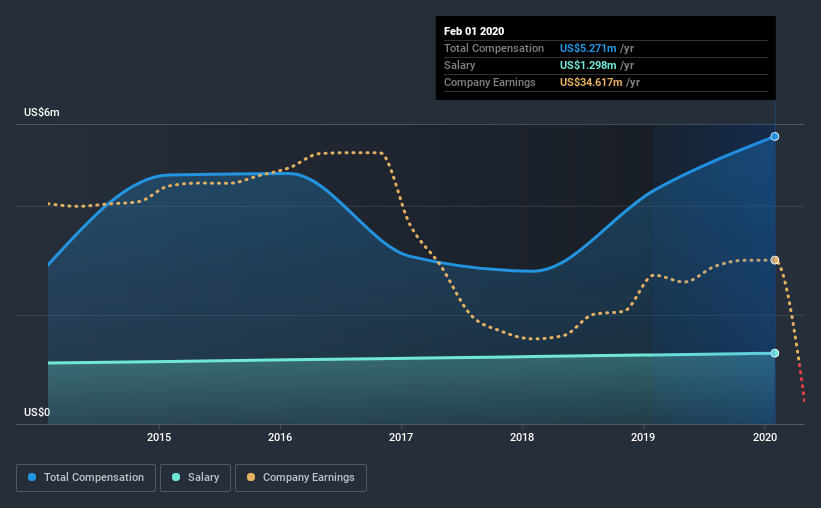
The Cato Corporation's Growth
The Cato Corporation has seen its earnings per share (EPS) increase by 6.2% a year over the past three years. Its revenue is down 15% over the previous year.
We generally like to see a little revenue growth, but the modest EPS growth gives us some relief. These two metrics are moving in different directions, so while it's hard to be confident judging performance, we think the stock is worth watching. We don't have analyst forecasts, but you could get a better understanding of its growth by checking out this more detailed historical graph of earnings, revenue and cash flow.
Has The Cato Corporation Been A Good Investment?
Since shareholders would have lost about 45% over three years, some The Cato Corporation investors would surely be feeling negative emotions. This suggests it would be unwise for the company to pay the CEO too generously.
In Summary...
As previously discussed, John is compensated more than what is normal for CEOs of companies of similar size, and which belong to the same industry. While we have not been overly impressed by the business performance, the shareholder returns have been utterly depressing, over the last three years. And the situation doesn't look all that good when you see John is remunerated higher than the industry average. With such poor returns, we would understand if shareholders had concerns related to the CEO's pay.
It is always advisable to analyse CEO pay, along with performing a thorough analysis of the company's key performance areas. In our study, we found 3 warning signs for Cato you should be aware of, and 1 of them is a bit unpleasant.
Important note: Cato is an exciting stock, but we understand investors may be looking for an unencumbered balance sheet and blockbuster returns. You might find something better in this list of interesting companies with high ROE and low debt.
If you’re looking to trade Cato, open an account with the lowest-cost* platform trusted by professionals, Interactive Brokers. Their clients from over 200 countries and territories trade stocks, options, futures, forex, bonds and funds worldwide from a single integrated account. Promoted
New: AI Stock Screener & Alerts
Our new AI Stock Screener scans the market every day to uncover opportunities.
• Dividend Powerhouses (3%+ Yield)
• Undervalued Small Caps with Insider Buying
• High growth Tech and AI Companies
Or build your own from over 50 metrics.
This article by Simply Wall St is general in nature. It does not constitute a recommendation to buy or sell any stock, and does not take account of your objectives, or your financial situation. We aim to bring you long-term focused analysis driven by fundamental data. Note that our analysis may not factor in the latest price-sensitive company announcements or qualitative material. Simply Wall St has no position in any stocks mentioned.
*Interactive Brokers Rated Lowest Cost Broker by StockBrokers.com Annual Online Review 2020
Have feedback on this article? Concerned about the content? Get in touch with us directly. Alternatively, email editorial-team@simplywallst.com.

 Mitchell Lawler
Market Insights
What happens to energy stocks as the fix gets built?

Conflict around the Strait of Hormuz has led investors to oil and tankers. The trouble is, the antidote to the chokepoints is already being built, and it may not reward the same energy stocks.
88
About NYSE:CATO
Cato
Operates as a specialty retailer of fashion apparel and accessories primarily in the southeastern United States.
Flawless balance sheet and slightly overvalued.
Similar Companies
Market Insights


Advertisement
Weekly Picks
CE


Ceazar on Buffalo Potash ·
Under the radar: This $78M stock controls a $1.5B project and it’ll start producing in a few months
Fair Value:CA$1.0625.5% undervalued
1 followerusers have followed this narrative
0 commentsusers have commented on this narrative
0 likesusers have liked this narrative
TO


Tokyo on Novo Nordisk ·
EU#2 - From Humble Beginnings to Global Powerhouse
Fair Value:DKK 851.0469.4% undervalued
75 followersusers have followed this narrative
11 commentsusers have commented on this narrative
25 likesusers have liked this narrative
HA


HarishPK on Zoetis ·
Decision Making Under Ambiguity – A Case Study on Expectations Investing
Fair Value:US$91.321.9% undervalued
3 followersusers have followed this narrative
1 commentusers have commented on this narrative
2 likesusers have liked this narrative
RE


RedCandleRx on AppLovin ·
Why the Market Still Misprices AppLovin as Just a Gaming Network
Fair Value:US$50734.9% undervalued
1 followerusers have followed this narrative
0 commentsusers have commented on this narrative
0 likesusers have liked this narrative
Recently Updated Narratives
HE

Heavysvene on Akamai Technologies ·
Akamai Technologies will see a 16.49% revenue increase driving growth
Fair Value:€139.2227.1% undervalued
1 followerusers have followed this narrative
0 commentsusers have commented on this narrative
0 likesusers have liked this narrative
PE

Pedro7 on Reklaim ·
Consent-based data just turned profitable. Q3 decides if it lasts.
Fair Value:CA$0.320% overvalued
1 followerusers have followed this narrative
0 commentsusers have commented on this narrative
0 likesusers have liked this narrative
RO


RockeTeller on Polymetals Resources ·
Polymetals Resources, 338 g/t Silver A$28M Restart at A$414M NPV, The Numbers That Matter
Fair Value:AU$1.9756.9% undervalued
5 followersusers have followed this narrative
0 commentsusers have commented on this narrative
1 likeusers have liked this narrative
Popular Narratives
AN


AnalystConsensusTarget on NVIDIA ·
NVDA: Expanding AI Demand Will Drive Major Data Center Investments Through 2026
Fair Value:US$302.8324.9% undervalued
1493 followersusers have followed this narrative
8 commentsusers have commented on this narrative
35 likesusers have liked this narrative
AN

AnalystConsensusTarget on Alphabet ·
GOOGL: AI Platform Expansion And Cloud Demand Will Support Durable Performance Amid Competitive Pressures
Fair Value:US$427.8917.0% undervalued
1650 followersusers have followed this narrative
0 commentsusers have commented on this narrative
19 likesusers have liked this narrative
AN

AnalystConsensusTarget on Amazon.com ·
AMZN: Acceleration In Cloud And AI Will Drive Margin Expansion Ahead
Fair Value:US$32721.0% undervalued
1668 followersusers have followed this narrative
1 commentusers have commented on this narrative
16 likesusers have liked this narrative
Trending Discussion


JO

john_mwm1h on Hemab Therapeutics Holdings ·
One thing I find disappointing about this model is how rare disease communities can become attractive targets because development pathways may move faster with smaller patient populations. The marketing they run creates the impression that patients are constantly in danger or have no meaningful options without the newest treatment, which does not reflect every patient’s experience.I would bet many do not even realize that gene therapy for Glanzmann Thrombasthenia is getting closer to clinical trials, yet that research continues to struggle for funding while commercial drug developers can raise hundreds of millions of dollars.
0
|0