
Advertisement
- United States
- /
- Software
- /
- NYSE:RNG
Here's What We Think About RingCentral, Inc.'s (NYSE:RNG) CEO Pay
Vlad Shmunis has been the CEO of RingCentral, Inc. (NYSE:RNG) since 1999. First, this article will compare CEO compensation with compensation at other large companies. Then we'll look at a snap shot of the business growth. And finally we will reflect on how common stockholders have fared in the last few years, as a secondary measure of performance. The aim of all this is to consider the appropriateness of CEO pay levels.
See our latest analysis for RingCentral
How Does Vlad Shmunis's Compensation Compare With Similar Sized Companies?
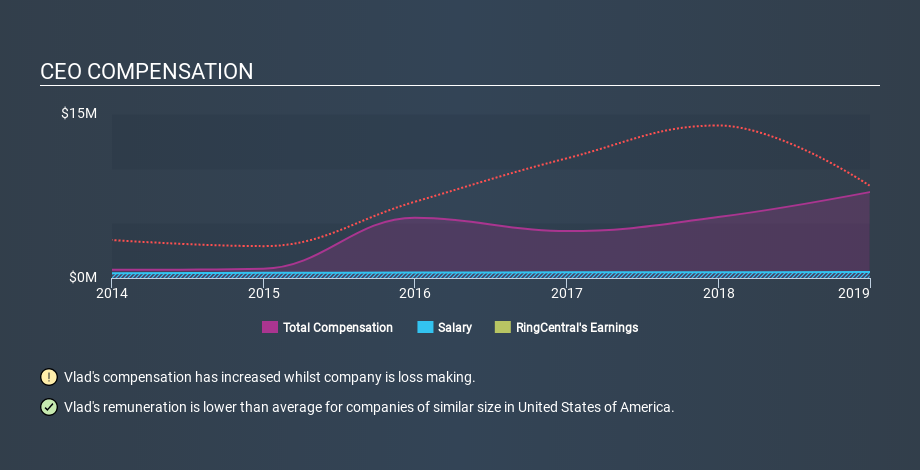
At the time of writing, our data says that RingCentral, Inc. has a market cap of US$22b, and reported total annual CEO compensation of US$7.9m for the year to December 2018. While this analysis focuses on total compensation, it's worth noting the salary is lower, valued at US$544k. We further remind readers that the CEO may face performance requirements to receive the non-salary part of the total compensation. We took a group of companies with market capitalizations over US$8.0b, and calculated the median CEO total compensation to be US$12m. (We took a wide range because the CEOs of massive companies tend to be paid similar amounts - even though some are quite a bit bigger than others).
Pay mix tells us a lot about how a company functions versus the wider industry, and it's no different in the case of RingCentral. On a sector level, around 13% of total compensation represents salary and 87% is other remuneration. RingCentral sets aside a smaller share of compensation for salary, in comparison to the overall industry.
This would give shareholders a good impression of the company, since most large companies pay more, leaving less for shareholders. While this is a good thing, you'll need to understand the business better before you can form an opinion. The graphic below shows how CEO compensation at RingCentral has changed from year to year.
Is RingCentral, Inc. Growing?
Over the last three years RingCentral, Inc. has shrunk its earnings per share by an average of 38% per year (measured with a line of best fit). In the last year, its revenue is up 34%.
As investors, we are a bit wary of companies that have lower earnings per share, over three years. But in contrast the revenue growth is strong, suggesting future potential for earnings growth. It's hard to reach a conclusion about business performance right now. This may be one to watch. You might want to check this free visual report on analyst forecasts for future earnings.
Has RingCentral, Inc. Been A Good Investment?
I think that the total shareholder return of 730%, over three years, would leave most RingCentral, Inc. shareholders smiling. This strong performance might mean some shareholders don't mind if the CEO were to be paid more than is normal for a company of its size.
In Summary...
RingCentral, Inc. is currently paying its CEO below what is normal for large companies.
Vlad Shmunis is paid less than what is normal at large companies, and the total shareholder return has been pleasing over the last three years. Although we could see higher growth, we'd argue the remuneration is modest, based on these observations. On another note, RingCentral has 4 warning signs (and 1 which is concerning) we think you should know about.
Arguably, business quality is much more important than CEO compensation levels. So check out this free list of interesting companies, that have HIGH return on equity and low debt.
If you spot an error that warrants correction, please contact the editor at editorial-team@simplywallst.com. This article by Simply Wall St is general in nature. It does not constitute a recommendation to buy or sell any stock, and does not take account of your objectives, or your financial situation. Simply Wall St has no position in the stocks mentioned.
We aim to bring you long-term focused research analysis driven by fundamental data. Note that our analysis may not factor in the latest price-sensitive company announcements or qualitative material. Thank you for reading.
MI

The Foxhole
A landmark settlement is meant to punish Meta (META). If the 1998 tobacco deal is any guide, it might protect it.
179
ZO
zoe_vi5fn
Any moat with an opt-out clause for your competitors is just a fence around your own garden.
CO
connor_iwn1g
Worth looking at what previous legal action actually did to Meta rather than reaching for tobacco. The FTC's record five billion dollar privacy fine in 2019 was met with the stock rising, because it came in below fears and removed an open question. GDPR was designed to constrain large platforms and increased their share of the European ad market, because compliance cost fell hardest on small intermediaries. The FTC's antitrust case, the one that could genuinely have broken the company up, was decided in Meta's favour last November. The only thing that ever meaningfully hurt the business was Apple changing a tracking default, and Meta out-spent that too, while the ad-tech firms that could not afford to rebuild disappeared. The pattern is not that Meta survives regulation. It is that regulation keeps costing its smaller competitors more.
 Andrew Legget
Market Insights
Great earnings season, but are the earnings real?

At first glance, this was the strongest earnings season in years. But when you look at where the growth actually came from, the story splits into two very different pictures.
10
About NYSE:RNG
RingCentral
An agentic voice AI–powered cloud business communication services provider, delivering an integrated platform for business phone, SMS, contact center, workforce engagement management, video collaboration, and messaging.
Reasonable growth potential with slight risk.
Similar Companies
Market Insights


Advertisement
Weekly Picks
LO


Lou_Basenese on Oncolytics Biotech ·
The Team Behind a $2 Billion Johnson & Johnson (JNJ) Deal Just Took Over This $105 Million Cancer Biotech
Fair Value:US$3.575.5% undervalued
31 followersusers have followed this narrative
0 commentsusers have commented on this narrative
8 likesusers have liked this narrative
TR


tripledub on Meta Platforms ·
The $135 Billion Bet That Should Make Every Shareholder Nervous
Fair Value:US$5861.4% undervalued
63 followersusers have followed this narrative
3 commentsusers have commented on this narrative
34 likesusers have liked this narrative
TA


Talos on Voyager Technologies ·
The "Landlord of Orbit" – A Deep Value Play Ahead of the Starlab Era
Fair Value:US$385.291.1% undervalued
65 followersusers have followed this narrative
0 commentsusers have commented on this narrative
6 likesusers have liked this narrative
IV

Ivoed on Uber Technologies ·
Uber’s Valuation Depends On Who Captures The Economics Of Driverless Rides
Fair Value:US$11632.1% undervalued
13 followersusers have followed this narrative
0 commentsusers have commented on this narrative
3 likesusers have liked this narrative
Recently Updated Narratives
JO


John_Eric on Betterware de MéxicoP.I. de ·
Only Two Analysts Cover This Stock.
Fair Value:US$54.6571.1% undervalued
2 followersusers have followed this narrative
1 commentusers have commented on this narrative
0 likesusers have liked this narrative
RO


RockeTeller on Kuya Silver ·
Kuya Silver, The High-Octane Rocket With 15,372 g/t Silver + $12 AISC
Fair Value:CA$10.8493.3% undervalued
10 followersusers have followed this narrative
1 commentusers have commented on this narrative
1 likeusers have liked this narrative
RO


Robbo on Unilever ·
Unilever (LSE:ULVR), changes in the wind.
Fair Value:UK£42.2813.0% overvalued
1 followerusers have followed this narrative
0 commentsusers have commented on this narrative
0 likesusers have liked this narrative
Popular Narratives
OS


oscargarcia on NVIDIA ·
The company that went from selling GPUs to gamers to becoming the AI arms dealer of the 21st century.
Fair Value:US$28022.3% undervalued
363 followersusers have followed this narrative
9 commentsusers have commented on this narrative
16 likesusers have liked this narrative
CU

CubanEros on Microsoft ·
A wonderful business at reasonable price.
Fair Value:US$419.9122.3% overvalued
212 followersusers have followed this narrative
0 commentsusers have commented on this narrative
9 likesusers have liked this narrative
JO

John_Eric on MercadoLibre ·
MercadoLibre and the Spreadsheet Trick That Decides Everything
Fair Value:US$7.31k73.1% undervalued
125 followersusers have followed this narrative
3 commentsusers have commented on this narrative
17 likesusers have liked this narrative
Trending Discussion

BL


Blagget on BP Silver ·
Yes, it is for sure. When I first published my narrative on BP Silver back in January, it gave me strong Santacruz Silver vibes. But now I know this is the next SCZ.I'd like to ask you to take a look at Terra Balcanica (CSE:TERA).I'd be REALLY surprised if it doesn't interest you. I'd even challenge you to find a more undervalued miner than TERA. I'm serious. You'd earn a loyal follower and reader for the rest of my life.Let me point you to three stocks, without further context or explanation of how they're related, to quickly show how unreasonably low Terra Balcanica's market cap is. You'll obviously figure out the connection pretty quickly yourself.Military Metals - license revokedRegener8 Resources - zero-drill neighborAdriatic Metals - neighbor that DPM boughtI promise you, you can dig as deep as you want here, count in every negative aspect and even things that aren't negative but that someone might read as negative, and the current market cap still makes no sense. I strongly believe that will change rather soon though, judging by the level 2 market depth over the last couple of days.I also suggest you take a look at DPM documents/reports regarding Vareš. They seem pleased with the purchase? 😁Anyway, I agree on BP, 100% correct. Enjoyed the read.
0
|0
