
Advertisement
- United States
- /
- Tech Hardware
- /
- NasdaqGM:TACT
This Broker Just Slashed Their TransAct Technologies Incorporated (NASDAQ:TACT) Earnings Forecasts
Today is shaping up negative for TransAct Technologies Incorporated (NASDAQ:TACT) shareholders, with the covering analyst delivering a substantial negative revision to this year's forecasts. Both revenue and earnings per share (EPS) estimates were cut sharply as the analyst factored in the latest outlook for the business, concluding that they were too optimistic previously. Surprisingly the share price has been buoyant, rising 17% to US$3.68 in the past 7 days. Whether the downgrade will have a negative impact on demand for shares is yet to be seen.
After the downgrade, the consensus from TransAct Technologies's lone analyst is for revenues of US$36m in 2020, which would reflect a concerning 21% decline in sales compared to the last year of performance. After this downgrade, the company is anticipated to report a loss of US$0.44 in 2020, a sharp decline from a profit over the last year. Yet before this consensus update, the analyst had been forecasting revenues of US$48m and losses of US$0.10 per share in 2020. Ergo, there's been a clear change in sentiment, with the analyst administering a notable cut to this year's revenue estimates, while at the same time increasing their loss per share forecasts.
Check out our latest analysis for TransAct Technologies
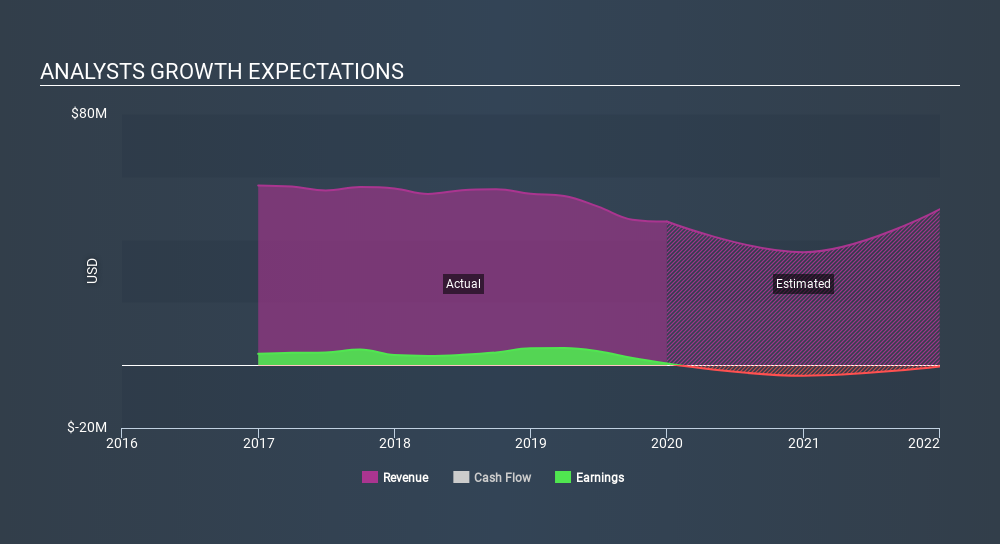
The consensus price target fell 71% to US$4.00, with the analyst clearly concerned about the company following the weaker revenue and earnings outlook.
These estimates are interesting, but it can be useful to paint some more broad strokes when seeing how forecasts compare, both to the TransAct Technologies's past performance and to peers in the same industry. Over the past five years, revenues have declined around 2.9% annually. Worse, forecasts are essentially predicting the decline to accelerate, with the estimate for a 21% decline in revenue next year. Compare this against analyst estimates for companies in the wider industry, which suggest that revenues (in aggregate) are expected to grow 6.6% next year. So while a broad number of companies are forecast to decline, unfortunately TransAct Technologies is expected to see its sales affected worse than other companies in the industry.
The Bottom Line
The most important thing to take away is that the analyst increased their loss per share estimates for this year. Regrettably, they also downgraded their revenue estimates, and the latest forecasts imply the business will grow sales slower than the wider market. Given the scope of the downgrades, it would not be a surprise to see the market become more wary of the business.
There might be good reason for analyst bearishness towards TransAct Technologies, like its declining profit margins. Learn more, and discover the 4 other warning signs we've identified, for free on our platform here.
Of course, seeing company management invest large sums of money in a stock can be just as useful as knowing whether analysts are downgrading their estimates. So you may also wish to search this free list of stocks that insiders are buying.
If you spot an error that warrants correction, please contact the editor at editorial-team@simplywallst.com. This article by Simply Wall St is general in nature. It does not constitute a recommendation to buy or sell any stock, and does not take account of your objectives, or your financial situation. Simply Wall St has no position in the stocks mentioned.
We aim to bring you long-term focused research analysis driven by fundamental data. Note that our analysis may not factor in the latest price-sensitive company announcements or qualitative material. Thank you for reading.
MI

The Foxhole
A landmark settlement is meant to punish Meta (META). If the 1998 tobacco deal is any guide, it might protect it.
179
ZO
zoe_vi5fn
Any moat with an opt-out clause for your competitors is just a fence around your own garden.
CO
connor_iwn1g
Worth looking at what previous legal action actually did to Meta rather than reaching for tobacco. The FTC's record five billion dollar privacy fine in 2019 was met with the stock rising, because it came in below fears and removed an open question. GDPR was designed to constrain large platforms and increased their share of the European ad market, because compliance cost fell hardest on small intermediaries. The FTC's antitrust case, the one that could genuinely have broken the company up, was decided in Meta's favour last November. The only thing that ever meaningfully hurt the business was Apple changing a tracking default, and Meta out-spent that too, while the ad-tech firms that could not afford to rebuild disappeared. The pattern is not that Meta survives regulation. It is that regulation keeps costing its smaller competitors more.
 Andrew Legget
Market Insights
Great earnings season, but are the earnings real?

At first glance, this was the strongest earnings season in years. But when you look at where the growth actually came from, the story splits into two very different pictures.
10
About NasdaqGM:TACT
TransAct Technologies
Designs, develops, and markets transaction-based and specialty printers and terminals in the United States and internationally.
Excellent balance sheet and fair value.
Similar Companies
Market Insights


Advertisement
Weekly Picks
LO


Lou_Basenese on Oncolytics Biotech ·
The Team Behind a $2 Billion Johnson & Johnson (JNJ) Deal Just Took Over This $105 Million Cancer Biotech
Fair Value:US$3.575.5% undervalued
31 followersusers have followed this narrative
0 commentsusers have commented on this narrative
9 likesusers have liked this narrative
TR


tripledub on Meta Platforms ·
The $135 Billion Bet That Should Make Every Shareholder Nervous
Fair Value:US$5861.4% undervalued
63 followersusers have followed this narrative
3 commentsusers have commented on this narrative
34 likesusers have liked this narrative
TA


Talos on Voyager Technologies ·
The "Landlord of Orbit" – A Deep Value Play Ahead of the Starlab Era
Fair Value:US$385.291.1% undervalued
65 followersusers have followed this narrative
0 commentsusers have commented on this narrative
6 likesusers have liked this narrative
IV

Ivoed on Uber Technologies ·
Uber’s Valuation Depends On Who Captures The Economics Of Driverless Rides
Fair Value:US$11632.1% undervalued
13 followersusers have followed this narrative
0 commentsusers have commented on this narrative
3 likesusers have liked this narrative
Recently Updated Narratives
JO


John_Eric on Betterware de MéxicoP.I. de ·
Only Two Analysts Cover This Stock.
Fair Value:US$54.6571.1% undervalued
2 followersusers have followed this narrative
1 commentusers have commented on this narrative
0 likesusers have liked this narrative
RO


RockeTeller on Kuya Silver ·
Kuya Silver, The High-Octane Rocket With 15,372 g/t Silver + $12 AISC
Fair Value:CA$10.8493.3% undervalued
10 followersusers have followed this narrative
1 commentusers have commented on this narrative
1 likeusers have liked this narrative
RO


Robbo on Unilever ·
Unilever (LSE:ULVR), changes in the wind.
Fair Value:UK£42.2813.0% overvalued
1 followerusers have followed this narrative
0 commentsusers have commented on this narrative
0 likesusers have liked this narrative
Popular Narratives
OS


oscargarcia on NVIDIA ·
The company that went from selling GPUs to gamers to becoming the AI arms dealer of the 21st century.
Fair Value:US$28022.3% undervalued
363 followersusers have followed this narrative
9 commentsusers have commented on this narrative
16 likesusers have liked this narrative
CU

CubanEros on Microsoft ·
A wonderful business at reasonable price.
Fair Value:US$419.9122.3% overvalued
211 followersusers have followed this narrative
0 commentsusers have commented on this narrative
9 likesusers have liked this narrative
JO

John_Eric on MercadoLibre ·
MercadoLibre and the Spreadsheet Trick That Decides Everything
Fair Value:US$7.31k73.1% undervalued
125 followersusers have followed this narrative
3 commentsusers have commented on this narrative
17 likesusers have liked this narrative
Trending Discussion

JE

jean_pierre_lan_dsslz on Mauritius Development Investment Trust ·
Yes, MDIT is simply just a Deposit-long term stock with a good Dividend, no more, no less. It has just declared a Dividend of 0.11 cs payable 21 September 2026. Its price fluctuates between 1.90cs & 2.00cs. No capital gain in the short or medium term.
0
|0
BL


Blagget on BP Silver ·
Yes, it is for sure. When I first published my narrative on BP Silver back in January, it gave me strong Santacruz Silver vibes. But now I know this is the next SCZ.I'd like to ask you to take a look at Terra Balcanica (CSE:TERA).I'd be REALLY surprised if it doesn't interest you. I'd even challenge you to find a more undervalued miner than TERA. I'm serious. You'd earn a loyal follower and reader for the rest of my life.Let me point you to three stocks, without further context or explanation of how they're related, to quickly show how unreasonably low Terra Balcanica's market cap is. You'll obviously figure out the connection pretty quickly yourself.Military Metals - license revokedRegener8 Resources - zero-drill neighborAdriatic Metals - neighbor that DPM boughtI promise you, you can dig as deep as you want here, count in every negative aspect and even things that aren't negative but that someone might read as negative, and the current market cap still makes no sense. I strongly believe that will change rather soon though, judging by the level 2 market depth over the last couple of days.I also suggest you take a look at DPM documents/reports regarding Vareš. They seem pleased with the purchase? 😁Anyway, I agree on BP, 100% correct. Enjoyed the read.
0
|0