Advertisement
- United States
- /
- Electronic Equipment and Components
- /
- NasdaqGS:ITRI
These 4 Measures Indicate That Itron (NASDAQ:ITRI) Is Using Debt Extensively
Legendary fund manager Li Lu (who Charlie Munger backed) once said, 'The biggest investment risk is not the volatility of prices, but whether you will suffer a permanent loss of capital.' It's only natural to consider a company's balance sheet when you examine how risky it is, since debt is often involved when a business collapses. We can see that Itron, Inc. (NASDAQ:ITRI) does use debt in its business. But is this debt a concern to shareholders?
Why Does Debt Bring Risk?
Debt and other liabilities become risky for a business when it cannot easily fulfill those obligations, either with free cash flow or by raising capital at an attractive price. Part and parcel of capitalism is the process of 'creative destruction' where failed businesses are mercilessly liquidated by their bankers. However, a more frequent (but still costly) occurrence is where a company must issue shares at bargain-basement prices, permanently diluting shareholders, just to shore up its balance sheet. Of course, the upside of debt is that it often represents cheap capital, especially when it replaces dilution in a company with the ability to reinvest at high rates of return. When we think about a company's use of debt, we first look at cash and debt together.
View our latest analysis for Itron
What Is Itron's Net Debt?
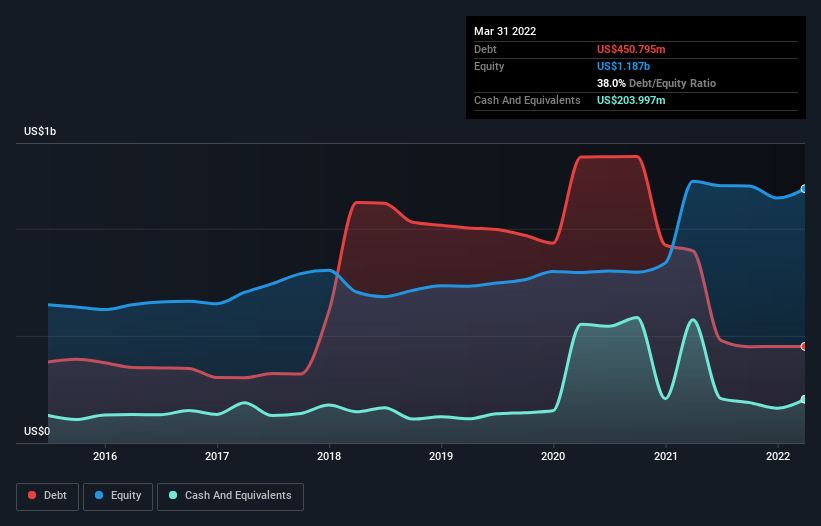
You can click the graphic below for the historical numbers, but it shows that Itron had US$450.8m of debt in March 2022, down from US$896.5m, one year before. However, it does have US$204.0m in cash offsetting this, leading to net debt of about US$246.8m.
A Look At Itron's Liabilities
Zooming in on the latest balance sheet data, we can see that Itron had liabilities of US$501.6m due within 12 months and liabilities of US$731.5m due beyond that. Offsetting this, it had US$204.0m in cash and US$303.3m in receivables that were due within 12 months. So it has liabilities totalling US$725.8m more than its cash and near-term receivables, combined.
While this might seem like a lot, it is not so bad since Itron has a market capitalization of US$2.17b, and so it could probably strengthen its balance sheet by raising capital if it needed to. But we definitely want to keep our eyes open to indications that its debt is bringing too much risk.
We use two main ratios to inform us about debt levels relative to earnings. The first is net debt divided by earnings before interest, tax, depreciation, and amortization (EBITDA), while the second is how many times its earnings before interest and tax (EBIT) covers its interest expense (or its interest cover, for short). Thus we consider debt relative to earnings both with and without depreciation and amortization expenses.
While Itron's debt to EBITDA ratio (2.8) suggests that it uses some debt, its interest cover is very weak, at 0.54, suggesting high leverage. In large part that's due to the company's significant depreciation and amortisation charges, which arguably mean its EBITDA is a very generous measure of earnings, and its debt may be more of a burden than it first appears. So shareholders should probably be aware that interest expenses appear to have really impacted the business lately. Worse, Itron's EBIT was down 88% over the last year. If earnings keep going like that over the long term, it has a snowball's chance in hell of paying off that debt. When analysing debt levels, the balance sheet is the obvious place to start. But ultimately the future profitability of the business will decide if Itron can strengthen its balance sheet over time. So if you want to see what the professionals think, you might find this free report on analyst profit forecasts to be interesting.
Finally, a business needs free cash flow to pay off debt; accounting profits just don't cut it. So we clearly need to look at whether that EBIT is leading to corresponding free cash flow. Over the last three years, Itron actually produced more free cash flow than EBIT. There's nothing better than incoming cash when it comes to staying in your lenders' good graces.
Our View
Neither Itron's ability to grow its EBIT nor its interest cover gave us confidence in its ability to take on more debt. But the good news is it seems to be able to convert EBIT to free cash flow with ease. When we consider all the factors discussed, it seems to us that Itron is taking some risks with its use of debt. So while that leverage does boost returns on equity, we wouldn't really want to see it increase from here. When analysing debt levels, the balance sheet is the obvious place to start. But ultimately, every company can contain risks that exist outside of the balance sheet. For example - Itron has 2 warning signs we think you should be aware of.
At the end of the day, it's often better to focus on companies that are free from net debt. You can access our special list of such companies (all with a track record of profit growth). It's free.
New: AI Stock Screener & Alerts
Our new AI Stock Screener scans the market every day to uncover opportunities.
• Dividend Powerhouses (3%+ Yield)
• Undervalued Small Caps with Insider Buying
• High growth Tech and AI Companies
Or build your own from over 50 metrics.
Have feedback on this article? Concerned about the content? Get in touch with us directly. Alternatively, email editorial-team (at) simplywallst.com.
This article by Simply Wall St is general in nature. We provide commentary based on historical data and analyst forecasts only using an unbiased methodology and our articles are not intended to be financial advice. It does not constitute a recommendation to buy or sell any stock, and does not take account of your objectives, or your financial situation. We aim to bring you long-term focused analysis driven by fundamental data. Note that our analysis may not factor in the latest price-sensitive company announcements or qualitative material. Simply Wall St has no position in any stocks mentioned.
About NasdaqGS:ITRI
Itron
A technology, solutions, and service company, provides end-to-end solutions that help manage energy, water, and smart city operations worldwide.
Very undervalued with flawless balance sheet.
Similar Companies
Market Insights

Advertisement
Weekly Picks
WE


WealthAP on PayPal Holdings ·
The "Sleeping Giant" Stumbles, Then Wakes Up
Fair Value:US$8229.7% undervalued
49 followersusers have followed this narrative
4 commentsusers have commented on this narrative
28 likesusers have liked this narrative
WO

woodworthfund on Bumble ·
Swiped Left by Wall Street: The BMBL Rebound Trade
Fair Value:US$961.3% undervalued
15 followersusers have followed this narrative
0 commentsusers have commented on this narrative
6 likesusers have liked this narrative
WE

WealthAP on Duolingo ·
Duolingo (DUOL): Why A 20% Drop Might Be The Entry Point We've Been Waiting For
Fair Value:US$268.6434.2% undervalued
32 followersusers have followed this narrative
5 commentsusers have commented on this narrative
8 likesusers have liked this narrative
Recently Updated Narratives
YI

yiannisz on Alphabet ·
The Real Power Behind Alphabet’s Growth
Fair Value:US$192.5470.7% overvalued
22 followersusers have followed this narrative
1 commentusers have commented on this narrative
0 likesusers have liked this narrative
YI

yiannisz on RELX ·
RELX: The Quiet Compounder Powering Law, Science, and Risk Intelligence
Fair Value:US$41.224.7% overvalued
1 followerusers have followed this narrative
0 commentsusers have commented on this narrative
0 likesusers have liked this narrative
YI

yiannisz on CVS Health ·
Why CVS’s Valuation Signals Opportunity
Fair Value:US$104.0122.8% undervalued
102 followersusers have followed this narrative
9 commentsusers have commented on this narrative
0 likesusers have liked this narrative
Popular Narratives
AG


Agricola on Excellon Resources ·
A case for CA$31.80 (undiluted), aka 8,616% upside from CA$0.37 (an 86 bagger!).
Fair Value:CA$31.898.3% undervalued
70 followersusers have followed this narrative
13 commentsusers have commented on this narrative
23 likesusers have liked this narrative
AN


AnalystConsensusTarget on NVIDIA ·
NVDA: Expanding AI Demand Will Drive Major Data Center Investments Through 2026
Fair Value:US$253.0226.9% undervalued
1029 followersusers have followed this narrative
6 commentsusers have commented on this narrative
29 likesusers have liked this narrative
AL

AlexLovell on Rocket Lab ·
Early mover in a fast growing industry. Likely to experience share price volatility as they scale
Fair Value:US$16.25422.2% overvalued
73 followersusers have followed this narrative
1 commentusers have commented on this narrative
18 likesusers have liked this narrative