
Advertisement
- United States
- /
- Electronic Equipment and Components
- /
- NasdaqGS:FLEX
Is Flex (FLEX) Undervalued On Raised FY2027 Guidance And AI Infrastructure Growth?
Flex (FLEX) is back in focus after raising its fiscal 2027 net sales guidance and releasing first quarter 2027 results, alongside rapid growth in its cloud and power infrastructure segment linked to AI demand.
See our latest analysis for Flex.
Over the past year, Flex’s share price has risen strongly, with a year to date share price return of 90.56% and a 1 year total shareholder return of 141.06%. However, momentum has eased recently, with the 30 day share price return down 10.64% and the 90 day share price return down 16.35%, even after the latest guidance lift and AI driven updates.
If you are interested in how other AI exposed companies are trading after big news, this is a good moment to scan the market using the 55 AI infrastructure stocks.
Flex now trades well below both analyst targets and one intrinsic value estimate, even after a strong run and recent pullback. The spread is wide enough to ask where fair value truly sits within that range.
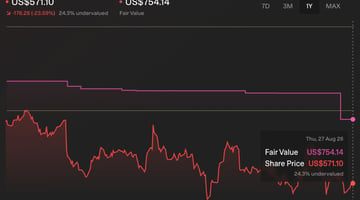
Most Popular Narrative: 24.3% Undervalued
The most followed narrative currently sees Flex as worth $160.40 a share, compared with the latest close at $121.35. This sets a clear valuation gap for investors to assess.
The ongoing surge in demand for data center and AI infrastructure requiring integrated power, cooling, and advanced IT hardware positions Flex for sustained, outsized revenue growth, as evidenced by the 35% forecasted annual increase in its data center segment, supporting both topline expansion and higher portfolio margins.
Want to understand why this narrative points to a higher fair value for Flex? It focuses on rapid revenue expansion, rising profitability, and a profit multiple that assumes the business earns a very different level of cash in a few years. Curious which growth and margin assumptions are doing the heavy lifting here? The full narrative lays out those building blocks in detail.
The fair value estimate of $160.40 is built using a discount rate of 9.05%, which reflects the return investors are assumed to require on Flex's future cash flows. Analysts contributing to this narrative incorporate compound revenue growth and a significant uplift in profit margins compared with today. Together, these inputs point to materially higher dollar earnings by the end of the forecast window.
Another key element is the assumed valuation multiple that Flex might trade on once those earnings are reached. The narrative uses a future P/E level that sits below one recent industry snapshot. This means the fair value is not purely a story of higher multiples. It is more about scaling the current business into a larger, more profitable operation across segments like Cloud and Power Infrastructure, Integrated Technology Solutions, and Regulated Manufacturing Solutions.
For investors comparing this to the current share price, the gap between $121.35 and $160.40 reflects both the growth profile embedded in the forecasts and the time value of money implied by the 9.05% discount rate. The question is not only whether Flex can reach the revenue and earnings levels described, but also whether the market will be willing to apply that future multiple once it gets there.
Result: Fair Value of $160.40 (UNDERVALUED)
Have a read of the narrative in full and understand what's behind the forecasts.
However, this Flex narrative still faces execution risk if large hyperscaler customers insource power and cooling, or if already thin margins come under cost or pricing pressure.
Find out about the key risks to this Flex narrative.
Another View: Flex Through The P/E Lens
The first narrative for Flex leans heavily on cash flow and long term growth assumptions. Yet on simple P/E math the stock looks full, with a 46.1x P/E compared with 31.8x for the US Electronic industry and 42.8x for peers, even though the fair ratio sits higher at 64.8x. That gap suggests either extra downside risk if sentiment cools or room for the market to stretch closer to the fair ratio if earnings keep tracking forecasts. Which side of that trade off feels more realistic to you?
See what the numbers say about this price — find out in our valuation breakdown.

Next Steps
Given the mixed sentiment around Flex after a sharp share price run and a rich P/E, it makes sense to move quickly and check the underlying drivers for yourself. To see how the current upside story balances against the issues investors are watching, review the 4 key rewards and 2 important warning signs
Looking for more investment ideas beyond Flex?
If Flex has your attention, do not stop here. The best opportunities rarely sit alone and the next move often starts with a wider look at the market.
- Spot potential value plays early and scan a focused set of companies using the screener containing 19 high quality undiscovered gems.
- Strengthen the quality of your watchlist by filtering for companies with resilient finances through the solid balance sheet and fundamentals stocks screener (49 results).
- Balance growth potential with capital protection and filter for steadier performers using the 79 resilient stocks with low risk scores.
This article by Simply Wall St is general in nature. We provide commentary based on historical data and analyst forecasts only using an unbiased methodology and our articles are not intended to be financial advice. It does not constitute a recommendation to buy or sell any stock, and does not take account of your objectives, or your financial situation. We aim to bring you long-term focused analysis driven by fundamental data. Note that our analysis may not factor in the latest price-sensitive company announcements or qualitative material. Simply Wall St has no position in any stocks mentioned.
New: AI Stock Screener & Alerts
Our new AI Stock Screener scans the market every day to uncover opportunities.
• Dividend Powerhouses (3%+ Yield)
• Undervalued Small Caps with Insider Buying
• High growth Tech and AI Companies
Or build your own from over 50 metrics.
Have feedback on this article? Concerned about the content? Get in touch with us directly. Alternatively, email editorial-team@simplywallst.com
MI

The Foxhole
A landmark settlement is meant to punish Meta (META). If the 1998 tobacco deal is any guide, it might protect it.
199
ZO
zoe_vi5fn
Any moat with an opt-out clause for your competitors is just a fence around your own garden.
CO
connor_iwn1g
Worth looking at what previous legal action actually did to Meta rather than reaching for tobacco. The FTC's record five billion dollar privacy fine in 2019 was met with the stock rising, because it came in below fears and removed an open question. GDPR was designed to constrain large platforms and increased their share of the European ad market, because compliance cost fell hardest on small intermediaries. The FTC's antitrust case, the one that could genuinely have broken the company up, was decided in Meta's favour last November. The only thing that ever meaningfully hurt the business was Apple changing a tracking default, and Meta out-spent that too, while the ad-tech firms that could not afford to rebuild disappeared. The pattern is not that Meta survives regulation. It is that regulation keeps costing its smaller competitors more.
 Andrew Legget
Market Insights
Great earnings season, but are the earnings real?

At first glance, this was the strongest earnings season in years. But when you look at where the growth actually came from, the story splits into two very different pictures.
20
About NasdaqGS:FLEX
Flex
Provides technology innovation, supply chain, and manufacturing solutions to data center, communications, enterprise, consumer, automotive, healthcare, industrial, and power industries in the Americas, Asia, and Europe.
Exceptional growth potential with excellent balance sheet.
Similar Companies
Market Insights


Advertisement
Weekly Picks
LO


Lou_Basenese on Oncolytics Biotech ·
The Team Behind a $2 Billion Johnson & Johnson (JNJ) Deal Just Took Over This $105 Million Cancer Biotech
Fair Value:US$3.575.5% undervalued
39 followersusers have followed this narrative
0 commentsusers have commented on this narrative
11 likesusers have liked this narrative
TR


tripledub on Meta Platforms ·
The $135 Billion Bet That Should Make Every Shareholder Nervous
Fair Value:US$5861.4% undervalued
62 followersusers have followed this narrative
3 commentsusers have commented on this narrative
34 likesusers have liked this narrative
TA


Talos on Voyager Technologies ·
The "Landlord of Orbit" – A Deep Value Play Ahead of the Starlab Era
Fair Value:US$385.291.1% undervalued
66 followersusers have followed this narrative
0 commentsusers have commented on this narrative
6 likesusers have liked this narrative
IV

Ivoed on Uber Technologies ·
Uber’s Valuation Depends On Who Captures The Economics Of Driverless Rides
Fair Value:US$11632.1% undervalued
14 followersusers have followed this narrative
0 commentsusers have commented on this narrative
3 likesusers have liked this narrative
Recently Updated Narratives
ES

Esteban on NVIDIA ·
NVIDIA is the toll booth on the largest infrastructure build-out in commercial history
Fair Value:US$99.52118.6% overvalued
1 followerusers have followed this narrative
0 commentsusers have commented on this narrative
0 likesusers have liked this narrative
LI

Lijo on Accenture ·
A value stock that's undervalued.
Fair Value:US$27029.8% undervalued
8 followersusers have followed this narrative
0 commentsusers have commented on this narrative
0 likesusers have liked this narrative
AR

ariz_scribe on Marti Technologies ·
$MRT at Roth - Pick of the Panel
Fair Value:US$1.9615.3% overvalued
7 followersusers have followed this narrative
0 commentsusers have commented on this narrative
0 likesusers have liked this narrative
Popular Narratives
OS

oscargarcia on NVIDIA ·
The company that went from selling GPUs to gamers to becoming the AI arms dealer of the 21st century.
Fair Value:US$28022.3% undervalued
363 followersusers have followed this narrative
9 commentsusers have commented on this narrative
16 likesusers have liked this narrative
CU

CubanEros on Microsoft ·
A wonderful business at reasonable price.
Fair Value:US$419.9122.3% overvalued
211 followersusers have followed this narrative
0 commentsusers have commented on this narrative
9 likesusers have liked this narrative
JO


John_Eric on MercadoLibre ·
MercadoLibre and the Spreadsheet Trick That Decides Everything
Fair Value:US$7.31k73.1% undervalued
125 followersusers have followed this narrative
3 commentsusers have commented on this narrative
17 likesusers have liked this narrative
Trending Discussion
MA

max_profit on Happiest Minds Technologies ·
sold all my happiest mind , if the owner doesn't want to stick around why would i
0
|0


JE

jean_pierre_lan_dsslz on Mauritius Development Investment Trust ·
Yes, MDIT is simply just a Deposit-long term stock with a good Dividend, no more, no less. It has just declared a Dividend of 0.11 cs payable 21 September 2026. Its price fluctuates between 1.90cs & 2.00cs. No capital gain in the short or medium term.
0
|0