
Advertisement
- United States
- /
- Software
- /
- NYSE:U
Unity Software's (NYSE:U) Acquisitions Should Bring the Needed Revenue Diversification
Few Wall Street proverbs echo more than "Big bases create big breakouts."
After 8 months of ranging, Unity Software Inc.(NYSE: U) finally recaptured the key level of US$150 and broke out in a parabolic fashion, with no signs of slowing down yet.
View our latest analysis for Unity Software
Q3 Earnings Results
The company reported a solid third-quarter result with reduced losses, improved revenues, and improved control over expenses.
- Revenue: US$286.3m (up 43% from 3Q 2020).
- Net loss: US$115.2m (loss narrowed 20% from 3Q 2020).
Guidance for Q4
- Revenue: US$285-290m
- Non-GAAP Operating loss: US$20-25m
Meanwhile, the company reached a definitive deal to buy Weta Digital, a well-known digital visual effects company founded by Peter Jackson. The deal is worth US$1.625b while Weta will remain a stand-alone entity.
This acquisition is a tailwind to Unity's plans as the company looks for a strong position in the booming AR/ VR market. Although a fast-growing market already, Morgan Stanley argues that the VR market will explode, with just the hardware market reaching US$60b by 2030 and US$250b by 2040.
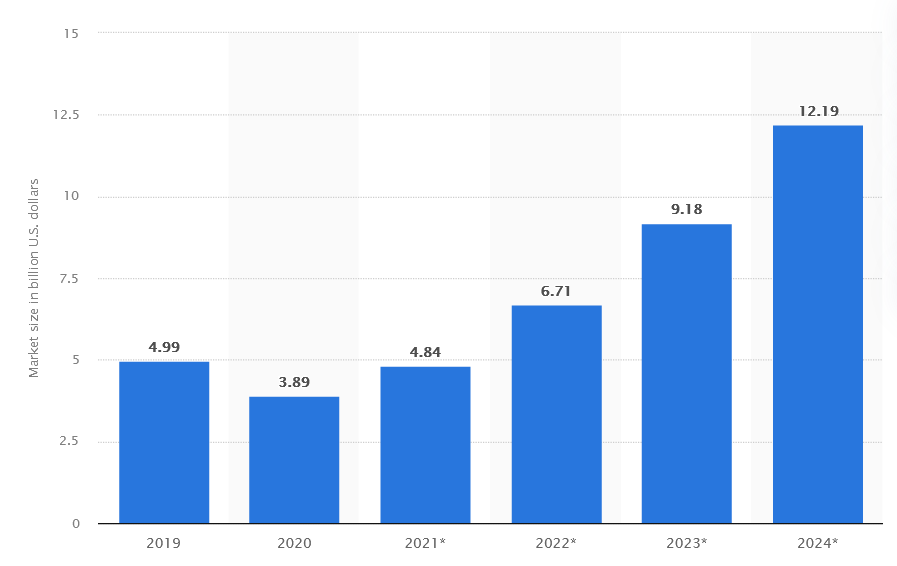
However, the company will have to work on its revenue diversification as 90% of its revenues currently come from the gaming industry. So far, the company is working on partnerships with automotive manufacturers, eye-wear, and media& entertainment – especially with their latest acquisition.
A Look Into the Revenue Growth
Given that Unity Software didn't make a profit in the last twelve months, we'll focus on revenue growth to form a quick view of its business development. When a company doesn't make profits, we'd generally expect to see good revenue growth. As you can imagine, fast revenue growth, when maintained, often leads to fast profit growth.
In the last year, Unity Software saw its revenue grow by 43%. We respect that sort of growth, no doubt. While the share price performed well, gaining 71% over twelve months, you could argue the revenue growth warranted it. If revenue stays on-trend, there may be plenty more share price gains to come. But before deciding this growth stock is underappreciated, you might want to check out profitability trends (and cash flow).
The image below shows how earnings and revenue have tracked over time (if you click on the image you can see greater detail).
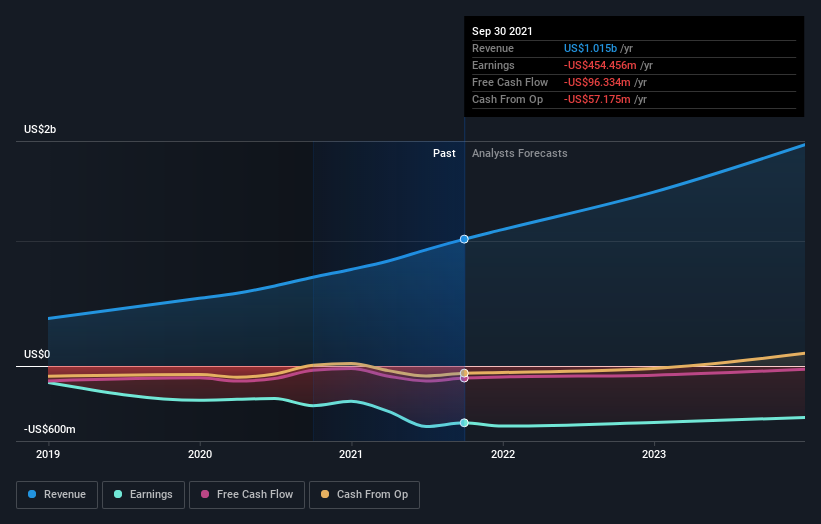
Unity Software is well known by investors, and plenty of clever analysts have tried to predict future profit levels. Given we have quite a good number of analyst forecasts, it might be well worth checking out this free chart depicting consensus estimates.
A Different Perspective
Unity Software boasts a total shareholder return of 71% for the last year. And the share price momentum remains respectable, with a gain of 61% over the previous three months. This suggests the company is continuing to win over new investors.
However, those who are thinking about investing in the stock should think twice about chasing parabolic moves. An orderly market move is in waves - price goes up and then retraces before making the next move.
If you're interested in an in-depth review, we've spotted 4 warning signs for Unity Software you should be aware of. Furthermore, if you're interested in growth companies, check out this free list of growing companies with considerable, recent, insider buying.
Please note, the market returns quoted in this article reflect the market-weighted average returns of stocks that currently trade on US exchanges.
New: AI Stock Screener & Alerts
Our new AI Stock Screener scans the market every day to uncover opportunities.
• Dividend Powerhouses (3%+ Yield)
• Undervalued Small Caps with Insider Buying
• High growth Tech and AI Companies
Or build your own from over 50 metrics.
Have feedback on this article? Concerned about the content? Get in touch with us directly. Alternatively, email editorial-team@simplywallst.com
Simply Wall St analyst Stjepan Kalinic and Simply Wall St have no position in any of the companies mentioned. This article is general in nature. We provide commentary based on historical data and analyst forecasts only using an unbiased methodology and our articles are not intended to be financial advice. It does not constitute a recommendation to buy or sell any stock and does not take account of your objectives, or your financial situation. We aim to bring you long-term focused analysis driven by fundamental data. Note that our analysis may not factor in the latest price-sensitive company announcements or qualitative material.
M

The Foxhole
Nasdaq will soon let you trade 23 hours a day. Buffett's advice was to barely trade at all.
912
s
sarah_c5otv
Discipline, Patience & Restraint will become a bigger and better edge now.

singhappily
Great news for anyone who felt their regrets were insufficiently spread across the day.
 Mitchell Lawler
Market Insights
What happens to energy stocks as the fix gets built?

Conflict around the Strait of Hormuz has led investors to oil and tankers. The trouble is, the antidote to the chokepoints is already being built, and it may not reward the same energy stocks.
84
ST

Stjepan Kalinic
Stjepan is a writer and an analyst covering equity markets. As a former multi-asset analyst, he prefers to look beyond the surface and uncover ideas that might not be on retail investors' radar. You can find his research all over the internet, including Simply Wall St News, Yahoo Finance, Benzinga, Vincent, and Barron's.
About NYSE:U
Unity Software
Operates a platform to develop, deploy, and grow games and interactive experiences for mobile phones, PCs, consoles, and extended reality devices in the United States, China, Hong Kong, Taiwan, Europe, the Middle East, Africa, the Asia Pacific, Canada, and Latin America.
High growth potential with excellent balance sheet.
Similar Companies
Market Insights


Advertisement
Weekly Picks
CE


Ceazar on Buffalo Potash ·
Under the radar: This $78M stock controls a $1.5B project and it’ll start producing in a few months
Fair Value:CA$1.0625.5% undervalued
1 followerusers have followed this narrative
0 commentsusers have commented on this narrative
0 likesusers have liked this narrative
CO


composite32 on Archrock ·
AI Needs Power. Power Needs Gas. Gas Needs Compression: The Archrock Investment Thesis
Fair Value:US$44.8831.5% undervalued
37 followersusers have followed this narrative
2 commentsusers have commented on this narrative
3 likesusers have liked this narrative
JO


John_Eric on Advanced Energy Industries ·
AEIS Is Firing on Every Cylinder. My Problem Is the Safety Factor.
Fair Value:US$567.8653.7% undervalued
22 followersusers have followed this narrative
0 commentsusers have commented on this narrative
7 likesusers have liked this narrative
IS

isidrohg on Lam Research ·
The Memory Shortage Is Lam's Order Book — Whether It Persists Or Resolves
Fair Value:US$423.8528.7% undervalued
26 followersusers have followed this narrative
0 commentsusers have commented on this narrative
7 likesusers have liked this narrative
Recently Updated Narratives
ON

Ontological on Hinge Health ·
Scaling Digital Musculoskeletal Care With Strong Growth and Margins, Hinge Health (HNGE)
Fair Value:US$145.0434.9% undervalued
1 followerusers have followed this narrative
0 commentsusers have commented on this narrative
0 likesusers have liked this narrative
HO

hongjuan_p6tor on DSC Holdings ·
DSC is not a second car dealer like Carvana but a used car dealer enabler
Fair Value:US$3.32103.9% overvalued
1 followerusers have followed this narrative
1 commentusers have commented on this narrative
0 likesusers have liked this narrative
TI

TimLee on 3REN Berhad ·
3REN Berhad Is Powering the Semiconductor Ecosystem and Smart Manufacturing
Fair Value:RM 0.6843.4% undervalued
6 followersusers have followed this narrative
0 commentsusers have commented on this narrative
0 likesusers have liked this narrative
Popular Narratives
AN


AnalystConsensusTarget on NVIDIA ·
NVDA: Expanding AI Demand Will Drive Major Data Center Investments Through 2026
Fair Value:US$302.8324.9% undervalued
1493 followersusers have followed this narrative
8 commentsusers have commented on this narrative
35 likesusers have liked this narrative
AN

AnalystConsensusTarget on Alphabet ·
GOOGL: AI Platform Expansion And Cloud Demand Will Support Durable Performance Amid Competitive Pressures
Fair Value:US$427.8917.0% undervalued
1652 followersusers have followed this narrative
0 commentsusers have commented on this narrative
19 likesusers have liked this narrative
AN

AnalystConsensusTarget on Amazon.com ·
AMZN: Acceleration In Cloud And AI Will Drive Margin Expansion Ahead
Fair Value:US$32721.0% undervalued
1669 followersusers have followed this narrative
1 commentusers have commented on this narrative
16 likesusers have liked this narrative
Trending Discussion


PE
peng_i7fl6 on DSC Holdings ·
What stood out to me in this piece is how Zou draws a clear line between DSC and platforms like Carvana. DSC doesn't sell cars itself — it sits behind dealers and provides the operating system and transaction services. Once you frame it that way, the 90% market share starts to mean something real. Dealers run their daily work on the system: listings, pricing, inventory. The data accumulates bit by bit, and that's not something a competitor can buy its way into. You can't just throw money at it and get tens of thousands of dealers to switch systems.Her point about EVs was practical too. More brands, more models, more trim levels — dealer SKU management has gotten a lot messier, and pricing moves fast. Relying on gut feel from the old days doesn't cut it anymore. That demand isn't something the company invented; the industry just got to this point on its own.On the stock, her answer was honest. Management can't control short-term price action after listing, so they focus on running the business and delivering results. That reads more credible than pumping a narrative.The things I'd watch: whether dealer retention holds up, and whether the data and AI tools eventually show up as real revenue. A good story still has to pass the financials.
0
|0