
Advertisement
- United States
- /
- IT
- /
- NYSE:DAVA
Institutional owners may consider drastic measures as Endava plc's (NYSE:DAVA) recent US$292m drop adds to long-term losses
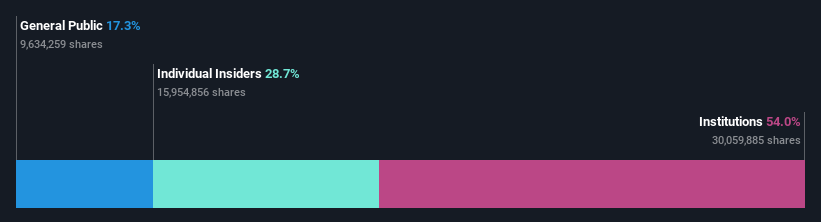
To get a sense of who is truly in control of Endava plc (NYSE:DAVA), it is important to understand the ownership structure of the business. With 54% stake, institutions possess the maximum shares in the company. That is, the group stands to benefit the most if the stock rises (or lose the most if there is a downturn).
As a result, institutional investors endured the highest losses last week after market cap fell by US$292m. Needless to say, the recent loss which further adds to the one-year loss to shareholders of 54% might not go down well especially with this category of shareholders. Also referred to as "smart money", institutions have a lot of sway over how a stock's price moves. As a result, if the decline continues, institutional investors may be pressured to sell Endava which might hurt individual investors.
Let's take a closer look to see what the different types of shareholders can tell us about Endava.
Check out the opportunities and risks within the US IT industry.
What Does The Institutional Ownership Tell Us About Endava?
Institutional investors commonly compare their own returns to the returns of a commonly followed index. So they generally do consider buying larger companies that are included in the relevant benchmark index.
Endava already has institutions on the share registry. Indeed, they own a respectable stake in the company. This suggests some credibility amongst professional investors. But we can't rely on that fact alone since institutions make bad investments sometimes, just like everyone does. It is not uncommon to see a big share price drop if two large institutional investors try to sell out of a stock at the same time. So it is worth checking the past earnings trajectory of Endava, (below). Of course, keep in mind that there are other factors to consider, too.

Investors should note that institutions actually own more than half the company, so they can collectively wield significant power. We note that hedge funds don't have a meaningful investment in Endava. The company's CEO John Cotterell is the largest shareholder with 16% of shares outstanding. Meanwhile, the second and third largest shareholders, hold 12% and 4.4%, of the shares outstanding, respectively.
On further inspection, we found that more than half the company's shares are owned by the top 9 shareholders, suggesting that the interests of the larger shareholders are balanced out to an extent by the smaller ones.
While studying institutional ownership for a company can add value to your research, it is also a good practice to research analyst recommendations to get a deeper understand of a stock's expected performance. There are a reasonable number of analysts covering the stock, so it might be useful to find out their aggregate view on the future.
Insider Ownership Of Endava
While the precise definition of an insider can be subjective, almost everyone considers board members to be insiders. The company management answer to the board and the latter should represent the interests of shareholders. Notably, sometimes top-level managers are on the board themselves.
I generally consider insider ownership to be a good thing. However, on some occasions it makes it more difficult for other shareholders to hold the board accountable for decisions.
Our information suggests that insiders maintain a significant holding in Endava plc. Insiders own US$1.1b worth of shares in the US$3.8b company. That's quite meaningful. It is good to see this level of investment. You can check here to see if those insiders have been buying recently.
General Public Ownership
With a 17% ownership, the general public, mostly comprising of individual investors, have some degree of sway over Endava. While this size of ownership may not be enough to sway a policy decision in their favour, they can still make a collective impact on company policies.
Next Steps:
It's always worth thinking about the different groups who own shares in a company. But to understand Endava better, we need to consider many other factors.
I always like to check for a history of revenue growth. You can too, by accessing this free chart of historic revenue and earnings in this detailed graph.
But ultimately it is the future, not the past, that will determine how well the owners of this business will do. Therefore we think it advisable to take a look at this free report showing whether analysts are predicting a brighter future.
NB: Figures in this article are calculated using data from the last twelve months, which refer to the 12-month period ending on the last date of the month the financial statement is dated. This may not be consistent with full year annual report figures.
Valuation is complex, but we're here to simplify it.
Discover if Endava might be undervalued or overvalued with our detailed analysis, featuring fair value estimates, potential risks, dividends, insider trades, and its financial condition.
Access Free AnalysisHave feedback on this article? Concerned about the content? Get in touch with us directly. Alternatively, email editorial-team (at) simplywallst.com.
This article by Simply Wall St is general in nature. We provide commentary based on historical data and analyst forecasts only using an unbiased methodology and our articles are not intended to be financial advice. It does not constitute a recommendation to buy or sell any stock, and does not take account of your objectives, or your financial situation. We aim to bring you long-term focused analysis driven by fundamental data. Note that our analysis may not factor in the latest price-sensitive company announcements or qualitative material. Simply Wall St has no position in any stocks mentioned.
 mitchell_lawler
The Foxhole
Micron (MU) is booming, and it still doesn't look ‘expensive’ based on next year's earnings. So why does our own valuation say it could be worth 40% less?
2413
zoe_vi5fn
A low price to earnings ratio at the top of the cycle is a warning rather than a bargain, and a terrifyingly high one at the bottom is often the entry point
darius_xnnrd
Memory used to have a dozen participants racing each other into oversupply, and now it has three. High bandwidth memory is qualified into customer designs years ahead, sold under long-term agreements, and is far harder to switch away from than commodity DRAM.
About NYSE:DAVA
Endava
Provides technology services in North America, Europe, the United Kingdom, and internationally.
Undervalued with moderate growth potential.
Similar Companies
Market Insights

Advertisement
Weekly Picks
RI


Rick_Orford on Starfighters Space ·
The 1960s Fighter Jet That Could Crack Open a $20 Billion Satellite Market
Fair Value:US$515.2% undervalued
34 followersusers have followed this narrative
1 commentusers have commented on this narrative
6 likesusers have liked this narrative
FU


FundamentalFlow on Vertiv Holdings Co ·
The Short and Long Term Compounder of Liquid Cooling industry.
Fair Value:US$45034.7% undervalued
62 followersusers have followed this narrative
0 commentsusers have commented on this narrative
12 likesusers have liked this narrative
JO


John_Eric on SPX Technologies ·
I Fell in Love With a Data-Center Cooling Stock. Then I Opened the Filings.
Fair Value:US$2037.1% overvalued
27 followersusers have followed this narrative
2 commentsusers have commented on this narrative
11 likesusers have liked this narrative
TR


tripledub on GQG Partners ·
The Cheap Genius Problem
Fair Value:AU$3.2155.0% undervalued
36 followersusers have followed this narrative
0 commentsusers have commented on this narrative
24 likesusers have liked this narrative
Recently Updated Narratives
SE


Sertan1978 on International Business Machines ·
Why I See IBM as a Long-Term Enterprise AI and Hybrid Cloud Play
Fair Value:US$166.7340.5% overvalued
1 followerusers have followed this narrative
0 commentsusers have commented on this narrative
0 likesusers have liked this narrative
AN


andrei9868 on Vistra ·
Vistra Energy ($VST): The Flexible Power Platform Capturing AI Load Growth
Fair Value:US$22534.2% undervalued
1 followerusers have followed this narrative
0 commentsusers have commented on this narrative
0 likesusers have liked this narrative
AN

andrei9868 on Constellation Energy ·
Constellation Energy ($CEG): The Nuclear Scarcity Play Powering the AI Demand Boom
Fair Value:US$35019.3% undervalued
1 followerusers have followed this narrative
0 commentsusers have commented on this narrative
0 likesusers have liked this narrative
Popular Narratives
OS


oscargarcia on NVIDIA ·
The company that went from selling GPUs to gamers to becoming the AI arms dealer of the 21st century.
Fair Value:US$28019.6% undervalued
314 followersusers have followed this narrative
9 commentsusers have commented on this narrative
16 likesusers have liked this narrative
CU

CubanEros on Microsoft ·
A wonderful business at reasonable price.
Fair Value:US$419.9118.0% overvalued
172 followersusers have followed this narrative
0 commentsusers have commented on this narrative
8 likesusers have liked this narrative
KI

KiwiInvest on Amazon.com ·
Amazon's high growth, high tech segments propel its profits, while traditional segments plod along
Fair Value:US$475.0944.7% undervalued
192 followersusers have followed this narrative
1 commentusers have commented on this narrative
8 likesusers have liked this narrative
Trending Discussion
JA
james_rxfd8 on Starfighters Space ·
How is this different to Virgin Orbit, which didn’t seem to work out, with a very similar plan?
3
|2
GE

george_b177x on Bloom Energy ·
Brilliant analysis. Great company with proven product and service!
1
|1