Advertisement
- United States
- /
- Software
- /
- NasdaqGS:GTLB
GitLab (GTLB) Is Down 7.5% After Mixed Q3 Results And New AI Monetization Plan - Has The Bull Case Changed?

Reviewed by Sasha Jovanovic
- GitLab Inc. reported past third-quarter 2025 results with revenue rising to US$244.35 million but shifting from US$29.1 million net income to a US$8.28 million net loss, and issued new guidance targeting US$251–252 million in fourth-quarter revenue and US$946–947 million for fiscal 2026.
- The company paired these results with the upcoming appointment of experienced finance leader Jessica Ross as CFO and plans to monetize its AI-powered Duo Agent platform through a hybrid seat-plus-usage model, signaling an emphasis on scaling AI-driven growth and financial discipline.
- We’ll now examine how GitLab’s raised full-year revenue guidance and AI-focused Duo Agent rollout may reshape its existing investment narrative.
Explore 27 top quantum computing companies leading the revolution in next-gen technology and shaping the future with breakthroughs in quantum algorithms, superconducting qubits, and cutting-edge research.
GitLab Investment Narrative Recap
To own GitLab, you need to believe its all-in-one DevSecOps and AI tools will keep winning enterprise budgets despite fierce competition and recent share price weakness. The main near term catalyst is successful monetization of its Duo Agent AI platform through the new seat plus usage model, while the biggest current risk is execution on that pricing shift and sustaining expansion with existing customers. The latest earnings and guidance do not materially change that equation.
The appointment of Jessica Ross as CFO from January 2026 looks especially relevant here, given GitLab’s move to a more complex hybrid pricing and AI monetization model. With 25 years in finance leadership across several public companies, she will be central to how GitLab balances Duo Agent driven growth with spending discipline, and how clearly it communicates progress on revenue quality, margins, and cash generation to investors watching this transition closely.
Yet investors should be aware that GitLab’s shift to a hybrid seat plus usage model introduces new uncertainty around...
Read the full narrative on GitLab (it's free!)
GitLab's narrative projects $1.4 billion revenue and $189.5 million earnings by 2028.
Uncover how GitLab's forecasts yield a $57.59 fair value, a 54% upside to its current price.
Exploring Other Perspectives
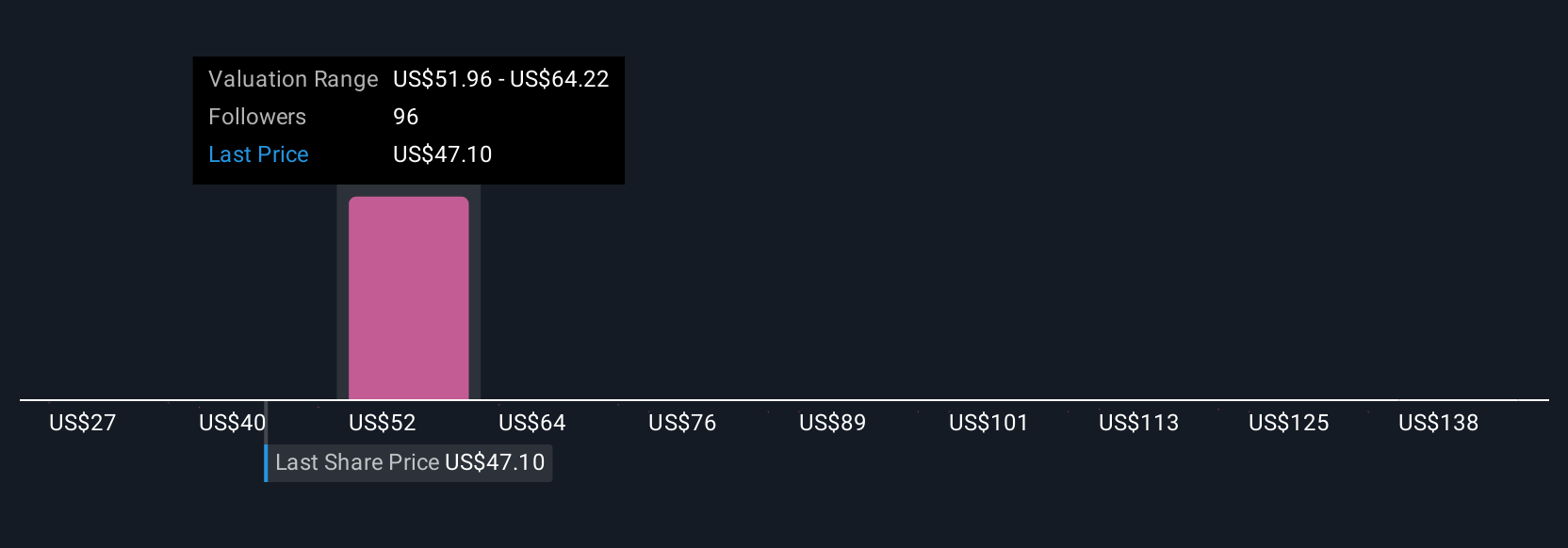
Simply Wall St Community members place GitLab’s fair value between US$27.92 and US$150 across 22 submissions, underscoring how far apart individual views can be. You are weighing those opinions against GitLab’s still unproven hybrid seat plus usage pricing shift and what that could mean for future revenue quality and volatility.
Explore 22 other fair value estimates on GitLab - why the stock might be worth 26% less than the current price!
Build Your Own GitLab Narrative
Disagree with existing narratives? Create your own in under 3 minutes - extraordinary investment returns rarely come from following the herd.
- A great starting point for your GitLab research is our analysis highlighting 3 key rewards and 1 important warning sign that could impact your investment decision.
- Our free GitLab research report provides a comprehensive fundamental analysis summarized in a single visual - the Snowflake - making it easy to evaluate GitLab's overall financial health at a glance.
Searching For A Fresh Perspective?
Early movers are already taking notice. See the stocks they're targeting before they've flown the coop:
- The best AI stocks today may lie beyond giants like Nvidia and Microsoft. Find the next big opportunity with these 26 smaller AI-focused companies with strong growth potential through early-stage innovation in machine learning, automation, and data intelligence that could fund your retirement.
- We've found 15 US stocks that are forecast to pay a dividend yield of over 6% next year. See the full list for free.
- The end of cancer? These 29 emerging AI stocks are developing tech that will allow early identification of life changing diseases like cancer and Alzheimer's.
This article by Simply Wall St is general in nature. We provide commentary based on historical data and analyst forecasts only using an unbiased methodology and our articles are not intended to be financial advice. It does not constitute a recommendation to buy or sell any stock, and does not take account of your objectives, or your financial situation. We aim to bring you long-term focused analysis driven by fundamental data. Note that our analysis may not factor in the latest price-sensitive company announcements or qualitative material. Simply Wall St has no position in any stocks mentioned.
New: Manage All Your Stock Portfolios in One Place
We've created the ultimate portfolio companion for stock investors, and it's free.
• Connect an unlimited number of Portfolios and see your total in one currency
• Be alerted to new Warning Signs or Risks via email or mobile
• Track the Fair Value of your stocks
Have feedback on this article? Concerned about the content? Get in touch with us directly. Alternatively, email editorial-team@simplywallst.com
About NasdaqGS:GTLB
GitLab
Develops software for the software development lifecycle in the United States, Europe, and the Asia Pacific.
Flawless balance sheet and good value.
Similar Companies
Market Insights


Advertisement
Weekly Picks
LO


Lou_Basenese on Virtuix Holdings ·
From a “Shark Tank” Snub to an Air Force “Yes”: Why Virtuix at $3.50 May Be the Market’s Most Mispriced AI Story
Fair Value:US$7.562.8% undervalued
22 followersusers have followed this narrative
0 commentsusers have commented on this narrative
3 likesusers have liked this narrative
IN


Investingwilly on Mastercard ·
Mastercard: The Best Dividend Stock You're Ignoring
Fair Value:US$75033.5% undervalued
72 followersusers have followed this narrative
1 commentusers have commented on this narrative
9 likesusers have liked this narrative
TR


tripledub on Intuit ·
A Wonderful Business at a Not-So-Wonderful Price
Fair Value:US$56052.2% undervalued
64 followersusers have followed this narrative
4 commentsusers have commented on this narrative
30 likesusers have liked this narrative
TA


Talos on MindWalk Holdings ·
The Asymmetric TechBio Play: MindWalk Holdings and the Valuation Disconnect
Fair Value:US$8.2780.9% undervalued
35 followersusers have followed this narrative
0 commentsusers have commented on this narrative
9 likesusers have liked this narrative
Recently Updated Narratives
RO


RockeTeller on Orezone Gold ·
Orezone Gold Could 3X–5X, Bomboré Ramp + Casa Berardi Quebec Asset Delivers 160-180Koz in 2026
Fair Value:CA$10.6878.4% undervalued
11 followersusers have followed this narrative
4 commentsusers have commented on this narrative
1 likeusers have liked this narrative
IV

Ivoed on Netflix ·
Netflix’s Business Quality Is Clear. The Harder Question Is Whether The Stock Is Still Cheap
Fair Value:US$8210.0% undervalued
4 followersusers have followed this narrative
0 commentsusers have commented on this narrative
0 likesusers have liked this narrative
RO

RockeTeller on NeXGold Mining ·
NexGold Mining: 4.7Moz M&I Resources, $100M Cash + Debt-Free, Construction Decision 2026 Undervalued Canadian Gold Developer
Fair Value:CA$39.5296.9% undervalued
5 followersusers have followed this narrative
3 commentsusers have commented on this narrative
1 likeusers have liked this narrative
Popular Narratives
IN
Investingwilly on Mastercard ·
Mastercard: The Best Dividend Stock You're Ignoring
Fair Value:US$75033.5% undervalued
72 followersusers have followed this narrative
1 commentusers have commented on this narrative
9 likesusers have liked this narrative
HA


HarishPK on Adobe ·
Adobe: A Probabilistic Case for Undervaluation
Fair Value:US$319.9636.6% undervalued
62 followersusers have followed this narrative
9 commentsusers have commented on this narrative
19 likesusers have liked this narrative
MA


martinarauz on Nu Holdings ·
Investment Analysis (May 2026)
Fair Value:US$22.7442.1% undervalued
68 followersusers have followed this narrative
0 commentsusers have commented on this narrative
17 likesusers have liked this narrative
