
Advertisement
- South Korea
- /
- IT
- /
- KOSDAQ:A351330
Health Check: How Prudently Does ISAAC EngineeringLtd (KOSDAQ:351330) Use Debt?
Legendary fund manager Li Lu (who Charlie Munger backed) once said, 'The biggest investment risk is not the volatility of prices, but whether you will suffer a permanent loss of capital.' So it seems the smart money knows that debt - which is usually involved in bankruptcies - is a very important factor, when you assess how risky a company is. As with many other companies ISAAC Engineering Co.,Ltd (KOSDAQ:351330) makes use of debt. But the real question is whether this debt is making the company risky.
When Is Debt Dangerous?
Debt assists a business until the business has trouble paying it off, either with new capital or with free cash flow. If things get really bad, the lenders can take control of the business. While that is not too common, we often do see indebted companies permanently diluting shareholders because lenders force them to raise capital at a distressed price. By replacing dilution, though, debt can be an extremely good tool for businesses that need capital to invest in growth at high rates of return. When we think about a company's use of debt, we first look at cash and debt together.
How Much Debt Does ISAAC EngineeringLtd Carry?
The image below, which you can click on for greater detail, shows that ISAAC EngineeringLtd had debt of ₩4.86b at the end of December 2024, a reduction from ₩10.8b over a year. But it also has ₩11.7b in cash to offset that, meaning it has ₩6.88b net cash.
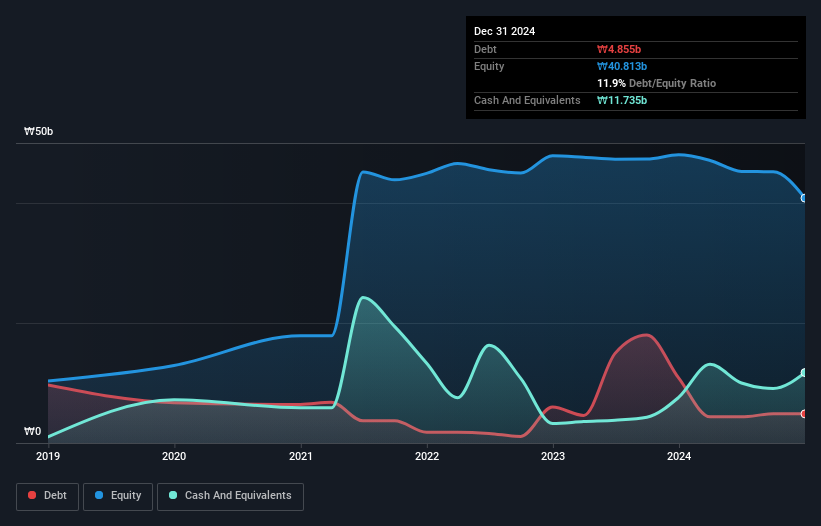
How Healthy Is ISAAC EngineeringLtd's Balance Sheet?
According to the last reported balance sheet, ISAAC EngineeringLtd had liabilities of ₩27.1b due within 12 months, and liabilities of ₩225.5m due beyond 12 months. Offsetting this, it had ₩11.7b in cash and ₩20.1b in receivables that were due within 12 months. So it can boast ₩4.49b more liquid assets than total liabilities.
This surplus suggests that ISAAC EngineeringLtd has a conservative balance sheet, and could probably eliminate its debt without much difficulty. Succinctly put, ISAAC EngineeringLtd boasts net cash, so it's fair to say it does not have a heavy debt load! When analysing debt levels, the balance sheet is the obvious place to start. But you can't view debt in total isolation; since ISAAC EngineeringLtd will need earnings to service that debt. So when considering debt, it's definitely worth looking at the earnings trend. Click here for an interactive snapshot.
Check out our latest analysis for ISAAC EngineeringLtd
In the last year ISAAC EngineeringLtd had a loss before interest and tax, and actually shrunk its revenue by 32%, to ₩68b. That makes us nervous, to say the least.
So How Risky Is ISAAC EngineeringLtd?
While ISAAC EngineeringLtd lost money on an earnings before interest and tax (EBIT) level, it actually generated positive free cash flow ₩6.8b. So although it is loss-making, it doesn't seem to have too much near-term balance sheet risk, keeping in mind the net cash. We'll feel more comfortable with the stock once EBIT is positive, given the lacklustre revenue growth. There's no doubt that we learn most about debt from the balance sheet. But ultimately, every company can contain risks that exist outside of the balance sheet. These risks can be hard to spot. Every company has them, and we've spotted 3 warning signs for ISAAC EngineeringLtd (of which 1 is a bit unpleasant!) you should know about.
At the end of the day, it's often better to focus on companies that are free from net debt. You can access our special list of such companies (all with a track record of profit growth). It's free.
New: AI Stock Screener & Alerts
Our new AI Stock Screener scans the market every day to uncover opportunities.
• Dividend Powerhouses (3%+ Yield)
• Undervalued Small Caps with Insider Buying
• High growth Tech and AI Companies
Or build your own from over 50 metrics.
Have feedback on this article? Concerned about the content? Get in touch with us directly. Alternatively, email editorial-team (at) simplywallst.com.
This article by Simply Wall St is general in nature. We provide commentary based on historical data and analyst forecasts only using an unbiased methodology and our articles are not intended to be financial advice. It does not constitute a recommendation to buy or sell any stock, and does not take account of your objectives, or your financial situation. We aim to bring you long-term focused analysis driven by fundamental data. Note that our analysis may not factor in the latest price-sensitive company announcements or qualitative material. Simply Wall St has no position in any stocks mentioned.
About KOSDAQ:A351330
ISAAC EngineeringLtd
Provides solutions for process and factory automation in South Korea and internationally.
Excellent balance sheet and slightly overvalued.
Market Insights



Advertisement
Weekly Picks
CE


Ceazar on Sparc AI ·
When GPS fails: this small cap is fixing a $54B drone problem
Fair Value:CA$5.2535.8% undervalued
144 followersusers have followed this narrative
0 commentsusers have commented on this narrative
26 likesusers have liked this narrative
HA


HarishPK on Amdocs ·
Why Amdocs is a high conviction Buy for me?
Fair Value:US$82.0332.6% undervalued
28 followersusers have followed this narrative
3 commentsusers have commented on this narrative
10 likesusers have liked this narrative
IV

Ivoed on SBM Offshore ·
Why SBM Offshore’s €30 Share Price May Be Too Harsh On Its Backlog
Fair Value:€44.529.5% undervalued
13 followersusers have followed this narrative
0 commentsusers have commented on this narrative
4 likesusers have liked this narrative
CL


Clive_Thompson on Green Tea Group ·
One of China's Fastest-Growing Restaurant Chains Trades on Just 7x Earnings and an 8% Dividend
Fair Value:HK$8.726.1% undervalued
37 followersusers have followed this narrative
3 commentsusers have commented on this narrative
18 likesusers have liked this narrative
Recently Updated Narratives
TI


TickerTickle on Figma ·
Figma (FIG): The S&P 500’s Design Standard Turning Into an All-in-One Platform
Fair Value:US$22.3625.9% overvalued
62 followersusers have followed this narrative
7 commentsusers have commented on this narrative
0 likesusers have liked this narrative
JO


John_Eric on MercadoLibre ·
MercadoLibre and the Spreadsheet Trick That Decides Everything
Fair Value:US$7.31k73.7% undervalued
23 followersusers have followed this narrative
0 commentsusers have commented on this narrative
0 likesusers have liked this narrative
DZ

Dzitkowskik on Diagnostyka ·
Diagnostyka SA: Solidny lider, który już nie jest tani
Fair Value:zł163.280.7% overvalued
1 followerusers have followed this narrative
0 commentsusers have commented on this narrative
0 likesusers have liked this narrative
Popular Narratives
OS


oscargarcia on NVIDIA ·
The company that went from selling GPUs to gamers to becoming the AI arms dealer of the 21st century.
Fair Value:US$28021.7% undervalued
256 followersusers have followed this narrative
9 commentsusers have commented on this narrative
16 likesusers have liked this narrative
CU

CubanEros on Microsoft ·
A wonderful business at reasonable price.
Fair Value:US$419.9116.1% overvalued
125 followersusers have followed this narrative
0 commentsusers have commented on this narrative
7 likesusers have liked this narrative
TR


tripledub on Alphabet ·
Warren Buffett Just Bet $10 Billion on Google. The Catch? You May Already Be Too Late.
Fair Value:US$202.6278.9% overvalued
138 followersusers have followed this narrative
1 commentusers have commented on this narrative
18 likesusers have liked this narrative
Trending Discussion
GR

greg_xasak on Fiserv ·
As someone who has dealt directly with them as a CTO for a credit union, I have 8 years of horror stories about doing business with them. If there was any other competitor than could deliver 80% of Fiserv services, there would be a mad rush to migrate to them. They should thank their lucky stars they are a near monopoly. this industry is so ripe for a well funded competitor. Their integration of technology is awful, their ability to fix their own implementation screwups is sadly tragic. Sometimes they just silently kill support tickets without resolution and you never find out until you do a follow up inquiry. Why, because sometimes no one you are dealing with knows how to fix it and knows no one to ask for help. They can not meet their own implementation deadlines and sometimes there is no one on a technical team dealing with you that has any banking or credit union experience. The is an industry insider phrase when you meet other Fiserv customers called being "Fiserved". It means telling others of your worst stories of dealing with them. Ask around, all CTO's have some doozies.
4
|0
YA


Yash_Upadhyaya on Reddit ·
Steve blamed "choppy" Google referral traffic for the miss on US daily active user (DAU) WHILST being in a standoff with Google on the AI licensing deal... hmm 🤔 One way or another a deal is happening. What's gonna be interesting is to see how good or bad (which the market is pricing in) would it be. PS - I don't own the stock but like the company.
1
|0
