
Advertisement
Kohl's (NYSE:KSS) Has A Somewhat Strained Balance Sheet
David Iben put it well when he said, 'Volatility is not a risk we care about. What we care about is avoiding the permanent loss of capital. So it seems the smart money knows that debt - which is usually involved in bankruptcies - is a very important factor, when you assess how risky a company is. We can see that Kohl's Corporation (NYSE:KSS) does use debt in its business. But is this debt a concern to shareholders?
Why Does Debt Bring Risk?
Debt is a tool to help businesses grow, but if a business is incapable of paying off its lenders, then it exists at their mercy. If things get really bad, the lenders can take control of the business. While that is not too common, we often do see indebted companies permanently diluting shareholders because lenders force them to raise capital at a distressed price. Of course, plenty of companies use debt to fund growth, without any negative consequences. The first thing to do when considering how much debt a business uses is to look at its cash and debt together.
See our latest analysis for Kohl's
How Much Debt Does Kohl's Carry?
You can click the graphic below for the historical numbers, but it shows that Kohl's had US$1.86b of debt in November 2019, down from US$2.27b, one year before. On the flip side, it has US$490.0m in cash leading to net debt of about US$1.37b.
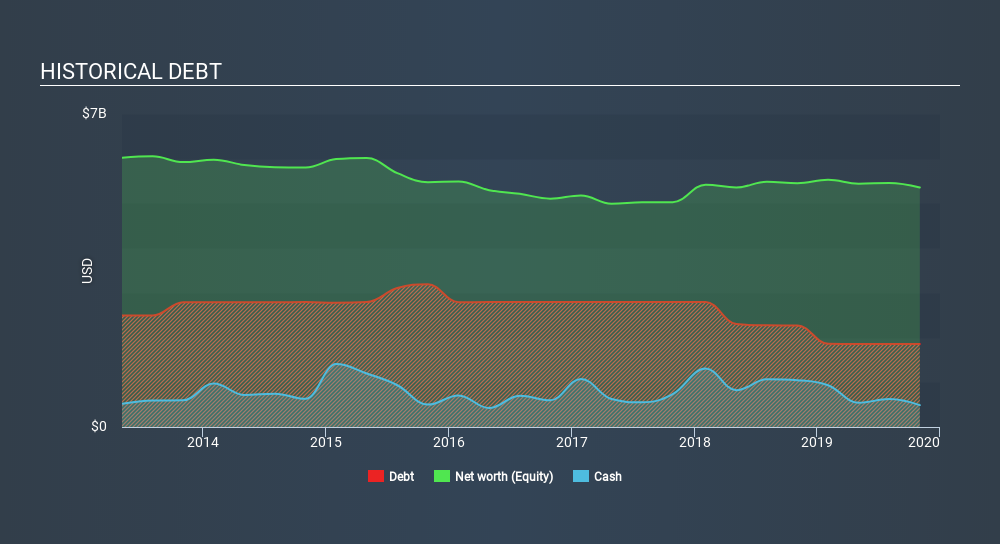
How Healthy Is Kohl's's Balance Sheet?
The latest balance sheet data shows that Kohl's had liabilities of US$4.08b due within a year, and liabilities of US$6.31b falling due after that. Offsetting this, it had US$490.0m in cash and US$29.0m in receivables that were due within 12 months. So its liabilities total US$9.87b more than the combination of its cash and short-term receivables.
Given this deficit is actually higher than the company's market capitalization of US$6.86b, we think shareholders really should watch Kohl's's debt levels, like a parent watching their child ride a bike for the first time. Hypothetically, extremely heavy dilution would be required if the company were forced to pay down its liabilities by raising capital at the current share price.
We measure a company's debt load relative to its earnings power by looking at its net debt divided by its earnings before interest, tax, depreciation, and amortization (EBITDA) and by calculating how easily its earnings before interest and tax (EBIT) cover its interest expense (interest cover). The advantage of this approach is that we take into account both the absolute quantum of debt (with net debt to EBITDA) and the actual interest expenses associated with that debt (with its interest cover ratio).
While Kohl's's low debt to EBITDA ratio of 0.62 suggests only modest use of debt, the fact that EBIT only covered the interest expense by 5.9 times last year does give us pause. So we'd recommend keeping a close eye on the impact financing costs are having on the business. The bad news is that Kohl's saw its EBIT decline by 16% over the last year. If earnings continue to decline at that rate then handling the debt will be more difficult than taking three children under 5 to a fancy pants restaurant. There's no doubt that we learn most about debt from the balance sheet. But ultimately the future profitability of the business will decide if Kohl's can strengthen its balance sheet over time. So if you're focused on the future you can check out this free report showing analyst profit forecasts.
Finally, a company can only pay off debt with cold hard cash, not accounting profits. So the logical step is to look at the proportion of that EBIT that is matched by actual free cash flow. Over the last three years, Kohl's recorded free cash flow worth a fulsome 88% of its EBIT, which is stronger than we'd usually expect. That puts it in a very strong position to pay down debt.
Our View
On the face of it, Kohl's's EBIT growth rate left us tentative about the stock, and its level of total liabilities was no more enticing than the one empty restaurant on the busiest night of the year. But on the bright side, its conversion of EBIT to free cash flow is a good sign, and makes us more optimistic. Once we consider all the factors above, together, it seems to us that Kohl's's debt is making it a bit risky. Some people like that sort of risk, but we're mindful of the potential pitfalls, so we'd probably prefer it carry less debt. There's no doubt that we learn most about debt from the balance sheet. But ultimately, every company can contain risks that exist outside of the balance sheet. Be aware that Kohl's is showing 2 warning signs in our investment analysis , you should know about...
When all is said and done, sometimes its easier to focus on companies that don't even need debt. Readers can access a list of growth stocks with zero net debt 100% free, right now.
If you spot an error that warrants correction, please contact the editor at editorial-team@simplywallst.com. This article by Simply Wall St is general in nature. It does not constitute a recommendation to buy or sell any stock, and does not take account of your objectives, or your financial situation. Simply Wall St has no position in the stocks mentioned.
We aim to bring you long-term focused research analysis driven by fundamental data. Note that our analysis may not factor in the latest price-sensitive company announcements or qualitative material. Thank you for reading.
About NYSE:KSS
Kohl's
Operates as an omnichannel retailer in the United States.
Undervalued second-rate dividend payer.
Similar Companies
Market Insights


Advertisement
Weekly Picks
ST


stuart_roberts on Upside Gold ·
An Undervalued 3.3Moz Gold Project in Canada
Fair Value:CA$5.0775.1% undervalued
107 followersusers have followed this narrative
1 commentusers have commented on this narrative
18 likesusers have liked this narrative
YA

Yang_ on SoFi Technologies ·
SoFi Technologies: The Apex Aggregator and the Infrastructure of the Modern Financial System
Fair Value:US$22.9819.4% undervalued
32 followersusers have followed this narrative
0 commentsusers have commented on this narrative
28 likesusers have liked this narrative
KO

Kouj on CSL ·
CSL: The Dip Is the Opportunity
Fair Value:AU$1558.0% undervalued
13 followersusers have followed this narrative
0 commentsusers have commented on this narrative
11 likesusers have liked this narrative
GA

GavrielH on DHT Holdings ·
DHT Holdings, inc: Strait of Hormuz Risk Amidst US-Israel vs Iran Tensions Spikes VLCC Rates.
Fair Value:US$3650.4% undervalued
12 followersusers have followed this narrative
0 commentsusers have commented on this narrative
6 likesusers have liked this narrative
Recently Updated Narratives
MA


MarkoVT on ANYCOLOR ·
Near zero debt, Japan centric focus provides future growth
Fair Value:JP¥8.25k50.8% undervalued
3 followersusers have followed this narrative
0 commentsusers have commented on this narrative
1 likeusers have liked this narrative
KR

Kri on Wesfarmers ·
Wesfarmers Limited is a high-quality, stable long-term compounder, though it often trades at a premium valuation.
Fair Value:AU$61.1723.9% overvalued
1 followerusers have followed this narrative
0 commentsusers have commented on this narrative
0 likesusers have liked this narrative
GR

greguman on IonQ ·
IonQ: Exceptional Technology but Valuation Far Ahead of Financial Reality
Fair Value:US$5.06577.3% overvalued
1 followerusers have followed this narrative
0 commentsusers have commented on this narrative
0 likesusers have liked this narrative
Popular Narratives
KA

kabz2342 on Nu Holdings ·
Nu holdings will continue to disrupt the South American banking market
Fair Value:US$64.377.5% undervalued
52 followersusers have followed this narrative
3 commentsusers have commented on this narrative
27 likesusers have liked this narrative
AN


AnalystConsensusTarget on Microsoft ·
Analyst Commentary Highlights Microsoft AI Momentum and Upward Valuation Amid Growth and Competitive Risks
Fair Value:US$59632.1% undervalued
1306 followersusers have followed this narrative
2 commentsusers have commented on this narrative
10 likesusers have liked this narrative
AN

AnalystConsensusTarget on NVIDIA ·
NVDA: Expanding AI Demand Will Drive Major Data Center Investments Through 2026
Fair Value:US$253.0226.5% undervalued
1103 followersusers have followed this narrative
7 commentsusers have commented on this narrative
34 likesusers have liked this narrative

