

Last Update 20 Jul 26
Fair value Increased 2k%CRIS: Future Profitability Execution Will Rely On TakeAim CLL Trial Progress
Analysts have sharply increased their price target on Curis, raising fair value from $14 to $280. They cite improved leadership, a more focused direct-to-consumer approach, and potential benefits from underappreciated tariff changes as key factors behind the reassessment.
Analyst Commentary
Analysts covering Curis are reacting to the sharp change in fair value with a mix of optimism around execution and leadership, and caution around how much of this improvement is already reflected in the stock.
Bullish Takeaways
- Bullish analysts point to improved leadership at Curis as a core reason for reassessing fair value, arguing that clearer decision making can support more consistent execution against growth plans.
- The increased focus on direct to consumer channels is viewed as a way for Curis to gain more control over pricing, branding, and customer data. These analysts see this as supportive of higher long term margins.
- Some bullish analysts see underappreciated upside from tariff changes, suggesting that lower cost pressures could give Curis room to protect or expand profitability if managed carefully.
- The step up in fair value estimates, from US$14 to US$280, is framed by bullish analysts as a repricing of Curis toward what they view as a more realistic reflection of its revised model and leadership profile. They emphasize that this is not intended as a short term trading call.
Bearish Takeaways
- Bearish analysts question how much of the leadership and direct to consumer thesis is already embedded in the new fair value. They warn that execution missteps could quickly challenge such a large valuation reset.
- There is caution that benefits from tariff changes may be less predictable in practice, especially if competitive responses or future policy shifts limit how much Curis can keep in improved margins.
- Some cautious voices highlight that a large gap between current trading levels and revised fair value can cut both ways. This may create pressure on Curis to consistently hit operational milestones to justify the higher valuation framework.
- Bearish analysts also flag the risk that focusing heavily on direct to consumer channels could require higher marketing and technology spend, which, if not well controlled, may offset some of the margin benefits assumed in more optimistic models.
What’s in the News for Curis
- Curis consented the first six patients in its TakeAim CLL Phase 2 study, combining emavusertib with BTK inhibitor zanubrutinib to pursue dual NF-kB pathway blockade in chronic lymphocytic leukemia, with initial CLL data guided for December 2026. (Source: Company announcement, TakeAim CLL study)
- Eleven clinical sites have opened for enrollment in the TakeAim CLL study, and Curis has reaffirmed guidance to dose five CLL patients by the end of July 2026. (Source: Company announcement, TakeAim CLL study)
- Emavusertib is being evaluated across multiple studies, including TakeAim Lymphoma in combination with BTK inhibitor ibrutinib in relapsed or refractory primary central nervous system lymphoma. It has received Orphan Drug Designation in PCNSL, AML and MDS in the U.S. and PCNSL in the EU. (Source: Company key developments)
- Curis stockholders approved a reverse stock split at a ratio between 1 for 5 and 1 for 25, with the board given discretion on the final ratio as part of efforts tied to maintaining compliance with Nasdaq listing rules. (Source: June 25, 2026 special meeting)
- Curis received a Delist Determination Letter from Nasdaq related to the $1.00 bid price requirement and has indicated an intention to request a hearing, which would stay delisting actions while the process plays out. (Source: Nasdaq listing correspondence)
Valuation Changes for Curis
- Fair Value: Revised from $14 to $280, representing a very large reset in the implied long term valuation framework for Curis.
- Discount Rate: Adjusted slightly higher from 7.29% to 7.37%, reflecting a modest change in the assumed risk profile.
- Revenue Growth: Held essentially flat at about 92.96%, indicating no material change in the modeled top line expansion rate.
- Net Profit Margin: Trimmed from 18.98% to 17.20%, indicating slightly more conservative expectations for future profitability.
- Future P/E: Reduced from 88.0x to 79.4x, indicating a somewhat lower earnings multiple being used in the updated Curis valuation.
Key Takeaways
- Advancing a key therapy in multiple cancer types and expanding its use could unlock major new markets and drive long-term revenue growth.
- Strategic cost controls and externally funded trials are minimizing cash burn while maximizing pipeline value and supporting future profitability.
- Heavy reliance on a single clinical asset and lack of approved products expose Curis to substantial risk from setbacks, competition, and challenging funding and regulatory environments.
Catalysts
About Curis- A biotechnology company, engages in the discovery and development of drug candidates for the treatment of human cancers in the United States.
- Progress toward pivotal clinical data and potential accelerated approvals for emavusertib in hematologic cancers (PCNSL, CLL, AML, and MDS) may unlock significant new market opportunities, supporting future revenue growth as global cancer incidence rises and demand for innovative therapies expands.
- Expansion of emavusertib into additional indications and combinations, including with BTK inhibitors and standard-of-care regimens, positions the company to benefit from the increasing clinical adoption of targeted/precision oncology, amplifying potential earnings and long-term addressable markets.
- Ongoing investigator-sponsored trials in various solid tumor types-funded externally-could yield additional value-creating data with minimal cash burn, thereby increasing pipeline optionality and de-risking future earnings without materially impacting current net margins or requiring large R&D expenditures.
- Sustained KOL interest, positive regulatory interactions, and the prospect of supportive expedited approval pathways in areas of high unmet need (e.g., PCNSL) may accelerate time-to-market, driving earlier revenue realization and improving operating leverage.
- Recent R&D and G&A cost reductions demonstrate strategic financial discipline, potentially extending the cash runway and limiting near-term dilution, setting the stage for improved operating margins as key pipeline assets mature and approach commercialization.
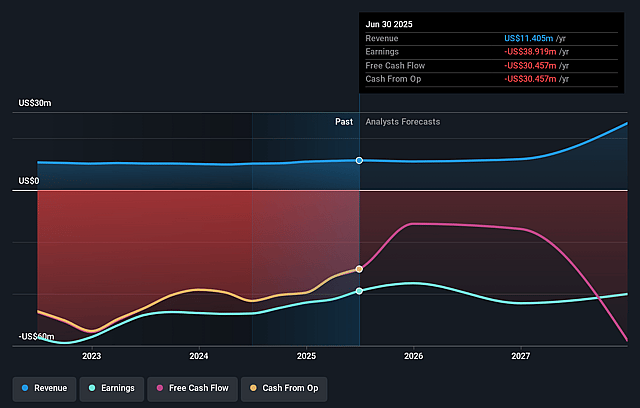
Curis Future Earnings and Revenue Growth
Assumptions
How have these above catalysts been quantified?
- Analysts are assuming Curis's revenue will grow by 93.0% annually over the next 3 years.
- Analysts are not forecasting that Curis will become profitable in next 3 years. To represent the Analyst Price Target as a Future PE Valuation we will estimate Curis's profit margin will increase from -299.7% to the average US Biotechs industry of 17.2% in 3 years.
- If Curis's profit margin were to converge on the industry average, you could expect earnings to reach $8.7 million (and earnings per share of $3.66) by about July 2029, up from -$21.2 million today. However, there is a considerable amount of disagreement amongst the analysts with the most bullish expecting $16.1 million in earnings, and the most bearish expecting $-92.2 million.
- In order for the above numbers to justify the price target of the analysts, the company would need to trade at a PE ratio of 94.8x on those 2029 earnings, up from -0.4x today. This future PE is greater than the current PE for the US Biotechs industry at 17.3x.
- Analysts expect the number of shares outstanding to grow by 7.0% per year for the next 3 years.
- To value all of this in today's terms, we will use a discount rate of 7.37%, as per the Simply Wall St company report.
Risks
What could happen that would invalidate this narrative?- Curis's heavy reliance on a single lead asset, emavusertib, with nearly all clinical and business updates centered around its progress, exposes the company-and thus its future revenues-to significant binary risk if clinical, regulatory, or competitive setbacks occur in any of its targeted indications.
- The persistent lack of commercial-stage or approved products, coupled with ongoing net losses and limited cash runway (estimated to last only into Q1 2026), increases the likelihood of secondary equity offerings or dilutive financing, which can pressure future earnings per share and depress share price.
- Increasing competition in Curis's key markets-such as CLL, NHL, and AML-from emerging therapies (BTK degraders, next-gen BCL2 inhibitors, and newer BTKis like tirabrutinib)-raises the risk that Curis's products, even if approved, will struggle to achieve meaningful market share, limiting long-term revenue growth.
- The highly challenging regulatory environment in oncology-characterized by evolving FDA standards, uncertainty in accelerated approval pathways, and greater requirements for demonstrating clinical benefit-could delay product approvals and force costly additional studies, extending timelines to revenue generation and straining net margins.
- Macro trends such as rising R&D costs, ongoing industry-wide financial constraints, and the need to prioritize trials with limited internal capital may constrain Curis from fully exploiting its pipeline, leading to slow pipeline advancement, chronic negative net margins, and delayed or reduced revenue realization.
Valuation
How have all the factors above been brought together to estimate a fair value?
- The analysts have a consensus price target of $280.0 for Curis based on their expectations of its future earnings growth, profit margins and other risk factors.
- However, there is a degree of disagreement amongst analysts, with the most bullish reporting a price target of $400.0, and the most bearish reporting a price target of just $100.0.
- In order for you to agree with the analysts, you'd need to believe that by 2029, revenues will be $50.7 million, earnings will come to $8.7 million, and it would be trading on a PE ratio of 94.8x, assuming you use a discount rate of 7.4%.
- Given the current share price of $4.52, the analyst price target of $280.0 is 98.4% higher.
- We always encourage you to reach your own conclusions though. So sense check these analyst numbers against your own assumptions and expectations based on your understanding of the business and what you believe is probable.
Have other thoughts on Curis?
Create your own narrative on this stock, and estimate its Fair Value using our Valuator tool.
Create NarrativeHow well do narratives help inform your perspective?
Disclaimer
AnalystConsensusTarget is a tool utilizing a Large Language Model (LLM) that ingests data on consensus price targets, forecasted revenue and earnings figures, as well as the transcripts of earnings calls to produce qualitative analysis. The narratives produced by AnalystConsensusTarget are general in nature and are based solely on analyst data and publicly-available material published by the respective companies. These scenarios are not indicative of the company's future performance and are exploratory in nature. Simply Wall St has no position in the company(s) mentioned. Simply Wall St may provide the securities issuer or related entities with website advertising services for a fee, on an arm's length basis. These relationships have no impact on the way we conduct our business, the content we host, or how our content is served to users. The price targets and estimates used are consensus data, and do not constitute a recommendation to buy or sell any stock, and they do not take account of your objectives, or your financial situation. Note that AnalystConsensusTarget's analysis may not factor in the latest price-sensitive company announcements or qualitative material.


