

Last Update 19 Aug 26
Fair value Increased 2.58%ULVR: Mid Term Volume And Margin Risks Will Likely Restrain Upside
Unilever's analyst fair value estimate has been lifted by about £1 to £40.73. Analysts point to recent price target increases that reflect stronger volume-led sales, slightly higher revenue growth and profit margin assumptions, and a modestly lower future P/E.
Analyst Commentary
Recent research on Unilever highlights a split in sentiment. Some analysts focus on volume-led upside and higher earnings estimates, while more cautious voices point to ongoing execution risks and pressure on the long term investment case.
One group of bearish analysts lifted their target price to 3,800 GBp from 3,700 GBp, yet kept an Underperform stance. Their view reflects concerns that future comparisons could become tougher, which they see as a potential headwind for Unilever's ability to sustain volume and margin ambitions over the medium term.
These cautious views sit alongside more constructive reports that followed the most recent quarterly update. Research citing a 300 basis point beat on volume and mix in Q2 and a volume-led sales beat of 5.8% versus consensus 4.3% also referenced small upward adjustments to earnings expectations over 2026 to 2028. Those more optimistic takes, however, do not remove the valuation and execution questions raised by bearish analysts.
Bearish Takeaways
- Bearish analysts still see Unilever's core valuation as exposed to medium term volume and margin risks, even after a small increase in their target price.
- They highlight tougher earnings and sales comparisons beyond the near term, which could limit the company's ability to sustain volume and mix growth above 2% in later periods.
- Concerns focus on whether Unilever can consistently deliver on its volume and margin ambitions, which they believe could weigh on investor confidence if execution falls short.
- This cautious stance suggests some investors may continue to question the upside in the current P/E, given perceived risks around growth durability and profitability targets.
What’s in the News for Unilever
- Ben & Jerry’s co founder Ben Cohen is publicly criticizing Unilever, which owns Magnum and Ben & Jerry’s, accusing the company of abandoning the brand’s original social mission and weakening its independent board. He has launched a "Free Ben & Jerry’s" campaign that calls for a sale to investors aligned with the brand’s founding values. Source, recent profile and interview coverage.
- Unilever plans to develop a new Global Innovation Center in New Haven, Connecticut, with total public and private investment expected to exceed $300m. The site will replace the long running Trumbull facility by spring 2029 and will concentrate on personal care, beauty and wellbeing research, including a global center for skin care and cleansing and a human performance lab. Source, company business expansion announcement.
- The New Haven Global Innovation Center will bring about 300 employees under one roof and consolidate formulation, fragrance creation, packaging design and consumer insights. The facility is described as digital first and AI powered and is positioned in a large biosciences cluster with access to universities and research partners. Source, company business expansion announcement.
- Unilever has expanded its use of AI enabled digital twins in partnership with Accenture across multiple factories. Reported examples include lower thermal energy use at a detergents plant in India, reduced waste and higher capacity in deodorant production in the United States, and fewer quality defects for Dove soap in India. Source, company client announcement.
- Unilever was an early partner in Fetch Rewards’ launch of an opt in rewarded video format that targets shoppers after they scan receipts in the app. The format uses purchase based targeting and charges advertisers on completed views, and Unilever participated in the alpha test to offer rewards to consumers who watched branded video content. Source, client announcement from Fetch Rewards.
Valuation Changes for Unilever
- Fair Value increased slightly from £39.71 to £40.73.
- The Discount Rate rose modestly from 7.93% to 8.19%.
- Euro revenue growth was adjusted from 2.74% to 3.00%.
- Euro profit margin moved from 13.48% to 13.62%.
- The future P/E ratio was reduced from 17.24x to 16.60x.
Key Takeaways
- Shifting consumer preferences and increased regulatory pressure on sustainability threaten Unilever's brand appeal, raise costs, and challenge long-term profit growth.
- Heavy emerging market exposure and rising competition from private labels and agile digital brands create earnings volatility and increase market share and margin risks.
- Strategic focus on premium segments, innovation, operational efficiency, and digital channels is enhancing Unilever's margins, market share, and resilience for sustained revenue growth.
Catalysts
About Unilever- Operates as a fast-moving consumer goods company in the Asia Pacific, Africa, the Americas, and Europe.
- Rising consumer preference for natural, locally produced, or clean-label products is likely to undermine the demand for Unilever's established global brands over the long term, constraining top-line growth and reducing future revenue opportunities despite current innovation efforts.
- Heightened regulatory scrutiny and public pressure regarding plastic waste, carbon emissions, and water usage are set to drive up compliance and operational costs for Unilever as sustainability expectations increase globally, putting sustained downward pressure on net margins and profit growth.
- Heavy reliance on emerging markets for expansion exposes Unilever to ongoing foreign exchange headwinds, currency devaluation (as evidenced by negative currency impact on turnover), and macroeconomic volatility, creating long-term unpredictability in reported earnings and making sustainable earnings growth less certain.
- The rapid expansion of private label and direct-to-consumer brands, enabled by e-commerce and digital disruption, is likely to accelerate price competition and erode Unilever's market share, particularly as smaller, agile players reach consumers directly, threatening volume growth and compressing operating margins.
- Supply chain complexity and ongoing restructuring efforts, including the costly spin-off of the Ice Cream division and multiple recent M&A and divestiture activities, introduce execution risk, potential inefficiencies, and possible restructuring charges-creating persistent drag on free cash flow and diminishing the potential for consistent improvement in return on invested capital.
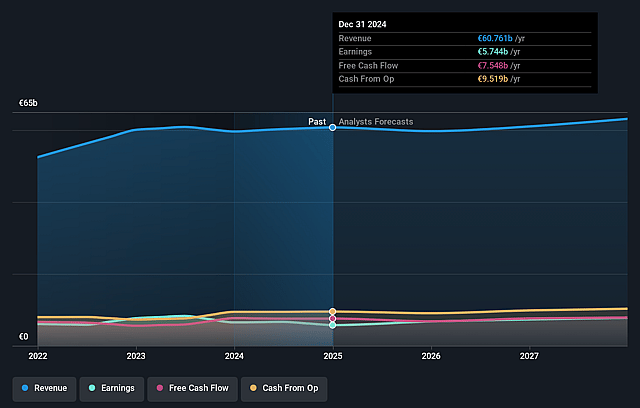
Unilever Future Earnings and Revenue Growth
Assumptions
How have these above catalysts been quantified?
- This narrative explores a more pessimistic perspective on Unilever compared to the consensus, based on a Fair Value that aligns with the bearish cohort of analysts.
- The bearish analysts are assuming Unilever's revenue will grow by 3.0% annually over the next 3 years.
- The bearish analysts assume that profit margins will increase from 11.1% today to 13.6% in 3 years time.
- The bearish analysts expect earnings to reach €7.5 billion (and earnings per share of €3.4) by about August 2029, up from €5.6 billion today. The analysts are largely in agreement about this estimate.
- In order for the above numbers to justify the price target of the more bearish analyst cohort, the company would need to trade at a PE ratio of 16.6x on those 2029 earnings, down from 20.8x today. This future PE is lower than the current PE for the US Personal Products industry at 20.6x.
- The bearish analysts expect the number of shares outstanding to decline by 1.2% per year for the next 3 years.
- To value all of this in today's terms, we will use a discount rate of 8.19%, as per the Simply Wall St company report.
Risks
What could happen that would invalidate this narrative?- Unilever's strong volume and sales growth across developed markets, particularly the United States and Europe, as well as early signs of recovery in India and Asia Pacific, could provide a solid base for sustained or growing revenues, counteracting a long-term share price decline.
- The company's transformation strategy includes portfolio optimization, focus on higher-margin segments such as Beauty & Wellbeing and Personal Care, and targeted acquisitions of innovative brands in premium and natural spaces, all of which are designed to structurally lift net profit margins and improve earnings quality.
- Investments in brand building and marketing (at 15-16% of sales, a structurally higher level than before) are already strengthening category positions-market share gains in the US, Europe, and India indicate Unilever is effectively defending its pricing power and brand equity, which may sustain or grow net revenues.
- Operational excellence initiatives such as end-to-end productivity programs and disciplined cost control are delivering significant procurement and supply chain savings, supporting ongoing gross margin expansion and ensuring resilience in earnings and cash flow over the medium term.
- Accelerating exposure to long-term secular growth vectors-including premiumization, digital commerce, and the rise of health and wellbeing categories-along with strong performance and share gains in e-commerce and quick commerce channels, could drive topline expansion and support attractive returns on invested capital.
Valuation
How have all the factors above been brought together to estimate a fair value?
- The assumed bearish price target for Unilever is £40.73, which represents up to two standard deviations below the consensus price target of £52.49. This valuation is based on what can be assumed as the expectations of Unilever's future earnings growth, profit margins and other risk factors from analysts on the more bearish end of the spectrum.
- However, there is a degree of disagreement amongst analysts, with the most bullish reporting a price target of £60.01, and the most bearish reporting a price target of just £39.01.
- In order for you to agree with the more bearish analyst cohort, you'd need to believe that by 2029, revenues will be €55.3 billion, earnings will come to €7.5 billion, and it would be trading on a PE ratio of 16.6x, assuming you use a discount rate of 8.2%.
- Given the current share price of £46.38, the analyst price target of £40.73 is 13.9% lower. Despite analysts expecting the underlying business to improve, they seem to believe the market's expectations are too high.
- We always encourage you to reach your own conclusions though. So sense check these analyst numbers against your own assumptions and expectations based on your understanding of the business and what you believe is probable.
Have other thoughts on Unilever?
Create your own narrative on this stock, and estimate its Fair Value using our Valuator tool.
Create NarrativeHow well do narratives help inform your perspective?
Comments
0 commentsDisclaimer
AnalystLowTarget is a tool utilizing a Large Language Model (LLM) that ingests data on consensus price targets, forecasted revenue and earnings figures, as well as the transcripts of earnings calls to produce qualitative analysis. The narratives produced by AnalystLowTarget are general in nature and are based solely on analyst data and publicly-available material published by the respective companies. These scenarios are not indicative of the company's future performance and are exploratory in nature. Simply Wall St has no position in the company(s) mentioned. Simply Wall St may provide the securities issuer or related entities with website advertising services for a fee, on an arm's length basis. These relationships have no impact on the way we conduct our business, the content we host, or how our content is served to users. The price targets and estimates used are consensus data, and do not constitute a recommendation to buy or sell any stock, and they do not take account of your objectives, or your financial situation. Note that AnalystLowTarget's analysis may not factor in the latest price-sensitive company announcements or qualitative material.


