
Advertisement
Should You Be Adding Seagate Technology (NASDAQ:STX) To Your Watchlist Today?
For beginners, it can seem like a good idea (and an exciting prospect) to buy a company that tells a good story to investors, even if it completely lacks a track record of revenue and profit. Unfortunately, high risk investments often have little probability of ever paying off, and many investors pay a price to learn their lesson.
So if you're like me, you might be more interested in profitable, growing companies, like Seagate Technology (NASDAQ:STX). Now, I'm not saying that the stock is necessarily undervalued today; but I can't shake an appreciation for the profitability of the business itself. While a well funded company may sustain losses for years, unless its owners have an endless appetite for subsidizing the customer, it will need to generate a profit eventually, or else breathe its last breath.
Check out our latest analysis for Seagate Technology
How Fast Is Seagate Technology Growing Its Earnings Per Share?
In the last three years Seagate Technology's earnings per share took off like a rocket; fast, and from a low base. So the actual rate of growth doesn't tell us much. As a result, I'll zoom in on growth over the last year, instead. Like the last firework on New Year's Eve accelerating into the sky, Seagate Technology's EPS shot from US$4.09 to US$7.13, over the last year. You don't see 74% year-on-year growth like that, very often.
I like to take a look at earnings before interest and (EBIT) tax margins, as well as revenue growth, to get another take on the quality of the company's growth. While Seagate Technology may have maintained EBIT margins over the last year, revenue has fallen. Suffice it to say that is not a great sign of growth.
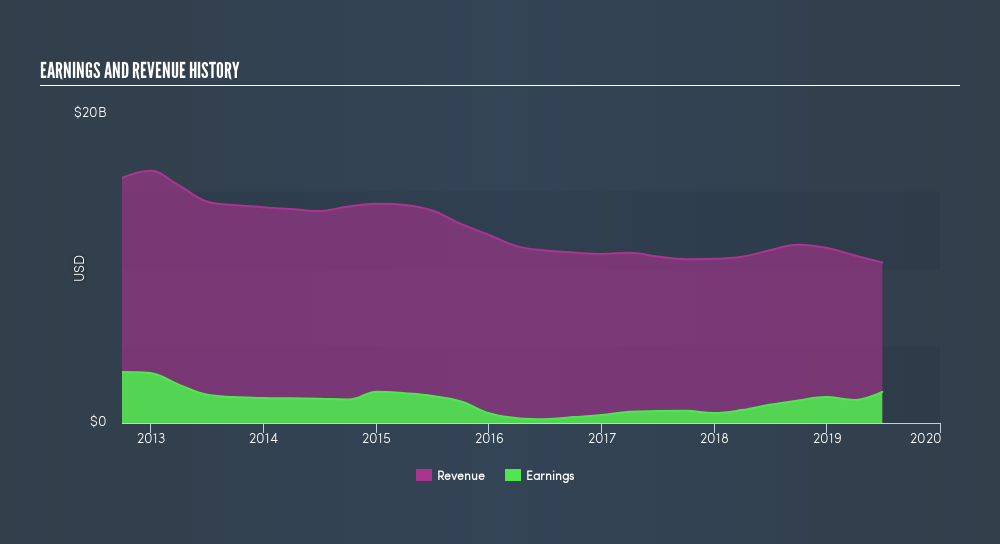
While we live in the present moment at all times, there's no doubt in my mind that the future matters more than the past. So why not check this interactive chart depicting future EPS estimates, for Seagate Technology?
Are Seagate Technology Insiders Aligned With All Shareholders?
Since Seagate Technology has a market capitalization of US$12b, we wouldn't expect insiders to hold a large percentage of shares. But we are reassured by the fact they have invested in the company. With a whopping US$74m worth of shares as a group, insiders have plenty riding on the company's success. That's certainly enough to make me think that management will be very focussed on long term growth.
It's good to see that insiders are invested in the company, but are remuneration levels reasonable? Well, based on the CEO pay, I'd say they are indeed. For companies with market capitalizations over US$8.0b, like Seagate Technology, the median CEO pay is around US$11m.
Seagate Technology offered total compensation worth US$9.3m to its CEO in the year to June 2018. That comes in below the average for similar sized companies, and seems pretty reasonable to me. While the level of CEO compensation isn't a huge factor in my view of the company, modest remuneration is a positive, because it suggests that the board keeps shareholder interests in mind. It can also be a sign of good governance, more generally.
Is Seagate Technology Worth Keeping An Eye On?
Seagate Technology's earnings per share growth have been levitating higher, like a mountain goat scaling the Alps. The sweetener is that insiders have a mountain of stock, and the CEO remuneration is quite reasonable. The sharp increase in earnings could signal good business momentum. Seagate Technology certainly ticks a few of my boxes, so I think it's probably well worth further consideration. Once you've identified a business you like, the next step is to consider what you think it's worth. And right now is your chance to view our exclusive discounted cashflow valuation of Seagate Technology. You might benefit from giving it a glance today.
Although Seagate Technology certainly looks good to me, I would like it more if insiders were buying up shares. If you like to see insider buying, too, then this free list of growing companies that insiders are buying, could be exactly what you're looking for.
Please note the insider transactions discussed in this article refer to reportable transactions in the relevant jurisdiction
We aim to bring you long-term focused research analysis driven by fundamental data. Note that our analysis may not factor in the latest price-sensitive company announcements or qualitative material.
If you spot an error that warrants correction, please contact the editor at editorial-team@simplywallst.com. This article by Simply Wall St is general in nature. It does not constitute a recommendation to buy or sell any stock, and does not take account of your objectives, or your financial situation. Simply Wall St has no position in the stocks mentioned. Thank you for reading.
Market Insights


Advertisement
Weekly Picks
DA


davidlsander on Optimi Health ·
OPTH: A licensed manufacturer already selling MDMA while peers still wait on trials
Fair Value:US$1261.0% undervalued
15 followersusers have followed this narrative
0 commentsusers have commented on this narrative
2 likesusers have liked this narrative
FU

FundamentalFlow on Vertiv Holdings Co ·
The Short and Long Term Compounder of Liquid Cooling industry.
Fair Value:US$45037.4% undervalued
17 followersusers have followed this narrative
0 commentsusers have commented on this narrative
4 likesusers have liked this narrative
JO


John_Eric on SPX Technologies ·
I Fell in Love With a Data-Center Cooling Stock. Then I Opened the Filings.
Fair Value:US$2036.8% overvalued
8 followersusers have followed this narrative
1 commentusers have commented on this narrative
4 likesusers have liked this narrative
TR


tripledub on GQG Partners ·
The Cheap Genius Problem
Fair Value:AU$2.4540.0% undervalued
17 followersusers have followed this narrative
0 commentsusers have commented on this narrative
18 likesusers have liked this narrative
Recently Updated Narratives
JO

Jobeda on MSCI ·
MSCI's Impressive 7.99% Revenue Growth and the Path to Future Gains
Fair Value:US$762.5826.3% undervalued
1 followerusers have followed this narrative
0 commentsusers have commented on this narrative
0 likesusers have liked this narrative
NE

NeuralAlpha on NVIDIA ·
NVIDIA: The Indispensable Backbone of the AI Revolution
Fair Value:US$25013.0% undervalued
21 followersusers have followed this narrative
4 commentsusers have commented on this narrative
0 likesusers have liked this narrative
CO

CoksiBoy on Cisco Systems ·
AI Workforce Rollout
Fair Value:US$14516.9% undervalued
1 followerusers have followed this narrative
0 commentsusers have commented on this narrative
0 likesusers have liked this narrative
Popular Narratives
OS

oscargarcia on NVIDIA ·
The company that went from selling GPUs to gamers to becoming the AI arms dealer of the 21st century.
Fair Value:US$28022.3% undervalued
297 followersusers have followed this narrative
9 commentsusers have commented on this narrative
16 likesusers have liked this narrative
CU

CubanEros on Microsoft ·
A wonderful business at reasonable price.
Fair Value:US$419.9120.0% overvalued
159 followersusers have followed this narrative
0 commentsusers have commented on this narrative
8 likesusers have liked this narrative
KI

KiwiInvest on Amazon.com ·
Amazon's high growth, high tech segments propel its profits, while traditional segments plod along
Fair Value:US$475.0942.7% undervalued
178 followersusers have followed this narrative
1 commentusers have commented on this narrative
8 likesusers have liked this narrative
Trending Discussion

IA

ian_oii7z on Woodside Energy Group ·
Hey James! Thank you but I am not sure if I am reading this correctly as your analysis opens with "At A$36.602 per share, Woodside Energy Group (ASX: WDS) appears reasonably valued based on its existing operations and near-term production growth." I would like to say that the last time that WDS was above $36.00 per share was in October 2023, so I am a little confused by your statement w.r.t. current prices etc . Can you please explain?
1
|0