Advertisement
- United States
- /
- Software
- /
- NasdaqGS:QBTS
Does CHIPS Act Funding Change The Bull Case For D Wave Quantum (QBTS)?
SI

Reviewed by Sasha Jovanovic
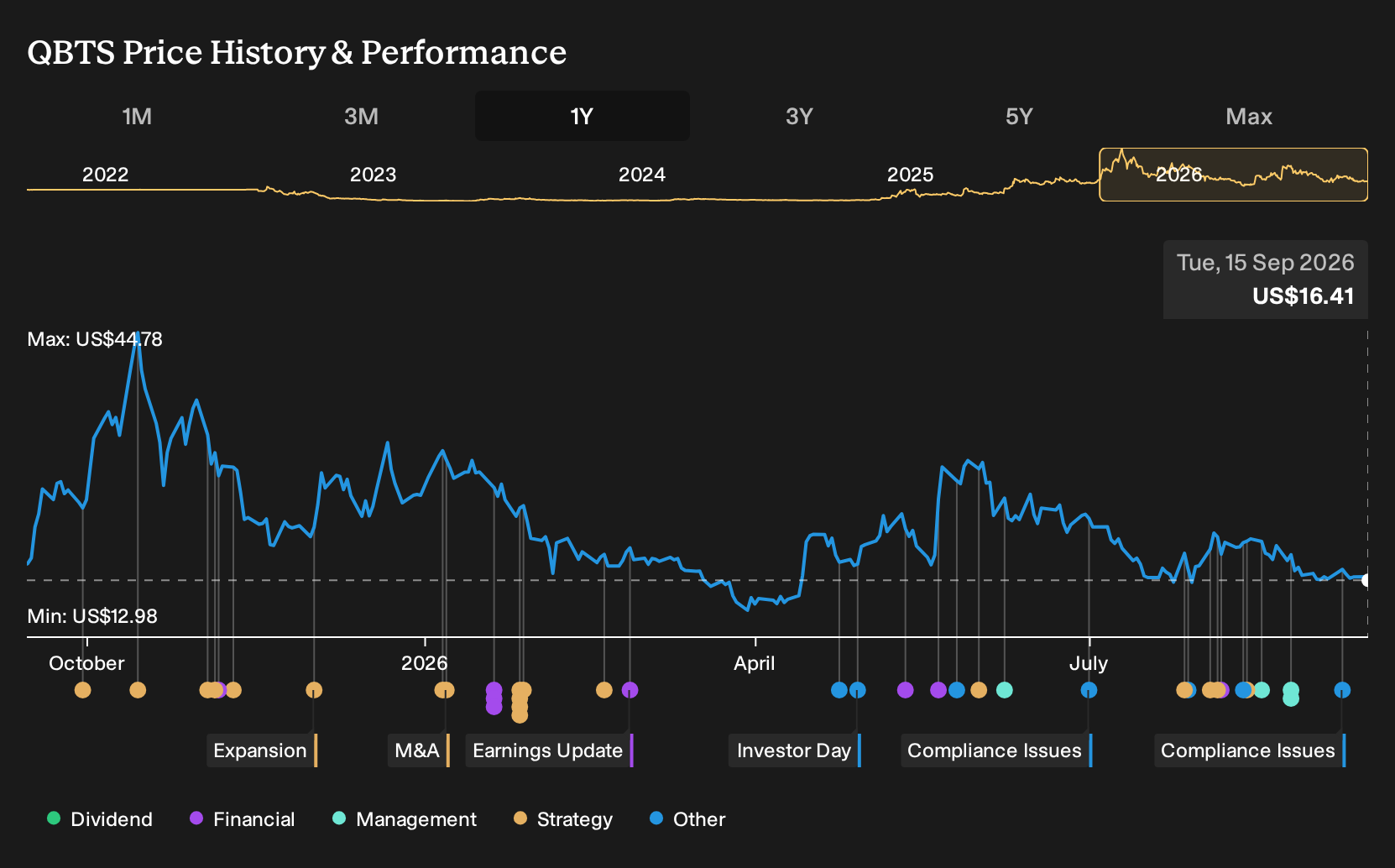
- D-Wave Quantum executed a definitive agreement with the U.S. Department of Commerce in September 2026, giving the company access to up to US$100 million in CHIPS and Science Act funding to advance its annealing and gate model quantum systems.
- The funding structure includes a minority, non controlling equity stake for the U.S. government and supports development of large scale qubit systems aimed at real world optimization, AI and quantum chemistry workloads, which directly ties federal support to D-Wave Quantum’s commercialization efforts.
- We will examine how D-Wave Quantum’s investment narrative is influenced by CHIPS Act funding that is tied to a registered government equity stake.
D-Wave Quantum Investment Narrative Recap
D-Wave Quantum appeals to investors who believe superconducting quantum hardware and hybrid cloud services can turn today’s niche pilots into broader commercial use. Access to CHIPS Act funding helps the company pursue larger annealing and gate model systems without relying solely on high ticket system deals. The key near term swing factor remains the conversion of proof of concepts into repeatable QCaaS contracts.
The biggest operational risk is a widening loss profile if rising R&D and go to market spending does not translate into more predictable usage based revenue. The minority government equity stake and potential resale overhang add share price volatility. The news does not change that execution on customer adoption remains the central question.
The registration of 7.1 million shares held by the U.S. Department of Commerce ties directly into this CHIPS Act agreement. That filing does not dilute existing holders, but it introduces an overhang that can weigh on the stock while investors follow the pace and timing of any government sales linked to funding drawdowns.
In terms of catalysts, the critical issue is whether the CHIPS backed build out of 100,000 qubit annealing and 10,000 qubit gate model systems helps D-Wave Quantum secure more production workloads across optimization, materials and AI. The share registration underscores that access to this capital comes with capital structure complexity, which sits alongside commercialization progress as a key factor to monitor.
D-Wave Quantum's narrative projects US$201.1 million revenue and US$23.0 million earnings by 2029. This aligns with analyst assumptions of very large yearly revenue growth of 152.9% and an earnings improvement of about US$271.7 million from a current loss of US$248.7 million.
Discover how D-Wave Quantum's fair value indicates a 115% potential upside to its current price that may not last much longer.
Exploring Other Perspectives
For D-Wave Quantum, the bearish analysts focus on execution risk rather than CHIPS funding upside. They worry that slower adoption could leave 2029 revenue closer to US$137.2 million and earnings around US$15.9 million, well below the consensus story. That gap shows how sharply opinions can differ, so explore these competing views before reacting to the new agreement.
Explore 11 other D-Wave Quantum fair value estimates, including one that suggests as much as 85% downside from the current price.
Reach Your Own Conclusion
Don't just follow the ticker. Dig into the data and build a conviction that's truly your own.
- A great starting point for your D-Wave Quantum research is our analysis highlighting 1 key reward and 2 important warning signs that could impact your investment decision.
- See our latest analysis for D-Wave Quantum. The report includes a comprehensive fundamental analysis summarized in a single visual, the Snowflake, making it easy to evaluate D-Wave Quantum's overall financial health at a glance.
Looking For More D-Wave Quantum Investment Ideas?
If the D-Wave Quantum story has you thinking about how quantum, AI and advanced computing might fit into your wider portfolio, it can help to line it up against other opportunities with clear financial traits. The Simply Wall St Screener lets you move from a single stock to a short list of ideas that match the risk, quality and income profile you care about most.
- If you want potential growth with less balance sheet strain, focus on companies with stronger finances than D-Wave Quantum by scanning this list of solid balance sheet and fundamentals (22 results).
- For investors who care about resilience and capital preservation, you can look for businesses with steadier risk profiles using this 11 resilient stocks with low risk scores.
- When you want to cast a wider net beyond D-Wave Quantum and uncover lesser known opportunities with robust fundamentals, you might start with this 16 high quality undiscovered gems.
This article by Simply Wall St is general in nature. We provide commentary based on historical data and analyst forecasts only using an unbiased methodology and our articles are not intended to be financial advice. It does not constitute a recommendation to buy or sell any stock, and does not take account of your objectives, or your financial situation. We aim to bring you long-term focused analysis driven by fundamental data. Note that our analysis may not factor in the latest price-sensitive company announcements or qualitative material. Simply Wall St has no position in any stocks mentioned.
New: Manage All Your Stock Portfolios in One Place
We've created the ultimate portfolio companion for stock investors, and it's free.
• Connect an unlimited number of Portfolios and see your total in one currency
• Be alerted to new Warning Signs or Risks via email or mobile
• Track the Fair Value of your stocks
Have feedback on this article? Concerned about the content? Get in touch with us directly. Alternatively, email editorial-team@simplywallst.com
M

The Foxhole
Oil routes are being dismantled one by one. The durable winner could be the North American energy left standing.
136
R
Rob_Curious
The durable premium you describe does not really exist for crude in a liquid market. This scenario, in almost a similar form, is happening thrice this year.

marcus_reid
Persistent volatility raises the hurdle rate on every long-lived energy investment, which suppresses the supply response that would eventually fix the problem. The instability is self-perpetuating in a way the price level is not.
 Andrew Legget
Market Insights
Are social media stocks the new Big Tobacco?

Greater regulatory scrutiny is catching up with digital platforms, posing a rising risk for social media stocks. But as Big Tobacco discovered, that's not always a bad outcome for shareholders.
14
About NasdaqGS:QBTS
D-Wave Quantum
Engages in the development and delivery of quantum computing systems, software, and services worldwide.
Flawless balance sheet with limited growth.
Similar Companies
Market Insights


Advertisement
Weekly Picks
CE


Ceazar on Sparc AI ·
When GPS fails: this small cap is fixing a $54B drone problem
Fair Value:CA$5.2541.1% undervalued
194 followersusers have followed this narrative
0 commentsusers have commented on this narrative
29 likesusers have liked this narrative
CO


composite32 on Archrock ·
AI Needs Power. Power Needs Gas. Gas Needs Compression: The Archrock Investment Thesis
Fair Value:US$44.8831.9% undervalued
7 followersusers have followed this narrative
0 commentsusers have commented on this narrative
1 likeusers have liked this narrative
JO


John_Eric on Advanced Energy Industries ·
AEIS Is Firing on Every Cylinder. My Problem Is the Safety Factor.
Fair Value:US$567.8655.9% undervalued
5 followersusers have followed this narrative
0 commentsusers have commented on this narrative
4 likesusers have liked this narrative
IS

isidrohg on Lam Research ·
The Memory Shortage Is Lam's Order Book — Whether It Persists Or Resolves
Fair Value:US$423.8536.1% undervalued
5 followersusers have followed this narrative
0 commentsusers have commented on this narrative
2 likesusers have liked this narrative
Recently Updated Narratives
RO


Robbo on Intuit ·
Intuit: Is AI Really the Threat the Market Thinks It Is?
Fair Value:US$37412.0% undervalued
1 followerusers have followed this narrative
0 commentsusers have commented on this narrative
0 likesusers have liked this narrative
RO


RockeTeller on TriStar Gold ·
Tristar Gold: 1.4Moz Reserves, 40% IRR, $92M Stock, $603M NPV. One Court Ruling in the Way.
Fair Value:CA$13.2598.4% undervalued
1 followerusers have followed this narrative
0 commentsusers have commented on this narrative
0 likesusers have liked this narrative
CL


Clive_Thompson on Upside Gold ·
Upside Gold - New Technical Report Expected in Q1 2027 Could Re-Rate The Stock.
Fair Value:CA$1.552.7% undervalued
1 followerusers have followed this narrative
0 commentsusers have commented on this narrative
0 likesusers have liked this narrative
Popular Narratives
AN


AnalystConsensusTarget on NVIDIA ·
NVDA: Expanding AI Demand Will Drive Major Data Center Investments Through 2026
Fair Value:US$302.8329.9% undervalued
1451 followersusers have followed this narrative
8 commentsusers have commented on this narrative
35 likesusers have liked this narrative
AN

AnalystConsensusTarget on Alphabet ·
GOOGL: AI Platform Expansion And Cloud Demand Will Support Durable Performance Amid Competitive Pressures
Fair Value:US$427.8919.4% undervalued
1628 followersusers have followed this narrative
0 commentsusers have commented on this narrative
19 likesusers have liked this narrative
AN

AnalystConsensusTarget on Amazon.com ·
AMZN: Acceleration In Cloud And AI Will Drive Margin Expansion Ahead
Fair Value:US$32724.0% undervalued
1644 followersusers have followed this narrative
1 commentusers have commented on this narrative
16 likesusers have liked this narrative
Trending Discussion
AN

anthony_x0j2w on Platform Group SE KGaA ·
Hello,(I am a shareholder).I spent the summer investigating in whatever I was able to find in the press, the trustee, or legal, and comparing it to FS Benner's declaration/transcripts:press: MM has a tendancy to use facts, modify them and turn them the way they want: 100% of their claims against TPG0 is traçable factually, 80% is flawed and interpreted. Example are numerous: 11M loans banks to be paid seems right, but it has not been an issue at all, it has been paid in full. (and it happens all the time in every business...); the previous HR becoming a financial director in the article herself being attacked by TPG on the legal side; the wrong address of curator (if truly announced by TPG).Trustee: according to my research (which can be incomplete) no communication to the Nordic trustee (hereby, bond holders) has been done on a, indebtedness (late payment) > 1M€, which is their obligation by contract (clause 14.d - https://corporate.the-platform-group.com/bond/) => this is a sign of a huge lie and fraud, or the sign that there is no indebtedness > 1M€ over the whole TPG group.Legal: still awaiting for an answer, probable that I won't get it.VALUATIONYou can spent hours working the fundamentals, if they're flawed...the thesis falls.Anyway, I always substracts the badwill (that I consider non-current - you have it in the CFS) & non-controlling interests from my valuation:Earnings ~22MFCF ~40M€The financial statements are not the issue here, we are more on an cheap option on the sincerity of the accounts that a real valuation. Unfortunately, these are unverifiable elements, hence the low price./!\ Careful:the accounts are consolidated and skip the subsidiaries issues...Careful with the business model: TPG0 is a financial holding that acquire subsidiaries, hold the debt, and has no operations. 100% of the Cash Flow comes from subs' dividends => it is a risk here, more a plumber risk than an operational one, but nevertheless...The auditor is too small, and managed by the same firm than before, with 140K€/year commission => it's too low, nobody external really reviewed what Benner and his team are doing internallycapital increase do not go through the CFS, but through change in equity AND equity in the BSIf the equity stays low too long, the WACC increase will be unbearable (I have a 30% global, with a 118% on equity): diluting is expensive => TPG machine can stay broken for a while.Most of the people I talk with never saw this, while this is ESSENTIAL to Benner's business model.SEVERAL EVENTS THAT COULD CHANGE:AEP is being audited by KPMG: if Benner plays the "we will propose KPMG to our shareholders BEOY", this can increase the trust in him significantly/KPMG (or other) to validate the 2026 IFRS accounts & having a word on HGB's: though still consolidated, at least we'll know...AEP being eventually acquired: while it carries a high integration risk due to its size, they talked about it so many times, that trust goes with it.Without this combination of event, the equity is doomed to stay at this level, IMO.Do not forget to also follow the bond: with TPG's announced safe harbor plan for buyback (25% of daily exchange), it is also interesting to check this illiquid and retail market: https://live.deutsche-boerse.com/bond/no0013256834-the-platform-group-ag-8-875-24-28?mic=XFRA
1
|0
CO

Constantin_Mar on Platform Group SE KGaA ·
Quite a lot of speculation presented as if it were evidence.You are combining alleged payment disputes, alleged bank actions, legal disputes with journalists and other unverified claims to imply that TPG’s financial reporting is somehow unreliable or that the company is approaching insolvency. That’s a very serious conclusion, but the evidence you’ve presented doesn’t establish it.TPG’s financial statements, share count, debt, cash flow and acquisitions can all be checked against official filings and corporate documents. That’s called due diligence. Repeating allegations and then pointing to a low P/E doesn’t prove anything.In fact, the P/E below 1 is precisely the reason the underlying numbers need to be investigated rather than dismissed. If you have documentary evidence that TPG’s reported figures are false, that banks actually cancelled the alleged facilities, or that the company is insolvent, publish the documents and numbers.Otherwise, this reads less like analysis and more like an attempt to create fear and selling pressure around a micro-cap stock.Claims require evidence. Allegations are not evidence.
1
|1
