Advertisement
- United States
- /
- IT
- /
- NasdaqGM:MDB
Is MongoDB (MDB) Pricing Look Justified After Recent Share Price Volatility?
SI

Reviewed by Bailey Pemberton
- If you are wondering whether MongoDB's current share price reflects its long term potential, you are not alone. A closer look at its valuation can help frame that question more clearly.
- The stock last closed at US$364.46, with returns of 8.0% over 7 days, a 12.8% decline over 30 days, a 8.8% decline year to date, a 24.6% gain over 1 year, a 56.1% gain over 3 years, and a 11.3% decline over 5 years.
- Recent coverage around MongoDB has focused on its position in cloud based databases and how investors weigh long term adoption against shorter term share price swings. This context helps explain why the market reaction can shift quickly as sentiment changes around growth software names like MongoDB.
- MongoDB currently has a valuation score of 1 out of 6, which means it screens as undervalued on only one of six checks. We will look at what different valuation approaches say about the stock and finish by considering a broader way to think about value beyond the standard models.
MongoDB scores just 1/6 on our valuation checks. See what other red flags we found in the full valuation breakdown.
Approach 1: MongoDB Discounted Cash Flow (DCF) Analysis
A Discounted Cash Flow, or DCF, model projects a company’s future cash flows and then discounts them back to today to estimate what the business might be worth right now.
For MongoDB, the model used is a 2 Stage Free Cash Flow to Equity approach, working in US$. The latest twelve month free cash flow is about $360.1 million. Analysts and extrapolated estimates point to free cash flow of $1.46b by 2031, with intermediate projections such as $393.9 million in 2026 and $1.04b in 2030. Simply Wall St only relies on analyst inputs for the earlier years and then extends the trend for the outer years.
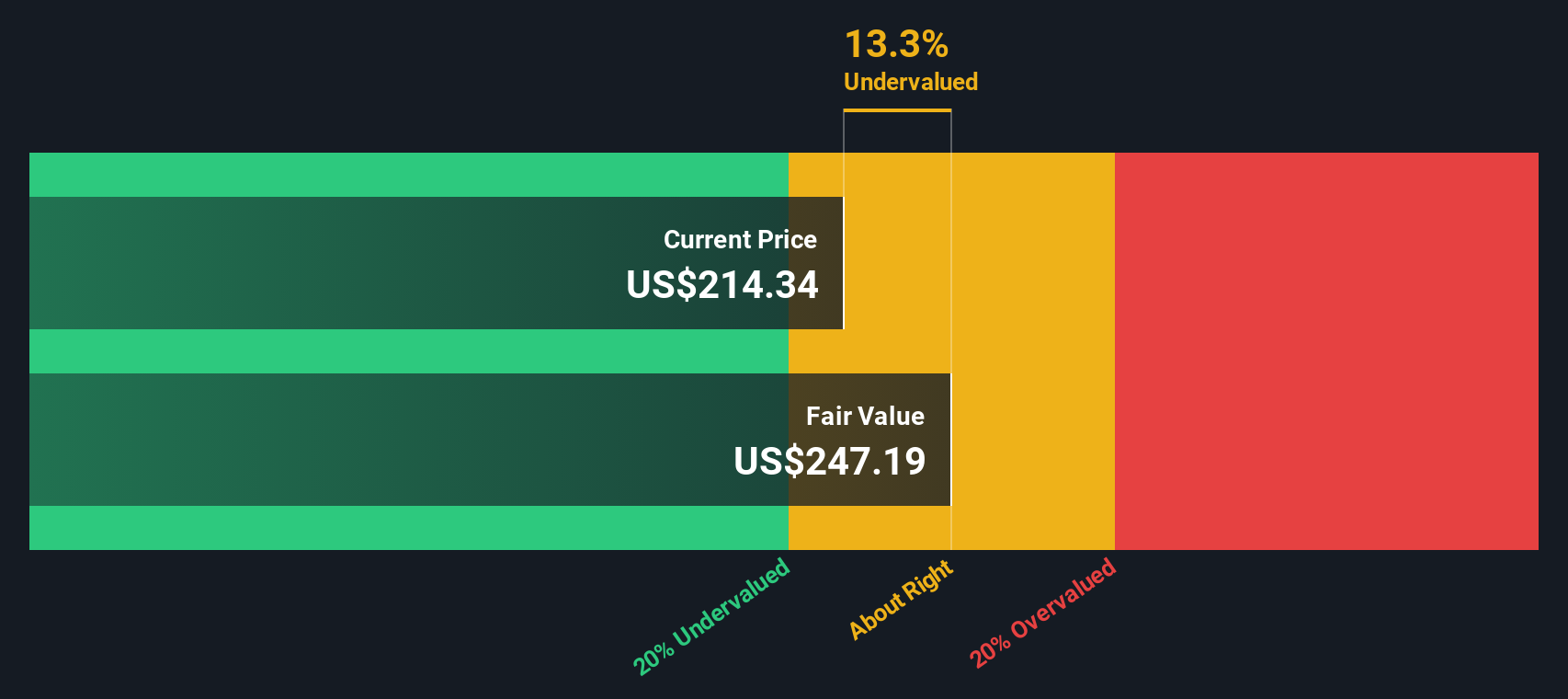
Bringing all of those projected cash flows back to today produces an estimated intrinsic value of about $344.13 per share, compared with the recent share price of $364.46. On this model, MongoDB screens as about 5.9% overvalued, which is a relatively small gap and well within the range where reasonable investors might disagree.
Result: ABOUT RIGHT
MongoDB is fairly valued according to our Discounted Cash Flow (DCF), but this can change at a moment's notice. Track the value in your watchlist or portfolio and be alerted on when to act.
Approach 2: MongoDB Price vs Sales
For a company like MongoDB that is not being valued on current earnings, the P/S ratio is often more useful than P/E, because it focuses on revenue, which is less affected by short term swings in profitability.
Growth expectations and risk still matter here, because higher expected growth or lower perceived risk can justify a higher P/S multiple, while slower growth or higher risk usually calls for a lower, more conservative multiple.
MongoDB trades on a P/S of 12.80x, compared with an IT industry average of 2.06x and a peer group average of 8.70x. To go a step further, Simply Wall St calculates a “Fair Ratio” of 9.84x, which is the P/S level suggested after considering factors such as earnings growth, industry, profit margins, market cap and company specific risks.
This Fair Ratio can offer a more tailored view than a simple peer or industry comparison, because it adjusts for MongoDB’s own characteristics rather than assuming it should trade in line with broad group averages.
On this basis, MongoDB’s current 12.80x P/S sits above the 9.84x Fair Ratio. This indicates that the shares screen as overvalued on this metric.
Result: OVERVALUED

P/S ratios tell one story, but what if the real opportunity lies elsewhere? Start investing in legacies, not executives. Discover our 22 top founder-led companies.
Upgrade Your Decision Making: Choose your MongoDB Narrative
Earlier we mentioned that there is an even better way to understand valuation, so let us introduce you to Narratives. With Narratives, you combine your view of MongoDB’s story with your own numbers on future revenue, earnings and margins, link that story to a forecast and fair value, and then compare that fair value with today’s price using an easy tool on Simply Wall St’s Community page that updates as new news or earnings arrive.
For example, one MongoDB Narrative on the platform currently points to a fair value of about US$525 per share, while another sits closer to US$239. This shows how two investors can look at the same company, plug in different assumptions, and reach very different conclusions about whether the current price looks high or low.
For MongoDB however we will make it really easy for you with previews of two leading MongoDB Narratives:
Fair value in this bullish narrative: US$525.00 per share
Implied pricing gap: about 30.6% below this fair value, based on the recent US$364.46 share price
Revenue growth assumption: 21.76% a year
- Assumes AI workloads, cloud native architecture and modernization projects support higher long term revenue growth and margin improvement.
- Takes the view that recurring cloud revenue, international expansion and diversified customer adoption can support durable earnings over time.
- Uses analyst assumptions that point to a richer future P/E multiple and a fair value of US$525, with updated inputs around growth, margins and discount rate.
Fair value in this bearish narrative: US$239.42 per share
Implied pricing gap: about 52.2% above this fair value, based on the recent US$364.46 share price
Revenue growth assumption: 14.09% a year
- Focuses on rising regulatory complexity, data localization and compliance costs that could weigh on long term profitability.
- Highlights the risk that hyperscale cloud providers, open source options and multi model data platforms limit MongoDB's pricing power and market share.
- Builds to a fair value of about US$239, using lower growth assumptions and a view that current market expectations may already embed a high P/E multiple.
If you want to see how other investors are joining the dots between these kinds of numbers and their own expectations for MongoDB, you can review the full range of community views and tools, including Curious how numbers become stories that shape markets? Explore Community Narratives.
Do you think there's more to the story for MongoDB? Head over to our Community to see what others are saying!
This article by Simply Wall St is general in nature. We provide commentary based on historical data and analyst forecasts only using an unbiased methodology and our articles are not intended to be financial advice. It does not constitute a recommendation to buy or sell any stock, and does not take account of your objectives, or your financial situation. We aim to bring you long-term focused analysis driven by fundamental data. Note that our analysis may not factor in the latest price-sensitive company announcements or qualitative material. Simply Wall St has no position in any stocks mentioned.
New: Manage All Your Stock Portfolios in One Place
We've created the ultimate portfolio companion for stock investors, and it's free.
• Connect an unlimited number of Portfolios and see your total in one currency
• Be alerted to new Warning Signs or Risks via email or mobile
• Track the Fair Value of your stocks
Have feedback on this article? Concerned about the content? Get in touch with us directly. Alternatively, email editorial-team@simplywallst.com
MI

The Foxhole
Druckenmiller says cheap money's days are numbered. Boring, self-funding companies could be the opportunity.
1311
DE
devon_jd150
Leverage on its own is close to useless as a screen right now, because so much corporate debt was termed out at 2 to 3% and has not repriced. A business at three times leverage with nothing due until 2031 is in a completely different position from the same ratio rolling next year. Screen on weighted average maturity and the schedule behind it.
LE
LeverageIsLovely
In my view, Insurance companies are best positioned for this.
 Mitchell Lawler
Market Insights
Which payment stocks actually get paid?

Every new payment app was supposed to kill Visa and Mastercard. Instead, they got bigger. So what does that mean for the payment stocks on your radar?
32
About NasdaqGM:MDB
MongoDB
Provides general purpose database platform worldwide.
Flawless balance sheet with reasonable growth potential.
Similar Companies
Market Insights


Advertisement
Weekly Picks
RI


Rick_Orford on Starfighters Space ·
The 1960s Fighter Jet That Could Crack Open a $20 Billion Satellite Market
Fair Value:US$522.8% undervalued
67 followersusers have followed this narrative
4 commentsusers have commented on this narrative
11 likesusers have liked this narrative
TR


tripledub on Meta Platforms ·
The $135 Billion Bet That Should Make Every Shareholder Nervous
Fair Value:US$5862.7% undervalued
48 followersusers have followed this narrative
3 commentsusers have commented on this narrative
34 likesusers have liked this narrative
TA


Talos on Voyager Technologies ·
The "Landlord of Orbit" – A Deep Value Play Ahead of the Starlab Era
Fair Value:US$385.291.0% undervalued
32 followersusers have followed this narrative
0 commentsusers have commented on this narrative
5 likesusers have liked this narrative
IV

Ivoed on Uber Technologies ·
Uber’s Valuation Depends On Who Captures The Economics Of Driverless Rides
Fair Value:US$11630.7% undervalued
8 followersusers have followed this narrative
0 commentsusers have commented on this narrative
3 likesusers have liked this narrative
Recently Updated Narratives
WO


woodworthfund on Kraft Heinz ·
Kraft Heinz (KHC): Less Drama, More Ketchup
Fair Value:US$3527.7% undervalued
27 followersusers have followed this narrative
0 commentsusers have commented on this narrative
0 likesusers have liked this narrative
LU


LunaRodas on DICK'S Sporting Goods ·
DKS | DICK'S Sporting Goods: What They Said vs. What They Did
Fair Value:US$112.7710.2% overvalued
1 followerusers have followed this narrative
0 commentsusers have commented on this narrative
0 likesusers have liked this narrative
PR


prajeeshprathap on Medpace Holdings ·
Why Medpace Outperforms Competitors in the Mid-Sized Biotech Niche
Fair Value:US$53614.6% overvalued
1 followerusers have followed this narrative
0 commentsusers have commented on this narrative
0 likesusers have liked this narrative
Popular Narratives
OS


oscargarcia on NVIDIA ·
The company that went from selling GPUs to gamers to becoming the AI arms dealer of the 21st century.
Fair Value:US$28023.9% undervalued
356 followersusers have followed this narrative
9 commentsusers have commented on this narrative
16 likesusers have liked this narrative
CU

CubanEros on Microsoft ·
A wonderful business at reasonable price.
Fair Value:US$419.9117.1% overvalued
204 followersusers have followed this narrative
0 commentsusers have commented on this narrative
9 likesusers have liked this narrative
KI

KiwiInvest on Amazon.com ·
Amazon's high growth, high tech segments propel its profits, while traditional segments plod along
Fair Value:US$475.0945.1% undervalued
229 followersusers have followed this narrative
1 commentusers have commented on this narrative
8 likesusers have liked this narrative
Trending Discussion


JO
johnk72 on Global X AI Infrastructure ETF ·
Great picks & shovels investment. I hold 3,000 units with a plan to hold until the end of 2028
2
|0