Advertisement
- United States
- /
- Software
- /
- NasdaqGS:FROG
What JFrog (FROG)'s Governed Claude Code Integration Means For Shareholders
SI

Reviewed by Sasha Jovanovic
- Earlier this month, JFrog announced a new JFrog Platform plugin for Anthropic’s Claude Code, giving enterprises governed, supply-chain-aware AI coding agents with integrated security, compliance, and traceability features.
- By embedding policy enforcement and provenance checks directly into AI-assisted development workflows, the collaboration aims to curb unorthodox agent behavior while streamlining DevOps and strengthening audit readiness.
- Next, we’ll explore how this Claude Code integration, with its focus on governed AI coding workflows, affects JFrog’s existing investment narrative.
We've uncovered the 8 dividend fortresses yielding 5%+ that don't just survive market storms, but thrive in them.
JFrog Investment Narrative Recap
To own JFrog, you need to believe that its software supply chain platform becomes a core control plane for AI era DevOps, where governance and security are embedded directly into developer workflows. The new Claude Code plugin reinforces this AI governance angle, but does not materially change the near term focus on converting strong top line growth into a clearer path to profitability, or the key risk that intensifying competition in security and DevOps tools could limit pricing power.
The Claude Code integration fits neatly beside JFrog’s earlier launch of its plugin for the Cursor marketplace, which also pulls governance, scanning, and remediation directly into AI coding environments. Together, these moves extend the same supply chain security and compliance story across multiple AI assistants, supporting the existing catalyst that tighter regulation and growing concern over “shadow AI” can push enterprises toward unified DevSecOps platforms that centralize policy enforcement and auditability.
Yet beneath this AI governance momentum, investors still need to consider the risk that rising competition in security tooling could...
Read the full narrative on JFrog (it's free!)
JFrog's narrative projects $909.4 million revenue and $109.5 million earnings by 2029. This requires 17.3% yearly revenue growth and a $171.1 million earnings increase from -$61.6 million today.
Uncover how JFrog's forecasts yield a $80.75 fair value, in line with its current price.
Exploring Other Perspectives
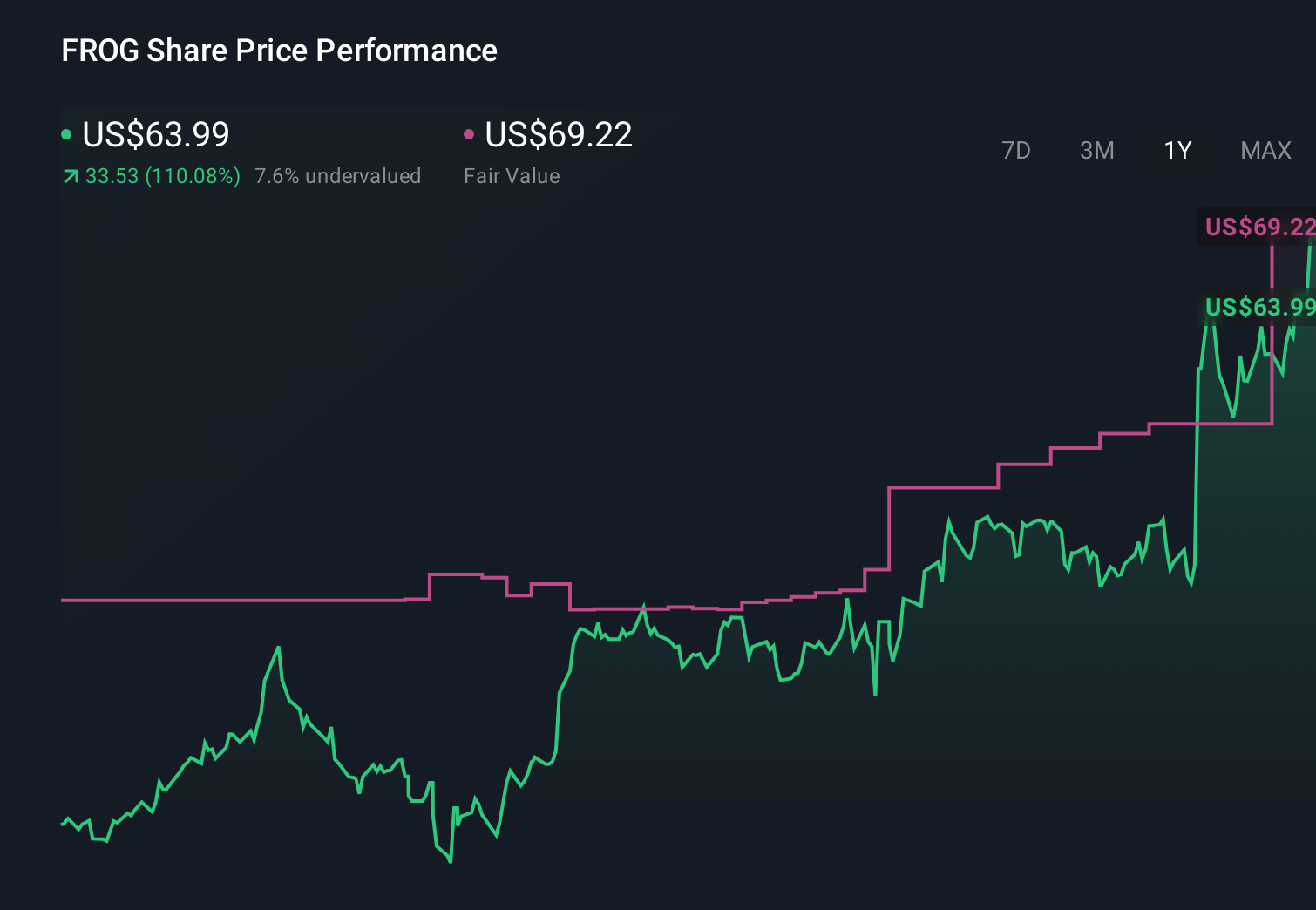
Three Simply Wall St Community fair value estimates span roughly US$58.69 to US$82.15, underscoring how differently individual investors are sizing up JFrog’s upside. Against that spread, the Claude Code integration highlights how much the long term payoff may hinge on JFrog defending its security and governance edge across rapidly evolving AI development workflows.
Explore 3 other fair value estimates on JFrog - why the stock might be worth 28% less than the current price!
Form Your Own Verdict
Don't just follow the ticker - dig into the data and build a conviction that's truly your own.
- A great starting point for your JFrog research is our analysis highlighting 1 key reward and 2 important warning signs that could impact your investment decision.
- Our free JFrog research report provides a comprehensive fundamental analysis summarized in a single visual - the Snowflake - making it easy to evaluate JFrog's overall financial health at a glance.
Searching For A Fresh Perspective?
Right now could be the best entry point. These picks are fresh from our daily scans. Don't delay:
- Capitalize on the AI infrastructure supercycle with our selection of the 49 best 'picks and shovels' of the AI gold rush converting record-breaking demand into massive cash flow.
- The future of work is here. Discover the 31 top robotics and automation stocks leading the charge in AI-driven automation and industrial transformation.
- Outshine the giants: these 14 early-stage AI stocks could fund your retirement.
This article by Simply Wall St is general in nature. We provide commentary based on historical data and analyst forecasts only using an unbiased methodology and our articles are not intended to be financial advice. It does not constitute a recommendation to buy or sell any stock, and does not take account of your objectives, or your financial situation. We aim to bring you long-term focused analysis driven by fundamental data. Note that our analysis may not factor in the latest price-sensitive company announcements or qualitative material. Simply Wall St has no position in any stocks mentioned.
New: Manage All Your Stock Portfolios in One Place
We've created the ultimate portfolio companion for stock investors, and it's free.
• Connect an unlimited number of Portfolios and see your total in one currency
• Be alerted to new Warning Signs or Risks via email or mobile
• Track the Fair Value of your stocks
Have feedback on this article? Concerned about the content? Get in touch with us directly. Alternatively, email editorial-team@simplywallst.com
MI

The Foxhole
A landmark settlement is meant to punish Meta (META). If the 1998 tobacco deal is any guide, it might protect it.
189
ZO
zoe_vi5fn
Any moat with an opt-out clause for your competitors is just a fence around your own garden.
CO
connor_iwn1g
Worth looking at what previous legal action actually did to Meta rather than reaching for tobacco. The FTC's record five billion dollar privacy fine in 2019 was met with the stock rising, because it came in below fears and removed an open question. GDPR was designed to constrain large platforms and increased their share of the European ad market, because compliance cost fell hardest on small intermediaries. The FTC's antitrust case, the one that could genuinely have broken the company up, was decided in Meta's favour last November. The only thing that ever meaningfully hurt the business was Apple changing a tracking default, and Meta out-spent that too, while the ad-tech firms that could not afford to rebuild disappeared. The pattern is not that Meta survives regulation. It is that regulation keeps costing its smaller competitors more.
 Andrew Legget
Market Insights
Great earnings season, but are the earnings real?

At first glance, this was the strongest earnings season in years. But when you look at where the growth actually came from, the story splits into two very different pictures.
10
About NasdaqGS:FROG
JFrog
Provides software supply chain platform in the United States, Israel, India, and internationally.
Flawless balance sheet with very low risk.
Similar Companies
Market Insights


Advertisement
Weekly Picks
LO


Lou_Basenese on Oncolytics Biotech ·
The Team Behind a $2 Billion Johnson & Johnson (JNJ) Deal Just Took Over This $105 Million Cancer Biotech
Fair Value:US$3.575.5% undervalued
34 followersusers have followed this narrative
0 commentsusers have commented on this narrative
10 likesusers have liked this narrative
TR


tripledub on Meta Platforms ·
The $135 Billion Bet That Should Make Every Shareholder Nervous
Fair Value:US$5861.4% undervalued
63 followersusers have followed this narrative
3 commentsusers have commented on this narrative
34 likesusers have liked this narrative
TA


Talos on Voyager Technologies ·
The "Landlord of Orbit" – A Deep Value Play Ahead of the Starlab Era
Fair Value:US$385.291.1% undervalued
66 followersusers have followed this narrative
0 commentsusers have commented on this narrative
6 likesusers have liked this narrative
IV

Ivoed on Uber Technologies ·
Uber’s Valuation Depends On Who Captures The Economics Of Driverless Rides
Fair Value:US$11632.1% undervalued
13 followersusers have followed this narrative
0 commentsusers have commented on this narrative
3 likesusers have liked this narrative
Recently Updated Narratives
MU


MullerHolding on Brava Energia ·
Brava Energia will see a revenue growth of 50% this year
Fair Value:R$36.8253.8% undervalued
1 followerusers have followed this narrative
0 commentsusers have commented on this narrative
0 likesusers have liked this narrative
EK


eKhalid on Cheetah Net Supply Chain Service ·
Cheetah Net is transforming its business through international trading growth
Fair Value:US$1.369.6% overvalued
1 followerusers have followed this narrative
0 commentsusers have commented on this narrative
0 likesusers have liked this narrative
AN

Anthony_Lee on A1 A.K. Koh Group Berhad ·
A1AKK Enters FY2027 on Firmer Footing as Core Earnings Improve and Expansion Plans Gather Pace
Fair Value:RM 0.341.7% undervalued
1 followerusers have followed this narrative
0 commentsusers have commented on this narrative
0 likesusers have liked this narrative
Popular Narratives
OS


oscargarcia on NVIDIA ·
The company that went from selling GPUs to gamers to becoming the AI arms dealer of the 21st century.
Fair Value:US$28022.3% undervalued
364 followersusers have followed this narrative
9 commentsusers have commented on this narrative
16 likesusers have liked this narrative
CU

CubanEros on Microsoft ·
A wonderful business at reasonable price.
Fair Value:US$419.9122.3% overvalued
211 followersusers have followed this narrative
0 commentsusers have commented on this narrative
9 likesusers have liked this narrative
JO


John_Eric on MercadoLibre ·
MercadoLibre and the Spreadsheet Trick That Decides Everything
Fair Value:US$7.31k73.1% undervalued
125 followersusers have followed this narrative
3 commentsusers have commented on this narrative
17 likesusers have liked this narrative
Trending Discussion


JE

jean_pierre_lan_dsslz on Mauritius Development Investment Trust ·
Yes, MDIT is simply just a Deposit-long term stock with a good Dividend, no more, no less. It has just declared a Dividend of 0.11 cs payable 21 September 2026. Its price fluctuates between 1.90cs & 2.00cs. No capital gain in the short or medium term.
0
|0