Advertisement
- United States
- /
- Semiconductors
- /
- NasdaqGS:ALGM
Is Allegro MicroSystems (ALGM) Using Integrated Brake-by-Wire PMICs To Deepen Its Automotive Moat?
SI

Reviewed by Sasha Jovanovic
- In early July 2026, Allegro MicroSystems introduced the A81415, an ASIL-D-certified power management IC that uniquely integrates a wheel-speed sensor interface to simplify and consolidate next-generation brake-by-wire systems for automakers.
- By combining power regulation, protocol decoding, and sensor support into a single chip that can reduce semiconductor BOM costs by up to US$4 per vehicle and free more than half of the usable board space, Allegro is aiming to make its technology more attractive for future 48V electromechanical braking architectures.
- We will now examine how this integrated ASIL-D PMIC for brake-by-wire systems may influence Allegro MicroSystems’ investment narrative and growth outlook.
Invest in the nuclear renaissance through our list of 89 elite nuclear energy infrastructure plays powering the global AI revolution.
Allegro MicroSystems Investment Narrative Recap
To own Allegro MicroSystems, you need to believe its focus on high value automotive and power ICs can translate new design wins into durable revenue, despite current unprofitability and a rich price to sales multiple. The A81415 brake by wire PMIC looks directionally positive for Allegro’s automotive content story, but by itself does not clearly change the near term earnings inflection catalyst or the key risks around auto cyclicality and pricing pressure.
Among recent developments, Allegro’s addition to several Russell Growth indexes in late June 2026 is most relevant here, as it reflects how the market currently groups Allegro alongside higher growth semiconductor names. That growth oriented investor base may react strongly, in either direction, as products like the A81415 ramp and as upcoming quarterly results test whether revenue and margin trends can support the premium multiples implied by those index placements.
Yet behind the promise of integrated brake by wire chips, investors should be aware of how deeply Allegro still depends on auto demand and pricing discipline...
Read the full narrative on Allegro MicroSystems (it's free!)
Allegro MicroSystems' narrative projects $1.4 billion revenue and $223.5 million earnings by 2029. This requires 16.8% yearly revenue growth and about a $238 million earnings increase from -$14.9 million today.
Uncover how Allegro MicroSystems' forecasts yield a $54.42 fair value, a 6% upside to its current price.
Exploring Other Perspectives
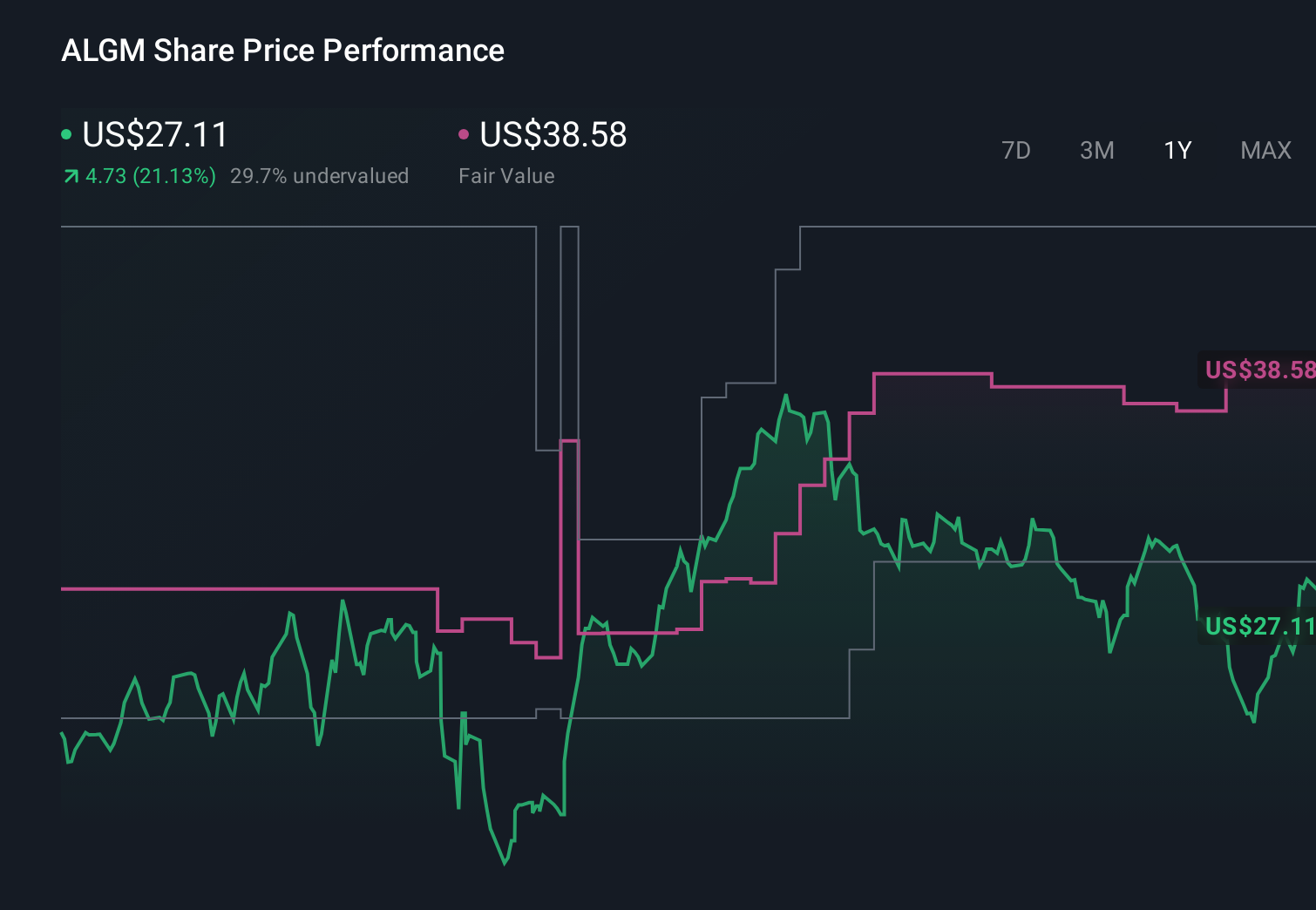
While this new PMIC targets future auto wins, the most cautious analysts were assuming about US$1.3 billion in 2029 revenue and US$248.8 million in earnings, reminding you that expectations and risks around automotive demand and margins can look very different depending on which narrative you find more convincing.
Explore 4 other fair value estimates on Allegro MicroSystems - why the stock might be worth as much as 18% more than the current price!
Reach Your Own Conclusion
Don't just follow the ticker - dig into the data and build a conviction that's truly your own.
- A great starting point for your Allegro MicroSystems research is our analysis highlighting 1 key reward and 2 important warning signs that could impact your investment decision.
- Our free Allegro MicroSystems research report provides a comprehensive fundamental analysis summarized in a single visual - the Snowflake - making it easy to evaluate Allegro MicroSystems' overall financial health at a glance.
Curious About Other Options?
The market won't wait. These fast-moving stocks are hot now. Grab the list before they run:
- Explore 26 top quantum computing companies leading the revolution in next-gen technology and shaping the future with breakthroughs in quantum algorithms, superconducting qubits, and cutting-edge research.
- The future of work is here. Discover the 30 top robotics and automation stocks leading the charge in AI-driven automation and industrial transformation.
- The best AI stocks today may lie beyond giants like Nvidia and Microsoft. Find the next big opportunity with these 16 smaller AI-focused companies with strong growth potential through early-stage innovation in machine learning, automation, and data intelligence that could fund your retirement.
This article by Simply Wall St is general in nature. We provide commentary based on historical data and analyst forecasts only using an unbiased methodology and our articles are not intended to be financial advice. It does not constitute a recommendation to buy or sell any stock, and does not take account of your objectives, or your financial situation. We aim to bring you long-term focused analysis driven by fundamental data. Note that our analysis may not factor in the latest price-sensitive company announcements or qualitative material. Simply Wall St has no position in any stocks mentioned.
New: Manage All Your Stock Portfolios in One Place
We've created the ultimate portfolio companion for stock investors, and it's free.
• Connect an unlimited number of Portfolios and see your total in one currency
• Be alerted to new Warning Signs or Risks via email or mobile
• Track the Fair Value of your stocks
Have feedback on this article? Concerned about the content? Get in touch with us directly. Alternatively, email editorial-team@simplywallst.com
MI

The Foxhole
A landmark settlement is meant to punish Meta (META). If the 1998 tobacco deal is any guide, it might protect it.
108
ZO
zoe_vi5fn
Any moat with an opt-out clause for your competitors is just a fence around your own garden.
CO
connor_iwn1g
Worth looking at what previous legal action actually did to Meta rather than reaching for tobacco. The FTC's record five billion dollar privacy fine in 2019 was met with the stock rising, because it came in below fears and removed an open question. GDPR was designed to constrain large platforms and increased their share of the European ad market, because compliance cost fell hardest on small intermediaries. The FTC's antitrust case, the one that could genuinely have broken the company up, was decided in Meta's favour last November. The only thing that ever meaningfully hurt the business was Apple changing a tracking default, and Meta out-spent that too, while the ad-tech firms that could not afford to rebuild disappeared. The pattern is not that Meta survives regulation. It is that regulation keeps costing its smaller competitors more.
 Andrew Legget
Market Insights
Great earnings season, but are the earnings real?

At first glance, this was the strongest earnings season in years. But when you look at where the growth actually came from, the story splits into two very different pictures.
10
About NasdaqGS:ALGM
Allegro MicroSystems
Designs, develops, manufactures, and markets sensor integrated circuits (ICs) and application-specific power ICs for sensing, motion control, and power management functions of complex electromechanical or power conversion systems.
High growth potential with excellent balance sheet.
Similar Companies
Market Insights


Advertisement
Weekly Picks
LO


Lou_Basenese on Oncolytics Biotech ·
The Team Behind a $2 Billion Johnson & Johnson (JNJ) Deal Just Took Over This $105 Million Cancer Biotech
Fair Value:US$3.575.5% undervalued
25 followersusers have followed this narrative
0 commentsusers have commented on this narrative
7 likesusers have liked this narrative
TR


tripledub on Meta Platforms ·
The $135 Billion Bet That Should Make Every Shareholder Nervous
Fair Value:US$5861.4% undervalued
59 followersusers have followed this narrative
3 commentsusers have commented on this narrative
34 likesusers have liked this narrative
TA


Talos on Voyager Technologies ·
The "Landlord of Orbit" – A Deep Value Play Ahead of the Starlab Era
Fair Value:US$385.291.1% undervalued
62 followersusers have followed this narrative
0 commentsusers have commented on this narrative
6 likesusers have liked this narrative
IV

Ivoed on Uber Technologies ·
Uber’s Valuation Depends On Who Captures The Economics Of Driverless Rides
Fair Value:US$11632.1% undervalued
12 followersusers have followed this narrative
0 commentsusers have commented on this narrative
3 likesusers have liked this narrative
Recently Updated Narratives
CO


composite32 on Eaton ·
"Grid-to-Chip: How Eaton Controls the Physical Bottlenecks of AI Data Centers"
Fair Value:US$517.0622.1% undervalued
1 followerusers have followed this narrative
0 commentsusers have commented on this narrative
0 likesusers have liked this narrative
QU


QuanD on NVIDIA ·
Nvidia Isn’t Cisco. And It’s Still Cheap
Fair Value:US$359.2239.4% undervalued
1 followerusers have followed this narrative
0 commentsusers have commented on this narrative
0 likesusers have liked this narrative
AC

achillez_97613 on Intel ·
Fair Value = $110, Bull = $150, Bear = $65.
Fair Value:US$56.0559.6% overvalued
1 followerusers have followed this narrative
0 commentsusers have commented on this narrative
0 likesusers have liked this narrative
Popular Narratives
OS

oscargarcia on NVIDIA ·
The company that went from selling GPUs to gamers to becoming the AI arms dealer of the 21st century.
Fair Value:US$28022.3% undervalued
365 followersusers have followed this narrative
9 commentsusers have commented on this narrative
16 likesusers have liked this narrative
CU

CubanEros on Microsoft ·
A wonderful business at reasonable price.
Fair Value:US$419.9122.3% overvalued
213 followersusers have followed this narrative
0 commentsusers have commented on this narrative
9 likesusers have liked this narrative
KI

KiwiInvest on Amazon.com ·
Amazon's high growth, high tech segments propel its profits, while traditional segments plod along
Fair Value:US$475.0943.9% undervalued
240 followersusers have followed this narrative
1 commentusers have commented on this narrative
8 likesusers have liked this narrative
Trending Discussion

DA

david_8pjjo on Axon Enterprise ·
One factor to consider for Axon's growth is whether the Russia - Ukraine war continues. Axon's Dedrone (dead drone) product could be a game changer, however if it is too successful, it could lead to an end of the war, thereby reducing Dedrone sales - an unintended consequence!David Lane
0
|0
