
Advertisement
- United States
- /
- Insurance
- /
- NYSE:PRU
Fewer Investors Than Expected Jumping On Prudential Financial, Inc. (NYSE:PRU)
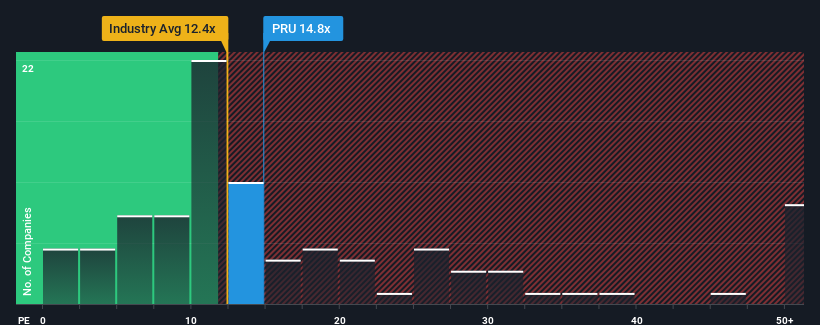
With a price-to-earnings (or "P/E") ratio of 14.8x Prudential Financial, Inc. (NYSE:PRU) may be sending bullish signals at the moment, given that almost half of all companies in the United States have P/E ratios greater than 19x and even P/E's higher than 34x are not unusual. However, the P/E might be low for a reason and it requires further investigation to determine if it's justified.
With earnings growth that's superior to most other companies of late, Prudential Financial has been doing relatively well. One possibility is that the P/E is low because investors think this strong earnings performance might be less impressive moving forward. If you like the company, you'd be hoping this isn't the case so that you could potentially pick up some stock while it's out of favour.
See our latest analysis for Prudential Financial
Is There Any Growth For Prudential Financial?
In order to justify its P/E ratio, Prudential Financial would need to produce sluggish growth that's trailing the market.
Taking a look back first, we see that the company managed to grow earnings per share by a handy 11% last year. However, this wasn't enough as the latest three year period has seen an unpleasant 66% overall drop in EPS. So unfortunately, we have to acknowledge that the company has not done a great job of growing earnings over that time.
Looking ahead now, EPS is anticipated to climb by 18% per year during the coming three years according to the ten analysts following the company. Meanwhile, the rest of the market is forecast to only expand by 10% per year, which is noticeably less attractive.
With this information, we find it odd that Prudential Financial is trading at a P/E lower than the market. It looks like most investors are not convinced at all that the company can achieve future growth expectations.
The Key Takeaway
Using the price-to-earnings ratio alone to determine if you should sell your stock isn't sensible, however it can be a practical guide to the company's future prospects.
We've established that Prudential Financial currently trades on a much lower than expected P/E since its forecast growth is higher than the wider market. When we see a strong earnings outlook with faster-than-market growth, we assume potential risks are what might be placing significant pressure on the P/E ratio. At least price risks look to be very low, but investors seem to think future earnings could see a lot of volatility.
Many other vital risk factors can be found on the company's balance sheet. Our free balance sheet analysis for Prudential Financial with six simple checks will allow you to discover any risks that could be an issue.
If P/E ratios interest you, you may wish to see this free collection of other companies with strong earnings growth and low P/E ratios.
New: Manage All Your Stock Portfolios in One Place
We've created the ultimate portfolio companion for stock investors, and it's free.
• Connect an unlimited number of Portfolios and see your total in one currency
• Be alerted to new Warning Signs or Risks via email or mobile
• Track the Fair Value of your stocks
Have feedback on this article? Concerned about the content? Get in touch with us directly. Alternatively, email editorial-team (at) simplywallst.com.
This article by Simply Wall St is general in nature. We provide commentary based on historical data and analyst forecasts only using an unbiased methodology and our articles are not intended to be financial advice. It does not constitute a recommendation to buy or sell any stock, and does not take account of your objectives, or your financial situation. We aim to bring you long-term focused analysis driven by fundamental data. Note that our analysis may not factor in the latest price-sensitive company announcements or qualitative material. Simply Wall St has no position in any stocks mentioned.
About NYSE:PRU
Prudential Financial
Provides insurance, investment management, and other financial products and services in the United States, Japan and internationally.
Average dividend payer and slightly overvalued.
Similar Companies
Market Insights

Advertisement
Community Narratives
Quality at a Premium. A time to watch, not to buy?
Fair Value US$154.56|27.6% undervalued
DA
Community Contributor
GRAB: The Super-App at the Heart of Southeast Asia’s Digital Boom
Fair Value US$8.20|22.1% undervalued
BL
Community Contributor
Verve Group to Surge with 51.61% Revenue Growth
Fair Value €6.00|60.0% undervalued
ME
Community Contributor