
Advertisement
- South Korea
- /
- Electronic Equipment and Components
- /
- KOSDAQ:A332570
Is Pentastone Electronics (KOSDAQ:332570) Using Too Much Debt?
David Iben put it well when he said, 'Volatility is not a risk we care about. What we care about is avoiding the permanent loss of capital.' So it might be obvious that you need to consider debt, when you think about how risky any given stock is, because too much debt can sink a company. We can see that Pentastone Electronics, Inc. (KOSDAQ:332570) does use debt in its business. But the more important question is: how much risk is that debt creating?
Why Does Debt Bring Risk?
Debt assists a business until the business has trouble paying it off, either with new capital or with free cash flow. Ultimately, if the company can't fulfill its legal obligations to repay debt, shareholders could walk away with nothing. While that is not too common, we often do see indebted companies permanently diluting shareholders because lenders force them to raise capital at a distressed price. Of course, debt can be an important tool in businesses, particularly capital heavy businesses. The first step when considering a company's debt levels is to consider its cash and debt together.
What Is Pentastone Electronics's Net Debt?
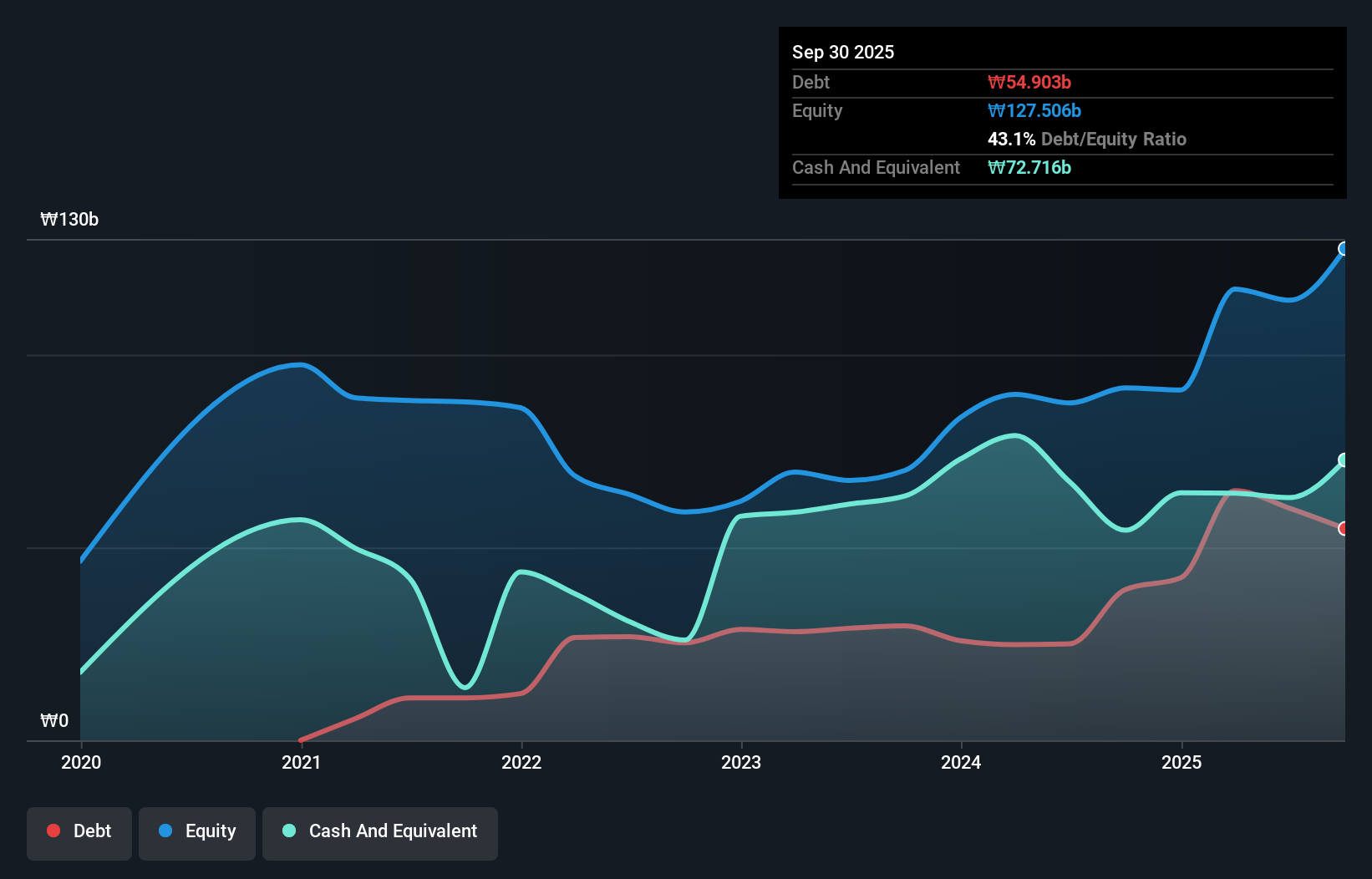
The image below, which you can click on for greater detail, shows that at September 2025 Pentastone Electronics had debt of ₩54.9b, up from ₩39.1b in one year. But on the other hand it also has ₩72.7b in cash, leading to a ₩17.8b net cash position.
A Look At Pentastone Electronics' Liabilities
The latest balance sheet data shows that Pentastone Electronics had liabilities of ₩57.4b due within a year, and liabilities of ₩34.7b falling due after that. Offsetting these obligations, it had cash of ₩72.7b as well as receivables valued at ₩24.5b due within 12 months. So it actually has ₩5.07b more liquid assets than total liabilities.
Having regard to Pentastone Electronics' size, it seems that its liquid assets are well balanced with its total liabilities. So while it's hard to imagine that the ₩280.3b company is struggling for cash, we still think it's worth monitoring its balance sheet. Simply put, the fact that Pentastone Electronics has more cash than debt is arguably a good indication that it can manage its debt safely.
Check out our latest analysis for Pentastone Electronics
Importantly, Pentastone Electronics's EBIT fell a jaw-dropping 70% in the last twelve months. If that earnings trend continues then paying off its debt will be about as easy as herding cats on to a roller coaster. When analysing debt levels, the balance sheet is the obvious place to start. But it is Pentastone Electronics's earnings that will influence how the balance sheet holds up in the future. So if you're keen to discover more about its earnings, it might be worth checking out this graph of its long term earnings trend.
But our final consideration is also important, because a company cannot pay debt with paper profits; it needs cold hard cash. While Pentastone Electronics has net cash on its balance sheet, it's still worth taking a look at its ability to convert earnings before interest and tax (EBIT) to free cash flow, to help us understand how quickly it is building (or eroding) that cash balance. Over the last three years, Pentastone Electronics actually produced more free cash flow than EBIT. There's nothing better than incoming cash when it comes to staying in your lenders' good graces.
Summing Up
While it is always sensible to investigate a company's debt, in this case Pentastone Electronics has ₩17.8b in net cash and a decent-looking balance sheet. And it impressed us with free cash flow of ₩21b, being 218% of its EBIT. So we don't have any problem with Pentastone Electronics's use of debt. The balance sheet is clearly the area to focus on when you are analysing debt. But ultimately, every company can contain risks that exist outside of the balance sheet. These risks can be hard to spot. Every company has them, and we've spotted 1 warning sign for Pentastone Electronics you should know about.
If you're interested in investing in businesses that can grow profits without the burden of debt, then check out this free list of growing businesses that have net cash on the balance sheet.
New: Manage All Your Stock Portfolios in One Place
We've created the ultimate portfolio companion for stock investors, and it's free.
• Connect an unlimited number of Portfolios and see your total in one currency
• Be alerted to new Warning Signs or Risks via email or mobile
• Track the Fair Value of your stocks
Have feedback on this article? Concerned about the content? Get in touch with us directly. Alternatively, email editorial-team (at) simplywallst.com.
This article by Simply Wall St is general in nature. We provide commentary based on historical data and analyst forecasts only using an unbiased methodology and our articles are not intended to be financial advice. It does not constitute a recommendation to buy or sell any stock, and does not take account of your objectives, or your financial situation. We aim to bring you long-term focused analysis driven by fundamental data. Note that our analysis may not factor in the latest price-sensitive company announcements or qualitative material. Simply Wall St has no position in any stocks mentioned.
About KOSDAQ:A332570
Pentastone Electronics
Supplies power amplifier modules for mobile devices.
Mediocre balance sheet and slightly overvalued.
Market Insights

Advertisement
Weekly Picks
DA


davidlsander on Nevgold ·
The U.S. Government Is Desperate for This Metal. This Tiny Miner Has It -- Its Closest Peer Is Already Worth Double.
Fair Value:US$2.1947.9% undervalued
43 followersusers have followed this narrative
0 commentsusers have commented on this narrative
4 likesusers have liked this narrative
BE

benjamin_lvieq on PayPal Holdings ·
PayPal: PayPal Doesn't Need to Grow – It Needs to Stop Falling – A Mispriced Cash Machine With a Cannibal Buyback
Fair Value:US$6512.6% undervalued
63 followersusers have followed this narrative
2 commentsusers have commented on this narrative
9 likesusers have liked this narrative
JD

JD009 on Celsius Holdings ·
From $5M to $2B: Why the 2024 Crash Was the Best Buying Opportunity in Consumer Stocks
Fair Value:US$55.4346.9% undervalued
23 followersusers have followed this narrative
1 commentusers have commented on this narrative
8 likesusers have liked this narrative
WA

Wavefarer on Accenture ·
High-quality global services company facing an AI-driven valuation reset.
Fair Value:US$30151.9% undervalued
17 followersusers have followed this narrative
1 commentusers have commented on this narrative
6 likesusers have liked this narrative
Recently Updated Narratives
TR


TripleS on Braemar Hotels & Resorts ·
Getting Paid 10% for a Ringside Seat at the Braemar Circus with a potential 2x payout
Fair Value:US$2029.0% undervalued
1 followerusers have followed this narrative
0 commentsusers have commented on this narrative
0 likesusers have liked this narrative
MA

Matt_1 on Rainbow Rare Earths ·
Only for the Patient...
Fair Value:UK£1.282.3% undervalued
3 followersusers have followed this narrative
2 commentsusers have commented on this narrative
0 likesusers have liked this narrative
RO


RockeTeller on Alkane Resources ·
Alkane Resources, Record Production, A$374M Cash and a Giant Copper-Gold Project
Fair Value:AU$8.5484.5% undervalued
7 followersusers have followed this narrative
0 commentsusers have commented on this narrative
1 likeusers have liked this narrative
Popular Narratives
IN


Investingwilly on Mastercard ·
Mastercard: The Best Dividend Stock You're Ignoring
Fair Value:US$75027.0% undervalued
96 followersusers have followed this narrative
1 commentusers have commented on this narrative
9 likesusers have liked this narrative
BL

BlackGoat on Cerebras Systems ·
The Wafer Giant Threatening NVIDIA's GPU Hegemony
Fair Value:US$415.5457.4% undervalued
64 followersusers have followed this narrative
3 commentsusers have commented on this narrative
11 likesusers have liked this narrative
BE
benjamin_lvieq on PayPal Holdings ·
PayPal: PayPal Doesn't Need to Grow – It Needs to Stop Falling – A Mispriced Cash Machine With a Cannibal Buyback
Fair Value:US$6512.6% undervalued
63 followersusers have followed this narrative
2 commentsusers have commented on this narrative
9 likesusers have liked this narrative
Trending Discussion
BE
benjamin_lvieq on PayPal Holdings ·
An investment case is not about loving the product. Its about price vs reality.
2
|0
ST


StoxEurope on Koninklijke Ahold Delhaize ·
I ran Ahold Delhaize through a three-model triangulation — DCF, dividend discount, and residual inco...
1
|0