
Markets are supposed to be efficient. Sometimes they are, and sometimes they aren’t. The rally in quantum computing stocks seems to be reflecting the latter. Quantum stocks are up, but it’s business as usual for the companies facing serious security risks if quantum computing is around the corner.
What happened in markets this week
Here’s a quick summary of what’s been going on:
👟 Nike's earnings beat masks a tougher turnaround ahead (Bloomberg)
- What happened: Nike reported revenue and earnings ahead of analyst expectations, helped by a one-time tariff refund. The company reported another decline in Greater China sales and guided for lower sales next quarter, with management saying meaningful improvement is unlikely before the first half of fiscal 2027.
- How it impacts investors: The results suggest Nike's recovery remains a work in progress, with demand trends, particularly in China, still the key metric to watch rather than one-off earnings benefits. The outlook could also shape sentiment toward other consumer companies with significant China exposure.
- Next steps: Have a look at this narrative for Nike to see how a member of the community got the numbers right six months ago.
⚡ Rising leverage adds another risk beneath the US stock rally (Yahoo Finance)
- What happened: Analysts are flagging the growing levels of leverage amongst retail investors, exchange-traded products, and hedge funds. This is increasing financing costs and adding stress beneath the US equity rally. Banks are also introducing more hedging products linked to equities and interest rates as investors prepare for the possibility of higher market volatility.
- How it impacts investors: Elevated leverage can amplify market swings if sentiment changes. This makes portfolio risk management and position sizing increasingly important as markets become more sensitive to unexpected shocks.
- Next steps: Volatility also creates opportunities. Use the Simply Wall St watchlist to set alerts at the price you’re prepared to pay for high quality companies.
☁️ Meta's entry to the cloud business could complicate the broader AI narrative (Yahoo Finance)
- What happened: Meta is reportedly entering the cloud business, selling excess compute capacity. SpaceX/xAI’s deal to sell excess compute to Anthropic was seen as an admission that its own AI models aren’t in demand. The same could be said of Meta, but the market chose to view the glass as half full and the stock price popped on the news. Reminder: Amazon got its cloud business started by selling excess compute capacity.
- How it impacts investors: Analysts were quick to point out that this would be bad news for CoreWeave and Nebius, both of which count Meta as their largest customer. Meanwhile, for Meta shareholders, a slowdown in capex might be a relief!
- Next steps: Check the CoreWeave community page to see how this development could impact narratives and valuations authored by community members.
💵 HSBC warns a dollar surge could catch markets off guard (Bloomberg)
- What happened: HSBC strategists said a sharp US dollar rally is one of the biggest underappreciated risks for the second half of 2026, as most investors remain positioned for a weaker currency. The bank said a more hawkish Federal Reserve or renewed geopolitical tensions could accelerate the rally, while also warning that crowded trades could unwind if interest rate expectations shift.
- How it impacts investors: A stronger US dollar could weigh on emerging markets, commodities, and multinational earnings, while increasing volatility across global asset classes. It also raises the importance of monitoring interest rate expectations and currency exposure within diversified portfolios.
- Next steps: You can use the portfolio tool to monitor the geographic diversification of your portfolio.
🇯🇵 Yen drops to 40-year low despite central bank intevention (CNBC)
- What happened: The Japanese yen fell to its weakest level against the US dollar since 1986 as the interest rate gap between the Federal Reserve and the Bank of Japan continued to support carry trades. The BOJ has reportedly spent $74 billion supporting the currency, with little effect.
- How it impacts investors: A weaker yen is a double-edged sword for manufacturers: it supports exports, but increases the cost of imports. On balance it appears to be positive as the BOJ's Tankan survey showed stronger-than-expected large-manufacturer confidence.
- Next steps: Use the stock screener to find Japanese exporters (including those listed in other countries) that may benefit from Yen weakness.
Something Doesn’t add up with the Quantum Trade
The announcements around quantum computing have grown from a trickle to a flood over the last two years. In response, quantum computing stocks have surged higher. The Defiance Quantum ETF (QTUM) is up 156% since November 2024.
The latest rally began in March when Google brought its ‘Q-Day’ deadline forward to 2029. Q-Day is the hypothetical date when a quantum computer becomes powerful enough to crack the cryptographic algorithms that currently secure the global internet and digital communications.
The next catalyst came in May, when the Trump administration announced investments in nine quantum computing firms. In June, Donald Trump signed two executive orders; one to accelerate the development of the technology, and the second mandating a transition to post-quantum cryptography for government agencies.
Investor demand has been met with supply. Four quantum companies have gone public in the last six months: Quantinuum (QNT) via IPO, and Xanadu Quantum Technologies (XNDU), Infleqtion (INFQ), and Horizon Quantum (HQ) via SPAC. And, at least three new quantum computing ETFs have been launched in the last year.
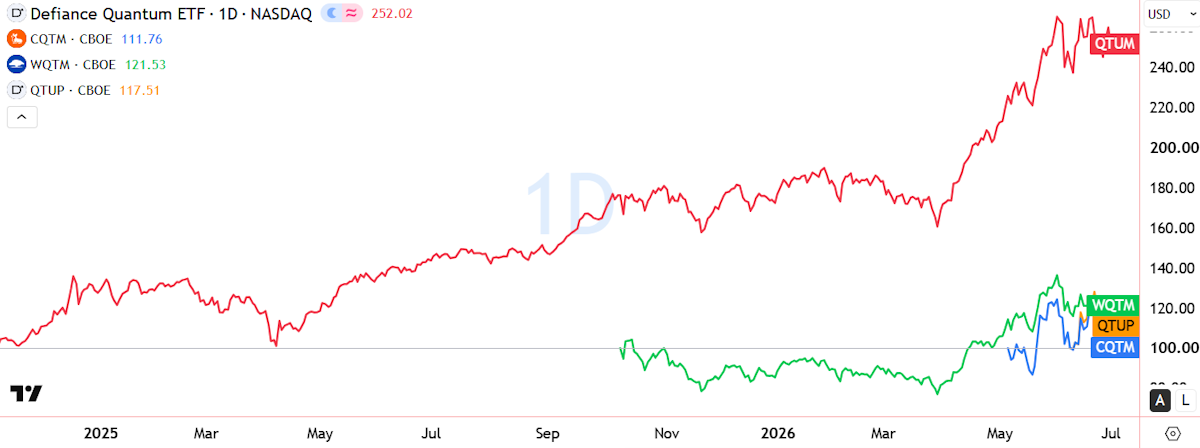
Source: Quantum Computing ETF performance, TradingView
The Q-Day blind spot
This newsletter isn’t about quantum stocks. It’s about Q-Day and the risk the market appears to be overlooking. The rally in quantum stocks isn’t surprising. But the market’s reaction regarding the rest of the market is.
Here’s the problem: the market is holding two contradictory beliefs. If quantum computing is going to arrive sooner than expected (which is a reason to be optimistic about the industry), what does that mean for the companies whose entire security model depends on Q-Day being a long way off?
If quantum stocks deserve a premium, the companies vulnerable to quantum computing should be repriced to reflect the increased risk.
Qubits, algorithms and public keys
Public-key cryptography is currently the backbone of network security. Cracking protocols like RSA-2048 with a normal computer is effectively impossible in a useful timeframe.
However these protocols can be cracked with a sufficiently large quantum computer (measured in qubits) and the right algorithm. In 1994, this was recognized as a theoretical possibility. Since then the hardware and the algorithms have improved:
Here’s a simplified version of what’s been happening:
- In 2019, Google announced its 53-qubit Sycamore chip. At the time it was estimated that cracking RSA-2048 would require 20 million qubits over 8 hours.
- In 2024 Google unveiled the 105-qubit Willow chip.
- In 2025, the estimate of qubits required to crack RSA-2048 was reduced to just one million.
- In February this year, a new estimate suggested even fewer qubits would be needed.
The bottom line is that progress on both the hardware and software fronts is bringing Q-Day closer. For a more technical overview, this report from Palo Alto is comprehensive.
Why does this matter for Investors?
The prospect of encrypted data and communication channels being compromised is a significant risk for companies, and for individuals. Furthermore, migrating to post-quantum encryption protocols is a seemingly unavoidable cost for companies.
The risks
Any data that stays sensitive for years or decades is at risk of being exposed. This isn’t a future risk: cyber-criminals are already gathering encrypted data to decrypt if or when they can (i.e. harvest now, decrypt later). Whether Q-Day arrives in 2029 or 2035, data that’s still sensitive in the future can be exposed.
The risks to companies include:
- Loss of operational integrity if systems are breached.
- Exposure of company secrets (IP).
- Liability and fines for exposing customer data.
- Reputation risk and loss of customer trust
Who’s at risk?
- Banks, payment networks and financial infrastructure: financial networks rely on trusted, signed, encrypted messaging.
- Telecoms and satellite operators: responsible for transmitting encrypted traffic, these networks are the target of anyone wanting to harvest encrypted data.
- Utilities: Power grids and other infrastructure are a target for cyber-terrorists, and often rely on aging legacy systems.
- Blockchain and cryptocurrencies: blockchains typically rely on elliptic-curve cryptography.
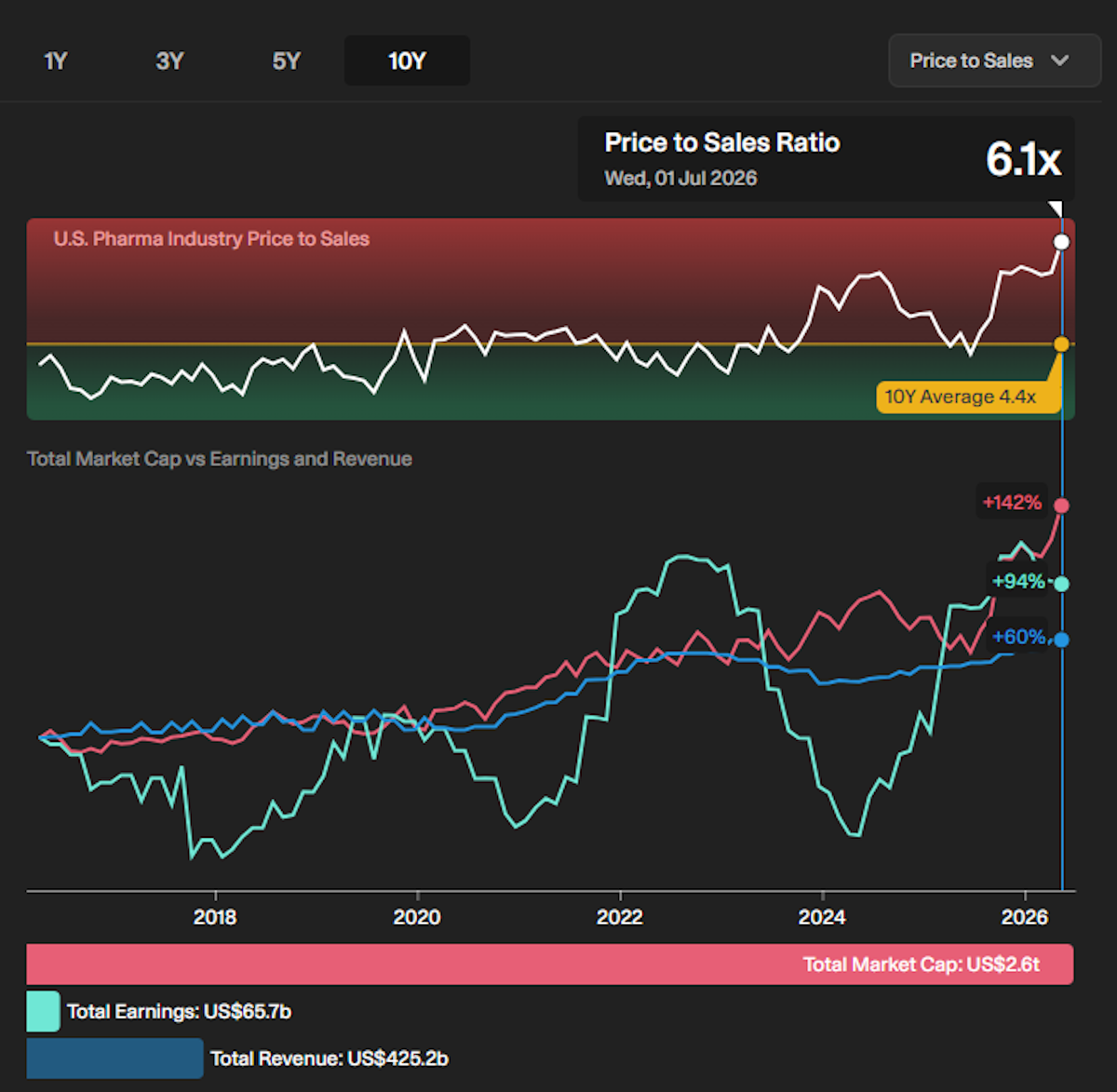
- Healthcare: from biotech and pharma companies with valuable IP, to insurers and healthtech companies with an obligation to protect patient data, this is amongst the most exposed sectors. The US pharma industry meanwhile is trading at the highest valuation in at least 10 years:
The cost: implementing PQC
Migration to post-quantum cryptography is a major, and unavoidable undertaking. Essentially, every encryption protocol needs to be replaced with post-quantum standards built on lattice and hash-based math. This process entails:
- Building an inventory of all cryptography currently being used.
- Prioritise long-lived, high-sensitivity data for early migration.
- Running PQC and current standards in parallel during a transition phase.
- Building in crypto-agility so that algorithms can be upgraded if they become vulnerable.
- Ensuring the supply chain is also secure.
The migration process could take more than 10 years for large organizations. Some of the work can be outsourced, but a lot will need to be done internally.
This narrative for 01 Quantum highlights a company focused on providing solutions to facilitate this transition for businesses.
So which is it?
The market may well be too optimistic about the near or mid-term prospects for companies racing to build quantum computers. There are still numerous engineering challenges to be solved.
In fact, quantum computing, like rare earth minerals, might have more strategic value than economic value. Developing the technology is a defence and security imperative, so it makes sense for governments to invest in the industry.
The economic value is less certain. The use cases are quite narrow and specific (for now anyway), and it could take a while for the market to reach a size that supports the pureplay companies that now have a combined market value of over $50 billion AND IBM, Alphabet etc.
This narrative for IonQ addresses the reality of quantum stock valuations.
One thing is clear though: Migration to PQC is becoming an imperative, and money is flowing into the industry. The companies facilitating the migration, and the companies supplying the picks and shovels may be the safer place to look for opportunities.
The Quantum undercard watchlist includes some some of those names:
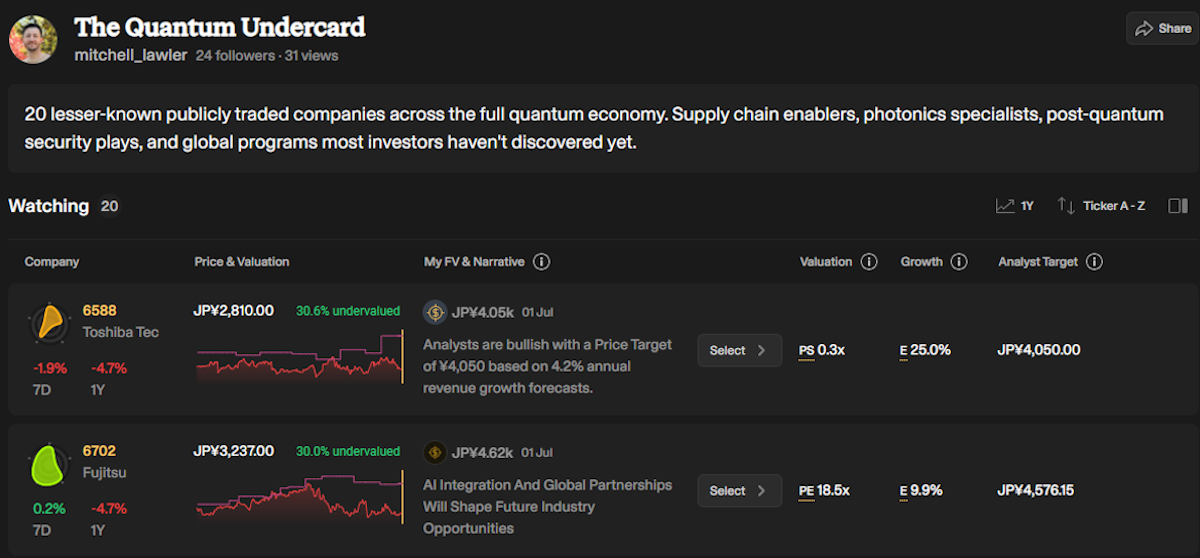
Source: Quantum Computing: the picks and shovels, Simply Wall St
💡 The Insight: Second-order effects are often mispriced
Industries don’t operate in a vacuum. Every wave of innovation creates an equal and opposite disruption somewhere else in the economic ecosystem. If quantum computing is on the verge of going mainstream then it is also on the verge of shattering global encryption infrastructure.
Sometimes the link is obvious: When hyperscalers ramped up Capex, it was obvious that hardware and chip companies would benefit.
But the market can also miss the connection, and assets become mispriced. Often the market overreacts too. In the case of software, the market ignored the threat from AI, and then quite possibly overreacted to it.
We recently covered the second-order effects of the AI power bottleneck. These second-order effects are often the ones that result in mispricing. This can create underappreciated risks, or opportunities.
Key Events Next Week
Wednesday
- 🇺🇸 FOMC Meeting Minutes (June 16–17 meeting)
- ➡️ Why it matters: First minutes under new Chair Warsh; markets will be looking for clues on how close the committee is to a hike, not a cut.
Thursday
- 🇨🇳 China PPI YoY
- 📉 Forecast : 3.5%, Previous: 3.9%
- ➡️ Why it matters: Factory-gate prices are near a 4-year high; any moderation would ease the squeeze on manufacturer margins.
- 🇺🇸 US Initial Jobless Claims
- 📈 Forecast: 220,000 to 230,000, Previous: 215,000
- ➡️ Why it matters: The July 4th holiday week could impact the report so it’s less important than usual.
Friday
- CA Canada Unemployment Rate
- 📈 Forecast: 7.0%, Previous: 6.6%
- ➡️ Why it matters: May’s number was at the low end of the range for the last 12 months, so 7% will be closer to the average.
Second quarter earnings season kicks off properly in two weeks time, but there are a few companies reporting ahead of the pack:
Have feedback on this article? Concerned about the content? Get in touch with us directly. Alternatively, email editorial-team@simplywallst.com
Simply Wall St analyst Richard Bowman and Simply Wall St have no position in any of the companies mentioned. This article is general in nature. Any comments below from SWS employees are their opinions only, should not be taken as financial advice and may not represent the views of Simply Wall St. Unless otherwise advised, SWS employees providing commentary do not own a position in any company mentioned in the article or in their comments.We provide analysis based on historical data and analyst forecasts only using an unbiased methodology and our articles are not intended to be financial advice. It does not constitute a recommendation to buy or sell any stock and does not take account of your objectives, or your financial situation. We aim to bring you long-term focused analysis driven by fundamental data. Note that our analysis may not factor in the latest price-sensitive company announcements or qualitative material.
Comments
Richard Bowman
Richard is an analyst, writer and investor based in Cape Town, South Africa. He has written for several online investment publications and continues to do so. Richard is fascinated by economics, financial markets and behavioral finance. He is also passionate about tools and content that make investing accessible to everyone.

