- Japan
- /
- Interactive Media and Services
- /
- TSE:7047
Port Inc.'s (TSE:7047) market cap dropped JP¥3.4b last week; Individual investors bore the brunt


Key Insights
- Port's significant individual investors ownership suggests that the key decisions are influenced by shareholders from the larger public
- A total of 6 investors have a majority stake in the company with 52% ownership
- Insiders own 40% of Port
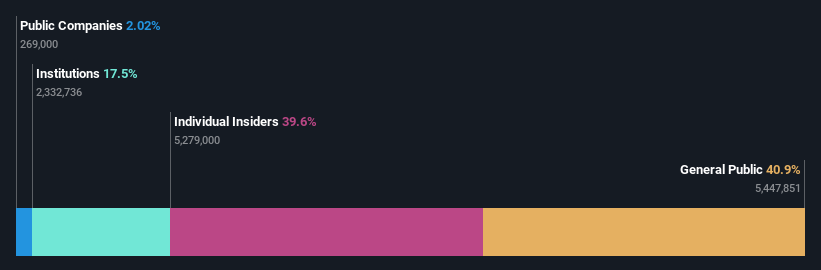
A look at the shareholders of Port Inc. (TSE:7047) can tell us which group is most powerful. And the group that holds the biggest piece of the pie are individual investors with 41% ownership. That is, the group stands to benefit the most if the stock rises (or lose the most if there is a downturn).
Following a 13% decrease in the stock price last week, individual investors suffered the most losses, but insiders who own 40% stock also took a hit.
Let's take a closer look to see what the different types of shareholders can tell us about Port.
View our latest analysis for Port
What Does The Institutional Ownership Tell Us About Port?
Many institutions measure their performance against an index that approximates the local market. So they usually pay more attention to companies that are included in major indices.
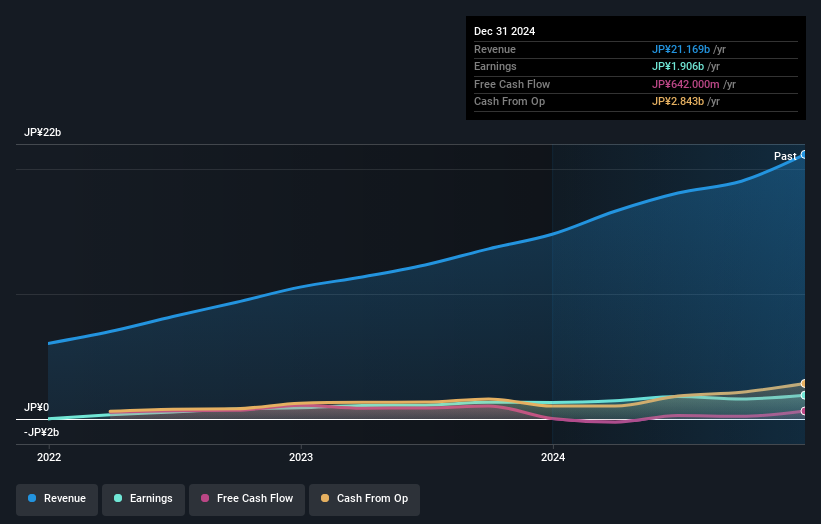
Port already has institutions on the share registry. Indeed, they own a respectable stake in the company. This can indicate that the company has a certain degree of credibility in the investment community. However, it is best to be wary of relying on the supposed validation that comes with institutional investors. They too, get it wrong sometimes. When multiple institutions own a stock, there's always a risk that they are in a 'crowded trade'. When such a trade goes wrong, multiple parties may compete to sell stock fast. This risk is higher in a company without a history of growth. You can see Port's historic earnings and revenue below, but keep in mind there's always more to the story.
Port is not owned by hedge funds. The company's CEO Hirofumi Kasuga is the largest shareholder with 32% of shares outstanding. For context, the second largest shareholder holds about 6.1% of the shares outstanding, followed by an ownership of 4.9% by the third-largest shareholder.
We did some more digging and found that 6 of the top shareholders account for roughly 52% of the register, implying that along with larger shareholders, there are a few smaller shareholders, thereby balancing out each others interests somewhat.
While it makes sense to study institutional ownership data for a company, it also makes sense to study analyst sentiments to know which way the wind is blowing. As far as we can tell there isn't analyst coverage of the company, so it is probably flying under the radar.
Insider Ownership Of Port
The definition of company insiders can be subjective and does vary between jurisdictions. Our data reflects individual insiders, capturing board members at the very least. Management ultimately answers to the board. However, it is not uncommon for managers to be executive board members, especially if they are a founder or the CEO.
Insider ownership is positive when it signals leadership are thinking like the true owners of the company. However, high insider ownership can also give immense power to a small group within the company. This can be negative in some circumstances.
Our most recent data indicates that insiders own a reasonable proportion of Port Inc.. It has a market capitalization of just JP¥22b, and insiders have JP¥8.8b worth of shares in their own names. It is great to see insiders so invested in the business. It might be worth checking if those insiders have been buying recently.
General Public Ownership
With a 41% ownership, the general public, mostly comprising of individual investors, have some degree of sway over Port. While this size of ownership may not be enough to sway a policy decision in their favour, they can still make a collective impact on company policies.
Next Steps:
It's always worth thinking about the different groups who own shares in a company. But to understand Port better, we need to consider many other factors. For instance, we've identified 1 warning sign for Port that you should be aware of.
Of course this may not be the best stock to buy. Therefore, you may wish to see our free collection of interesting prospects boasting favorable financials.
NB: Figures in this article are calculated using data from the last twelve months, which refer to the 12-month period ending on the last date of the month the financial statement is dated. This may not be consistent with full year annual report figures.
If you're looking to trade Port, open an account with the lowest-cost platform trusted by professionals, Interactive Brokers.
With clients in over 200 countries and territories, and access to 160 markets, IBKR lets you trade stocks, options, futures, forex, bonds and funds from a single integrated account.
Enjoy no hidden fees, no account minimums, and FX conversion rates as low as 0.03%, far better than what most brokers offer.
Sponsored ContentNew: Manage All Your Stock Portfolios in One Place
We've created the ultimate portfolio companion for stock investors, and it's free.
• Connect an unlimited number of Portfolios and see your total in one currency
• Be alerted to new Warning Signs or Risks via email or mobile
• Track the Fair Value of your stocks
Have feedback on this article? Concerned about the content? Get in touch with us directly. Alternatively, email editorial-team (at) simplywallst.com.
This article by Simply Wall St is general in nature. We provide commentary based on historical data and analyst forecasts only using an unbiased methodology and our articles are not intended to be financial advice. It does not constitute a recommendation to buy or sell any stock, and does not take account of your objectives, or your financial situation. We aim to bring you long-term focused analysis driven by fundamental data. Note that our analysis may not factor in the latest price-sensitive company announcements or qualitative material. Simply Wall St has no position in any stocks mentioned.
About TSE:7047
Port
Operates various domain-specific vertical media and develops content marketing for user needs in Japan.
Solid track record with excellent balance sheet.
Market Insights

Community Narratives