
Advertisement
Institutional owners may take dramatic actions as Coforge Limited's (NSE:COFORGE) recent 11% drop adds to one-year losses
Key Insights
- Given the large stake in the stock by institutions, Coforge's stock price might be vulnerable to their trading decisions
- 52% of the business is held by the top 16 shareholders
- Using data from analyst forecasts alongside ownership research, one can better assess the future performance of a company
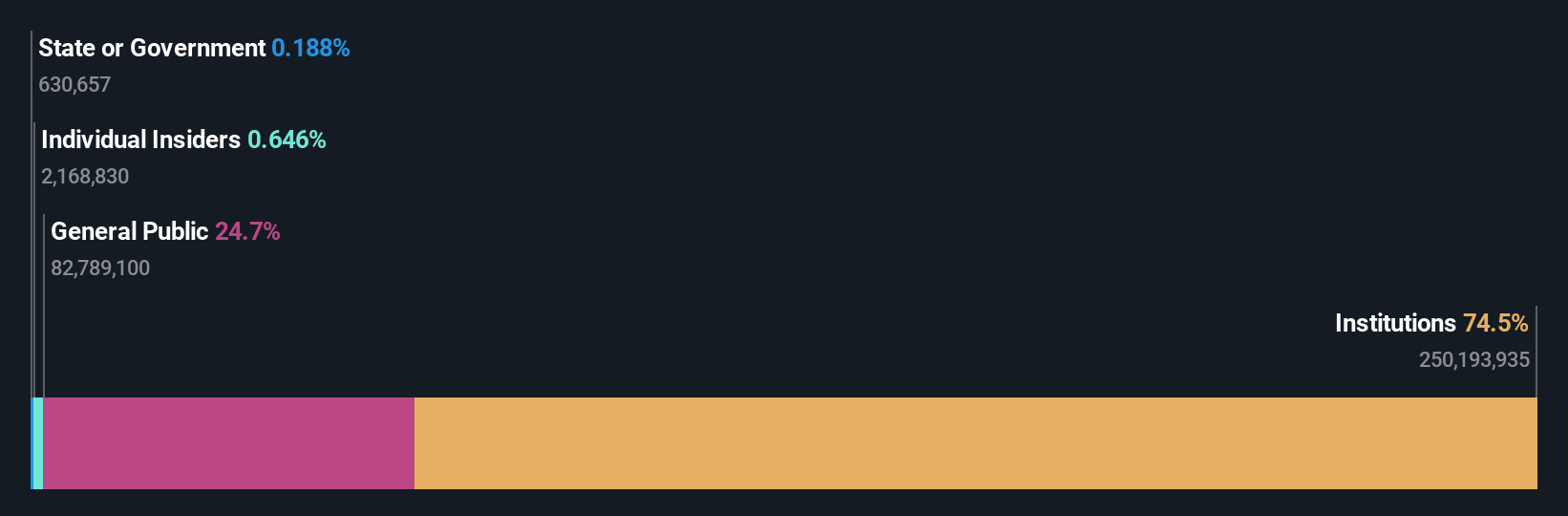
A look at the shareholders of Coforge Limited (NSE:COFORGE) can tell us which group is most powerful. And the group that holds the biggest piece of the pie are institutions with 75% ownership. That is, the group stands to benefit the most if the stock rises (or lose the most if there is a downturn).
As a result, institutional investors endured the highest losses last week after market cap fell by ₹60b. Needless to say, the recent loss which further adds to the one-year loss to shareholders of 8.9% might not go down well especially with this category of shareholders. Institutions or "liquidity providers" control large sums of money and therefore, these types of investors usually have a lot of influence over stock price movements. Hence, if weakness in Coforge's share price continues, institutional investors may feel compelled to sell the stock, which might not be ideal for individual investors.
Let's delve deeper into each type of owner of Coforge, beginning with the chart below.
Check out our latest analysis for Coforge
What Does The Institutional Ownership Tell Us About Coforge?
Institutions typically measure themselves against a benchmark when reporting to their own investors, so they often become more enthusiastic about a stock once it's included in a major index. We would expect most companies to have some institutions on the register, especially if they are growing.
As you can see, institutional investors have a fair amount of stake in Coforge. This can indicate that the company has a certain degree of credibility in the investment community. However, it is best to be wary of relying on the supposed validation that comes with institutional investors. They too, get it wrong sometimes. If multiple institutions change their view on a stock at the same time, you could see the share price drop fast. It's therefore worth looking at Coforge's earnings history below. Of course, the future is what really matters.

Investors should note that institutions actually own more than half the company, so they can collectively wield significant power. Coforge is not owned by hedge funds. Motilal Oswal Asset Management Company Limited is currently the largest shareholder, with 9.5% of shares outstanding. For context, the second largest shareholder holds about 5.7% of the shares outstanding, followed by an ownership of 4.6% by the third-largest shareholder.
Looking at the shareholder registry, we can see that 52% of the ownership is controlled by the top 16 shareholders, meaning that no single shareholder has a majority interest in the ownership.
Researching institutional ownership is a good way to gauge and filter a stock's expected performance. The same can be achieved by studying analyst sentiments. Quite a few analysts cover the stock, so you could look into forecast growth quite easily.
Insider Ownership Of Coforge
While the precise definition of an insider can be subjective, almost everyone considers board members to be insiders. The company management answer to the board and the latter should represent the interests of shareholders. Notably, sometimes top-level managers are on the board themselves.
I generally consider insider ownership to be a good thing. However, on some occasions it makes it more difficult for other shareholders to hold the board accountable for decisions.
Our data suggests that insiders own under 1% of Coforge Limited in their own names. It is a pretty big company, so it would be possible for board members to own a meaningful interest in the company, without owning much of a proportional interest. In this case, they own around ₹3.1b worth of shares (at current prices). It is good to see board members owning shares, but it might be worth checking if those insiders have been buying.
General Public Ownership
The general public, who are usually individual investors, hold a 25% stake in Coforge. This size of ownership, while considerable, may not be enough to change company policy if the decision is not in sync with other large shareholders.
Next Steps:
While it is well worth considering the different groups that own a company, there are other factors that are even more important. For instance, we've identified 1 warning sign for Coforge that you should be aware of.
Ultimately the future is most important. You can access this free report on analyst forecasts for the company.
NB: Figures in this article are calculated using data from the last twelve months, which refer to the 12-month period ending on the last date of the month the financial statement is dated. This may not be consistent with full year annual report figures.
New: AI Stock Screener & Alerts
Our new AI Stock Screener scans the market every day to uncover opportunities.
• Dividend Powerhouses (3%+ Yield)
• Undervalued Small Caps with Insider Buying
• High growth Tech and AI Companies
Or build your own from over 50 metrics.
Have feedback on this article? Concerned about the content? Get in touch with us directly. Alternatively, email editorial-team (at) simplywallst.com.
This article by Simply Wall St is general in nature. We provide commentary based on historical data and analyst forecasts only using an unbiased methodology and our articles are not intended to be financial advice. It does not constitute a recommendation to buy or sell any stock, and does not take account of your objectives, or your financial situation. We aim to bring you long-term focused analysis driven by fundamental data. Note that our analysis may not factor in the latest price-sensitive company announcements or qualitative material. Simply Wall St has no position in any stocks mentioned.
 mitchell_lawler
The Foxhole
People are still arguing about whether Nvidia's chips are the fastest. What if Jensen just built a moat that has nothing to do with the chips?
1114
PowerLaw
I wonder why Jensen is doing this. It just increases the risks of failure multifold.
zoe_vi5fn
The bearishness in threads like this is itself worth examining. Every large financing innovation has been called a bubble structure at inception, including securitisation of aircraft, of shipping, of fibre and of mortgages, and three of those four turned out to be genuinely useful market infrastructure that lowered the cost of capital for real assets. The failure case gets remembered because it was spectacular.
About NSEI:COFORGE
Coforge
Provides information technology (IT) and IT-enabled services in India, the Americas, Europe, the Middle East and Africa, India, and the Asia Pacific.
Flawless balance sheet with solid track record.
Similar Companies
Market Insights

Advertisement
Weekly Picks
RI


Rick_Orford on Starfighters Space ·
The 1960s Fighter Jet That Could Crack Open a $20 Billion Satellite Market
Fair Value:US$519.8% undervalued
22 followersusers have followed this narrative
1 commentusers have commented on this narrative
3 likesusers have liked this narrative
FU


FundamentalFlow on Vertiv Holdings Co ·
The Short and Long Term Compounder of Liquid Cooling industry.
Fair Value:US$45036.2% undervalued
47 followersusers have followed this narrative
0 commentsusers have commented on this narrative
13 likesusers have liked this narrative
JO


John_Eric on SPX Technologies ·
I Fell in Love With a Data-Center Cooling Stock. Then I Opened the Filings.
Fair Value:US$2034.5% overvalued
20 followersusers have followed this narrative
2 commentsusers have commented on this narrative
4 likesusers have liked this narrative
TR


tripledub on GQG Partners ·
The Cheap Genius Problem
Fair Value:AU$3.2155.5% undervalued
30 followersusers have followed this narrative
0 commentsusers have commented on this narrative
21 likesusers have liked this narrative
Recently Updated Narratives
RO


RockeTeller on Discovery Mining ·
#1 Silver Play with Positive Cashflow Gold Miner (Top Notch Team)
Fair Value:CA$7084.1% undervalued
61 followersusers have followed this narrative
16 commentsusers have commented on this narrative
0 likesusers have liked this narrative
ZO

zonedinout on Nasdaq ·
Nasdaq revenue will grow by 7.17% while profit margin surges to 35%
Fair Value:US$104.196.3% undervalued
1 followerusers have followed this narrative
0 commentsusers have commented on this narrative
0 likesusers have liked this narrative
MR


MRT23 on Fiserv ·
Q1 2026 FCF collapse has reset the debate from "fair value" to "distressed transformation"
Fair Value:US$5011.0% overvalued
5 followersusers have followed this narrative
1 commentusers have commented on this narrative
0 likesusers have liked this narrative
Popular Narratives
OS


oscargarcia on NVIDIA ·
The company that went from selling GPUs to gamers to becoming the AI arms dealer of the 21st century.
Fair Value:US$28019.5% undervalued
307 followersusers have followed this narrative
9 commentsusers have commented on this narrative
16 likesusers have liked this narrative
CU

CubanEros on Microsoft ·
A wonderful business at reasonable price.
Fair Value:US$419.9118.3% overvalued
165 followersusers have followed this narrative
0 commentsusers have commented on this narrative
8 likesusers have liked this narrative
KI

KiwiInvest on Amazon.com ·
Amazon's high growth, high tech segments propel its profits, while traditional segments plod along
Fair Value:US$475.0944.2% undervalued
185 followersusers have followed this narrative
1 commentusers have commented on this narrative
8 likesusers have liked this narrative
Trending Discussion
GE

george_b177x on Bloom Energy ·
Brilliant analysis. Great company with proven product and service!
1
|1
IA

ian_oii7z on Woodside Energy Group ·
Hey James! Thank you but I am not sure if I am reading this correctly as your analysis opens with "At A$36.602 per share, Woodside Energy Group (ASX: WDS) appears reasonably valued based on its existing operations and near-term production growth." I would like to say that the last time that WDS was above $36.00 per share was in October 2023, so I am a little confused by your statement w.r.t. current prices etc . Can you please explain?
1
|0