
Advertisement
- United Kingdom
- /
- Banks
- /
- LSE:HSBA
Is It Smart To Buy HSBC Holdings plc (LON:HSBA) Before It Goes Ex-Dividend?
Readers hoping to buy HSBC Holdings plc (LON:HSBA) for its dividend will need to make their move shortly, as the stock is about to trade ex-dividend. The ex-dividend date is usually set to be two business days before the record date, which is the cut-off date on which you must be present on the company's books as a shareholder in order to receive the dividend. The ex-dividend date is of consequence because whenever a stock is bought or sold, the trade can take two business days or more to settle. Accordingly, HSBC Holdings investors that purchase the stock on or after the 8th of May will not receive the dividend, which will be paid on the 20th of June.
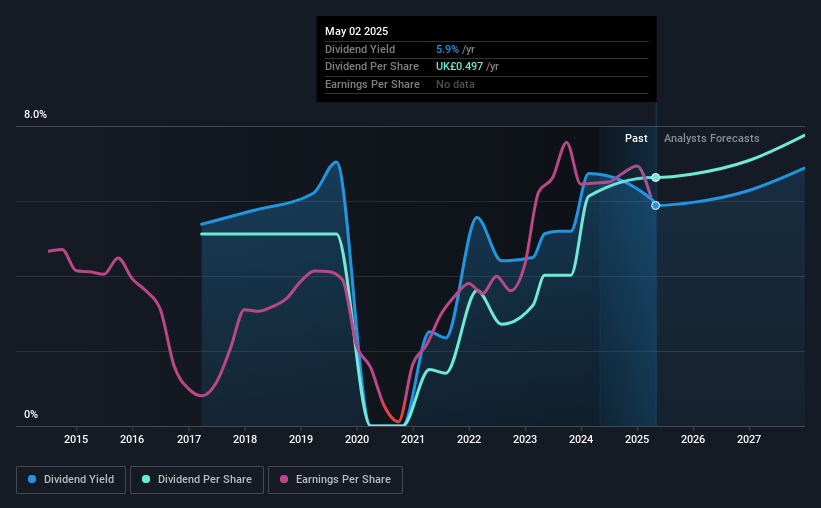
The company's next dividend payment will be US$0.10 per share, on the back of last year when the company paid a total of US$0.66 to shareholders. Looking at the last 12 months of distributions, HSBC Holdings has a trailing yield of approximately 5.9% on its current stock price of UK£8.454. If you buy this business for its dividend, you should have an idea of whether HSBC Holdings's dividend is reliable and sustainable. That's why we should always check whether the dividend payments appear sustainable, and if the company is growing.
We've discovered 2 warning signs about HSBC Holdings. View them for free.Dividends are typically paid from company earnings. If a company pays more in dividends than it earned in profit, then the dividend could be unsustainable. HSBC Holdings paid out more than half (61%) of its earnings last year, which is a regular payout ratio for most companies.
Generally speaking, the lower a company's payout ratios, the more resilient its dividend usually is.
See our latest analysis for HSBC Holdings
Click here to see the company's payout ratio, plus analyst estimates of its future dividends.
Have Earnings And Dividends Been Growing?
Stocks in companies that generate sustainable earnings growth often make the best dividend prospects, as it is easier to lift the dividend when earnings are rising. Investors love dividends, so if earnings fall and the dividend is reduced, expect a stock to be sold off heavily at the same time. That's why it's comforting to see HSBC Holdings's earnings have been skyrocketing, up 31% per annum for the past five years.
The main way most investors will assess a company's dividend prospects is by checking the historical rate of dividend growth. Since the start of our data, eight years ago, HSBC Holdings has lifted its dividend by approximately 3.3% a year on average. Earnings per share have been growing much quicker than dividends, potentially because HSBC Holdings is keeping back more of its profits to grow the business.
To Sum It Up
From a dividend perspective, should investors buy or avoid HSBC Holdings? HSBC Holdings has an acceptable payout ratio and its earnings per share have been improving at a decent rate. In summary, HSBC Holdings appears to have some promise as a dividend stock, and we'd suggest taking a closer look at it.
So while HSBC Holdings looks good from a dividend perspective, it's always worthwhile being up to date with the risks involved in this stock. Case in point: We've spotted 2 warning signs for HSBC Holdings you should be aware of.
Generally, we wouldn't recommend just buying the first dividend stock you see. Here's a curated list of interesting stocks that are strong dividend payers.
Valuation is complex, but we're here to simplify it.
Discover if HSBC Holdings might be undervalued or overvalued with our detailed analysis, featuring fair value estimates, potential risks, dividends, insider trades, and its financial condition.
Access Free AnalysisHave feedback on this article? Concerned about the content? Get in touch with us directly. Alternatively, email editorial-team (at) simplywallst.com.
This article by Simply Wall St is general in nature. We provide commentary based on historical data and analyst forecasts only using an unbiased methodology and our articles are not intended to be financial advice. It does not constitute a recommendation to buy or sell any stock, and does not take account of your objectives, or your financial situation. We aim to bring you long-term focused analysis driven by fundamental data. Note that our analysis may not factor in the latest price-sensitive company announcements or qualitative material. Simply Wall St has no position in any stocks mentioned.
About LSE:HSBA
HSBC Holdings
Engages in the provision of banking and financial products and services worldwide.
Adequate balance sheet second-rate dividend payer.
Similar Companies
Market Insights


Advertisement
Community Narratives
A Quality Compounder Marked Down on Overblown Fears
Fair Value US$120.72|62.4% undervalued
BA
Community Contributor

Wyndham Continues Global Expansion with 19% Ancillary Revenue Growth
Fair Value US$105.80|19.2% undervalued
ZW
Community Contributor