
Advertisement
- Australia
- /
- Professional Services
- /
- ASX:CPU
What Makes Computershare Limited (ASX:CPU) A Great Dividend Stock?
Today we'll take a closer look at Computershare Limited (ASX:CPU) from a dividend investor's perspective. Owning a strong dividend company and reinvesting the dividends is widely seen as an attractive way of growing your wealth. Yet sometimes, investors buy a popular dividend stock because of its yield, and then lose money if the company's dividend doesn't live up to expectations.
While Computershare's 2.3% dividend yield is not the highest, we think its lengthy payment history is quite interesting. Some simple analysis can offer a lot of insight when buying a company for its dividend, and we'll go through these below.
Click the interactive chart for our full dividend analysis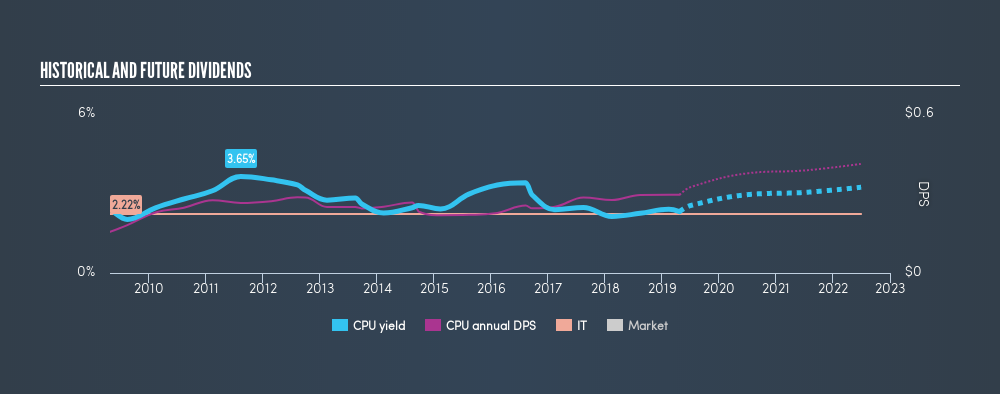
Payout ratios
Dividends are typically paid from company earnings. If a company pays more in dividends than it earned, then the dividend might become unsustainable - hardly an ideal situation. Comparing dividend payments to a company's net profit after tax is a simple way of reality-checking whether a dividend is sustainable. In the last year, Computershare paid out 41% of its profit as dividends. A medium payout ratio strikes a good balance between paying dividends, and keeping enough back to invest in the business. Besides, if reinvestment opportunities dry up, the company has room to increase the dividend.
Another important check we do is to see if the free cash flow generated is sufficient to pay the dividend. Computershare's cash payout ratio in the last year was 43%, which suggests dividends were well covered by cash generated by the business.
Is Computershare's Balance Sheet Risky?
As Computershare has a meaningful amount of debt, we need to check its balance sheet to see if the company might have debt risks.A quick way to check a company's financial situation uses these two ratios: net debt divided by EBITDA (earnings before interest, tax, depreciation and amortisation), and net interest cover. Net debt to EBITDA measures a company's total debt load relative to its earnings (lower = less debt), while net interest cover measures the company's ability to pay the interest on its debt (higher = greater ability to pay interest costs). With net debt of more than twice its EBITDA, Computershare has a noticeable amount of debt, although if business stays steady, this may not be overly concerning.
We calculated its interest cover by measuring its earnings before interest and tax (EBIT), and dividing this by the company's net interest expense. Computershare has EBIT of 7.46 times its interest expense, which we think is adequate.
Remember, you can always get a snapshot of Computershare's latest financial position, by checking our visualisation of its financial health.
Dividend Volatility
One of the major risks of relying on dividend income, is the potential for a company to struggle financially and cut its dividend. Not only is your income cut, but the value of your investment declines as well - nasty. For the purpose of this article, we only scrutinise the last decade of Computershare's dividend payments. The dividend has been cut by more than 20% on at least one occasion historically. During the past ten-year period, the first annual payment was US$0.16 in 2009, compared to US$0.30 last year. This works out to be a compound annual growth rate (CAGR) of approximately 6.6% a year over that time. The growth in dividends has not been linear, but the CAGR is a decent approximation of the rate of change over this time frame.
A reasonable rate of dividend growth is good to see, but we're wary that the dividend history is not as complete as we'd like.
Dividend Growth Potential
With a relatively unstable dividend, it's even more important to evaluate if earnings per share (EPS) are growing - it's not worth taking the risk on a dividend getting cut, unless you might be rewarded with larger dividends in future. It's good to see Computershare has been growing its earnings per share at 20% a year over the past 5 years. Earnings per share have rocketed in recent times, and we like that the company is retaining more than half of its earnings to reinvest. However, always remember that very few companies can grow at double digit rates forever.
Conclusion
Dividend investors should always want to know if a) a company's dividends are affordable, b) if there is a track record of consistent payments, and c) if the dividend is capable of growing. Firstly, we like that Computershare has low and conservative payout ratios. We were also glad to see it growing earnings, but it was concerning to see the dividend has been cut at least once in the past. Computershare performs well under this analysis, although it falls slightly short in some key areas. At the right valuation though, it may still be an interesting prospect.
Companies that are growing earnings tend to be the best dividend stocks over the long term. See what the 11 analysts we track are forecasting for Computershare for free with public analyst estimates for the company.
We have also put together a list of global stocks with a market capitalisation above $1bn and yielding more 3%.
We aim to bring you long-term focused research analysis driven by fundamental data. Note that our analysis may not factor in the latest price-sensitive company announcements or qualitative material.
If you spot an error that warrants correction, please contact the editor at editorial-team@simplywallst.com. This article by Simply Wall St is general in nature. It does not constitute a recommendation to buy or sell any stock, and does not take account of your objectives, or your financial situation. Simply Wall St has no position in the stocks mentioned. Thank you for reading.
MI

The Foxhole
Moderna nearly tripled overnight, and every other mRNA stock jumped with it. I think that could be a trap.

66
About ASX:CPU
Computershare
Provides issuer, corporate trust, employee share plans and voucher, communication and utilities, technology and operations, and mortgage and property rental services.
Excellent balance sheet average dividend payer.
Similar Companies
Market Insights


Advertisement
Weekly Picks
RI


Rick_Orford on Starfighters Space ·
The 1960s Fighter Jet That Could Crack Open a $20 Billion Satellite Market
Fair Value:US$520.6% undervalued
53 followersusers have followed this narrative
2 commentsusers have commented on this narrative
7 likesusers have liked this narrative
JO


John_Eric on MercadoLibre ·
MercadoLibre and the Spreadsheet Trick That Decides Everything
Fair Value:US$7.31k73.9% undervalued
97 followersusers have followed this narrative
2 commentsusers have commented on this narrative
14 likesusers have liked this narrative
RC

rcb9 on PayPal Holdings ·
Ten Percent More Volume, One Percent More Transaction Margin
Fair Value:US$70.8913.6% undervalued
12 followersusers have followed this narrative
1 commentusers have commented on this narrative
5 likesusers have liked this narrative
HE


HedgeY on Micron Technology ·
Micron - The Memory Bottleneck Behind the AI Supercycle
Fair Value:US$1.25k25.0% undervalued
35 followersusers have followed this narrative
0 commentsusers have commented on this narrative
11 likesusers have liked this narrative
Recently Updated Narratives
AS


AstrisCorporateAdvisory on Mitsubishi Research Institute ·
Exceptionally strong Q1 results, while FY guidance intact
Fair Value:JP¥4.2k18.8% overvalued
1 followerusers have followed this narrative
0 commentsusers have commented on this narrative
0 likesusers have liked this narrative
AN


ANTONI0 on IDP Education ·
IDP Education Limited (ASX: IEL) - A contrarian Review
Fair Value:AU$4.6563.0% undervalued
3 followersusers have followed this narrative
0 commentsusers have commented on this narrative
0 likesusers have liked this narrative
AN

ANTONI0 on Dusk Group ·
Dusk Group (ASX: DSK) — FY26: A Better Business With Less Money. No Margin of Safety at Current Price
Fair Value:AU$0.6618.2% overvalued
1 followerusers have followed this narrative
0 commentsusers have commented on this narrative
0 likesusers have liked this narrative
Popular Narratives
OS


oscargarcia on NVIDIA ·
The company that went from selling GPUs to gamers to becoming the AI arms dealer of the 21st century.
Fair Value:US$28022.3% undervalued
330 followersusers have followed this narrative
9 commentsusers have commented on this narrative
16 likesusers have liked this narrative
CU

CubanEros on Microsoft ·
A wonderful business at reasonable price.
Fair Value:US$419.9115.3% overvalued
184 followersusers have followed this narrative
0 commentsusers have commented on this narrative
9 likesusers have liked this narrative
KI

KiwiInvest on Amazon.com ·
Amazon's high growth, high tech segments propel its profits, while traditional segments plod along
Fair Value:US$475.0944.0% undervalued
209 followersusers have followed this narrative
1 commentusers have commented on this narrative
8 likesusers have liked this narrative
Trending Discussion
JA
james_rxfd8 on Starfighters Space ·
How is this different to Virgin Orbit, which didn’t seem to work out, with a very similar plan?
4
|2

