We're Interested To See How Dimerix (ASX:DXB) Uses Its Cash Hoard To Grow


Even when a business is losing money, it's possible for shareholders to make money if they buy a good business at the right price. For example, biotech and mining exploration companies often lose money for years before finding success with a new treatment or mineral discovery. But the harsh reality is that very many loss making companies burn through all their cash and go bankrupt.
So should Dimerix (ASX:DXB) shareholders be worried about its cash burn? In this report, we will consider the company's annual negative free cash flow, henceforth referring to it as the 'cash burn'. The first step is to compare its cash burn with its cash reserves, to give us its 'cash runway'.
Check out our latest analysis for Dimerix
Does Dimerix Have A Long Cash Runway?
You can calculate a company's cash runway by dividing the amount of cash it has by the rate at which it is spending that cash. In June 2024, Dimerix had AU$22m in cash, and was debt-free. In the last year, its cash burn was AU$7.0m. So it had a cash runway of about 3.2 years from June 2024. A runway of this length affords the company the time and space it needs to develop the business. Depicted below, you can see how its cash holdings have changed over time.
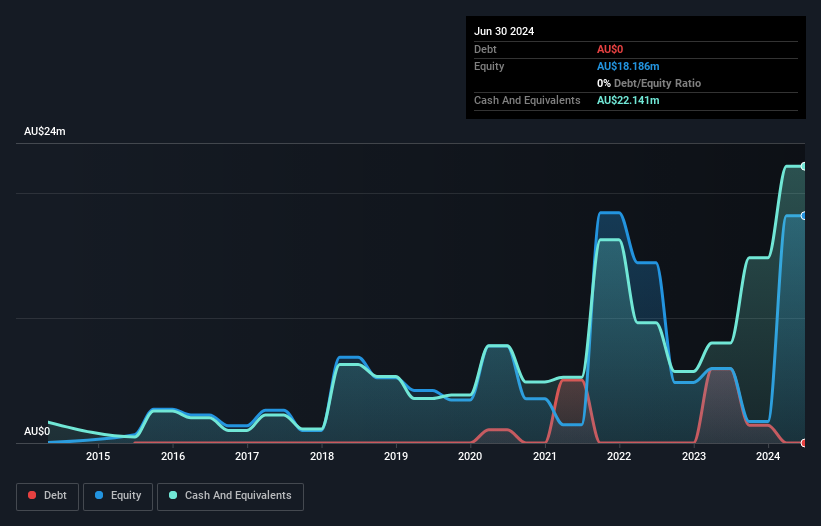
How Is Dimerix's Cash Burn Changing Over Time?
In our view, Dimerix doesn't yet produce significant amounts of operating revenue, since it reported just AU$583k in the last twelve months. Therefore, for the purposes of this analysis we'll focus on how the cash burn is tracking. While it hardly paints a picture of imminent growth, the fact that it has reduced its cash burn by 45% over the last year suggests some degree of prudence. Admittedly, we're a bit cautious of Dimerix due to its lack of significant operating revenues. We prefer most of the stocks on this list of stocks that analysts expect to grow.
Can Dimerix Raise More Cash Easily?
While Dimerix is showing a solid reduction in its cash burn, it's still worth considering how easily it could raise more cash, even just to fuel faster growth. Generally speaking, a listed business can raise new cash through issuing shares or taking on debt. Commonly, a business will sell new shares in itself to raise cash and drive growth. We can compare a company's cash burn to its market capitalisation to get a sense for how many new shares a company would have to issue to fund one year's operations.
Dimerix has a market capitalisation of AU$176m and burnt through AU$7.0m last year, which is 4.0% of the company's market value. That's a low proportion, so we figure the company would be able to raise more cash to fund growth, with a little dilution, or even to simply borrow some money.
Is Dimerix's Cash Burn A Worry?
As you can probably tell by now, we're not too worried about Dimerix's cash burn. In particular, we think its cash runway stands out as evidence that the company is well on top of its spending. But it's fair to say that its cash burn reduction was also very reassuring. Taking all the factors in this report into account, we're not at all worried about its cash burn, as the business appears well capitalized to spend as needs be. On another note, we conducted an in-depth investigation of the company, and identified 3 warning signs for Dimerix (2 are significant!) that you should be aware of before investing here.
If you would prefer to check out another company with better fundamentals, then do not miss this free list of interesting companies, that have HIGH return on equity and low debt or this list of stocks which are all forecast to grow.
New: Manage All Your Stock Portfolios in One Place
We've created the ultimate portfolio companion for stock investors, and it's free.
• Connect an unlimited number of Portfolios and see your total in one currency
• Be alerted to new Warning Signs or Risks via email or mobile
• Track the Fair Value of your stocks
Have feedback on this article? Concerned about the content? Get in touch with us directly. Alternatively, email editorial-team (at) simplywallst.com.
This article by Simply Wall St is general in nature. We provide commentary based on historical data and analyst forecasts only using an unbiased methodology and our articles are not intended to be financial advice. It does not constitute a recommendation to buy or sell any stock, and does not take account of your objectives, or your financial situation. We aim to bring you long-term focused analysis driven by fundamental data. Note that our analysis may not factor in the latest price-sensitive company announcements or qualitative material. Simply Wall St has no position in any stocks mentioned.
About ASX:DXB
Dimerix
A biopharmaceutical company, develops and commercializes pharmaceutical products for unmet medical needs in Australia.
Flawless balance sheet slight.
Market Insights

Community Narratives