
Advertisement
- United Kingdom
- /
- Industrials
- /
- LSE:SMIN
Smiths Group (LON:SMIN) Seems To Use Debt Quite Sensibly
The external fund manager backed by Berkshire Hathaway's Charlie Munger, Li Lu, makes no bones about it when he says 'The biggest investment risk is not the volatility of prices, but whether you will suffer a permanent loss of capital. When we think about how risky a company is, we always like to look at its use of debt, since debt overload can lead to ruin. We can see that Smiths Group plc (LON:SMIN) does use debt in its business. But the real question is whether this debt is making the company risky.
Why Does Debt Bring Risk?
Generally speaking, debt only becomes a real problem when a company can't easily pay it off, either by raising capital or with its own cash flow. If things get really bad, the lenders can take control of the business. However, a more common (but still painful) scenario is that it has to raise new equity capital at a low price, thus permanently diluting shareholders. Of course, plenty of companies use debt to fund growth, without any negative consequences. The first step when considering a company's debt levels is to consider its cash and debt together.
View our latest analysis for Smiths Group
What Is Smiths Group's Debt?
As you can see below, Smiths Group had UK£1.51b of debt at July 2019, down from UK£1.61b a year prior. However, it also had UK£289.0m in cash, and so its net debt is UK£1.22b.
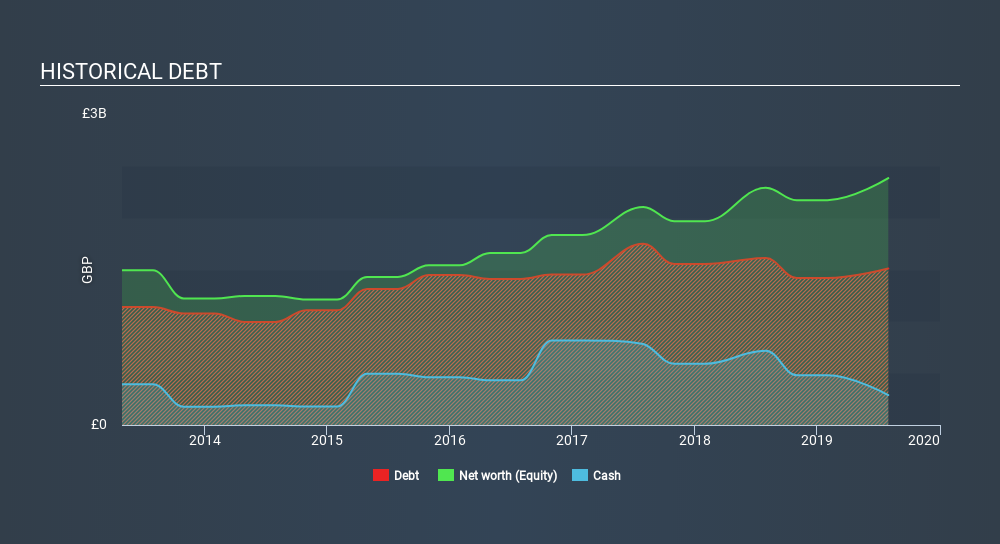
How Healthy Is Smiths Group's Balance Sheet?
Zooming in on the latest balance sheet data, we can see that Smiths Group had liabilities of UK£918.0m due within 12 months and liabilities of UK£2.02b due beyond that. On the other hand, it had cash of UK£289.0m and UK£750.0m worth of receivables due within a year. So its liabilities total UK£1.90b more than the combination of its cash and short-term receivables.
While this might seem like a lot, it is not so bad since Smiths Group has a market capitalization of UK£6.07b, and so it could probably strengthen its balance sheet by raising capital if it needed to. However, it is still worthwhile taking a close look at its ability to pay off debt.
We use two main ratios to inform us about debt levels relative to earnings. The first is net debt divided by earnings before interest, tax, depreciation, and amortization (EBITDA), while the second is how many times its earnings before interest and tax (EBIT) covers its interest expense (or its interest cover, for short). The advantage of this approach is that we take into account both the absolute quantum of debt (with net debt to EBITDA) and the actual interest expenses associated with that debt (with its interest cover ratio).
Smiths Group's net debt of 2.4 times EBITDA suggests graceful use of debt. And the alluring interest cover (EBIT of 7.8 times interest expense) certainly does not do anything to dispel this impression. Smiths Group grew its EBIT by 10.0% in the last year. That's far from incredible but it is a good thing, when it comes to paying off debt. The balance sheet is clearly the area to focus on when you are analysing debt. But it is future earnings, more than anything, that will determine Smiths Group's ability to maintain a healthy balance sheet going forward. So if you're focused on the future you can check out this free report showing analyst profit forecasts.
Finally, a company can only pay off debt with cold hard cash, not accounting profits. So we always check how much of that EBIT is translated into free cash flow. During the last three years, Smiths Group produced sturdy free cash flow equating to 68% of its EBIT, about what we'd expect. This cold hard cash means it can reduce its debt when it wants to.
Our View
The good news is that Smiths Group's demonstrated ability to convert EBIT to free cash flow delights us like a fluffy puppy does a toddler. But, on a more sombre note, we are a little concerned by its net debt to EBITDA. Looking at all the aforementioned factors together, it strikes us that Smiths Group can handle its debt fairly comfortably. On the plus side, this leverage can boost shareholder returns, but the potential downside is more risk of loss, so it's worth monitoring the balance sheet. When analysing debt levels, the balance sheet is the obvious place to start. But ultimately, every company can contain risks that exist outside of the balance sheet. Be aware that Smiths Group is showing 2 warning signs in our investment analysis , you should know about...
If you're interested in investing in businesses that can grow profits without the burden of debt, then check out this free list of growing businesses that have net cash on the balance sheet.
If you spot an error that warrants correction, please contact the editor at editorial-team@simplywallst.com. This article by Simply Wall St is general in nature. It does not constitute a recommendation to buy or sell any stock, and does not take account of your objectives, or your financial situation. Simply Wall St has no position in the stocks mentioned.
We aim to bring you long-term focused research analysis driven by fundamental data. Note that our analysis may not factor in the latest price-sensitive company announcements or qualitative material. Thank you for reading.
 mitchell_lawler
The Foxhole
A dozen retail giants report this week, and they won't agree on whether the consumer is healthy. What if that disagreement is the real signal?
88
PowerLaw
I won't rely solely on Retail Sales. It only tell you what was spent. Credit data is the one that tells you how. For me the latter is more important than the former.
About LSE:SMIN
Smiths Group
Operates as an industrial technology company in Americas, Europe, the Asia Pacific, and internationally.
Adequate balance sheet second-rate dividend payer.
Similar Companies
Market Insights

Advertisement
Weekly Picks
RI


Rick_Orford on Starfighters Space ·
The 1960s Fighter Jet That Could Crack Open a $20 Billion Satellite Market
Fair Value:US$515.2% undervalued
37 followersusers have followed this narrative
2 commentsusers have commented on this narrative
7 likesusers have liked this narrative
FU


FundamentalFlow on Vertiv Holdings Co ·
The Short and Long Term Compounder of Liquid Cooling industry.
Fair Value:US$45034.7% undervalued
67 followersusers have followed this narrative
0 commentsusers have commented on this narrative
13 likesusers have liked this narrative
JO


John_Eric on SPX Technologies ·
I Fell in Love With a Data-Center Cooling Stock. Then I Opened the Filings.
Fair Value:US$2037.1% overvalued
30 followersusers have followed this narrative
2 commentsusers have commented on this narrative
11 likesusers have liked this narrative
TR


tripledub on GQG Partners ·
The Cheap Genius Problem
Fair Value:AU$3.2154.8% undervalued
36 followersusers have followed this narrative
0 commentsusers have commented on this narrative
24 likesusers have liked this narrative
Recently Updated Narratives
LU

LunaRodas on InspireMD ·
NSPR | InspireMD Q2 2026: What They Said vs. What They Did
Fair Value:US$2.8365.3% undervalued
1 followerusers have followed this narrative
0 commentsusers have commented on this narrative
0 likesusers have liked this narrative
AS


AstrisCorporateAdvisory on MIXI ·
Growth engine emerging, evolution beyond legacy core earnings
Fair Value:JP¥2.68k22.6% overvalued
1 followerusers have followed this narrative
0 commentsusers have commented on this narrative
0 likesusers have liked this narrative
AS

AstrisCorporateAdvisory on Itoki ·
Positioned strongly with strategic clarity and structural reform
Fair Value:JP¥3.55k26.3% undervalued
3 followersusers have followed this narrative
0 commentsusers have commented on this narrative
0 likesusers have liked this narrative
Popular Narratives
OS


oscargarcia on NVIDIA ·
The company that went from selling GPUs to gamers to becoming the AI arms dealer of the 21st century.
Fair Value:US$28019.6% undervalued
316 followersusers have followed this narrative
9 commentsusers have commented on this narrative
16 likesusers have liked this narrative
CU

CubanEros on Microsoft ·
A wonderful business at reasonable price.
Fair Value:US$419.9118.0% overvalued
173 followersusers have followed this narrative
0 commentsusers have commented on this narrative
8 likesusers have liked this narrative
KI

KiwiInvest on Amazon.com ·
Amazon's high growth, high tech segments propel its profits, while traditional segments plod along
Fair Value:US$475.0944.7% undervalued
195 followersusers have followed this narrative
1 commentusers have commented on this narrative
8 likesusers have liked this narrative
Trending Discussion
JA
james_rxfd8 on Starfighters Space ·
How is this different to Virgin Orbit, which didn’t seem to work out, with a very similar plan?
4
|2
GE

george_b177x on Bloom Energy ·
Brilliant analysis. Great company with proven product and service!
1
|1