
Advertisement
- United Kingdom
- /
- Specialty Stores
- /
- LSE:DNLM
Here's What Dunelm Group plc's (LON:DNLM) P/E Is Telling Us
Want to participate in a short research study? Help shape the future of investing tools and you could win a $250 gift card!
Today, we'll introduce the concept of the P/E ratio for those who are learning about investing. We'll apply a basic P/E ratio analysis to Dunelm Group plc's (LON:DNLM), to help you decide if the stock is worth further research. Based on the last twelve months, Dunelm Group's P/E ratio is 22.11. That means that at current prices, buyers pay £22.11 for every £1 in trailing yearly profits.
View our latest analysis for Dunelm Group
How Do I Calculate A Price To Earnings Ratio?
The formula for P/E is:
Price to Earnings Ratio = Share Price ÷ Earnings per Share (EPS)
Or for Dunelm Group:
P/E of 22.11 = £9.21 ÷ £0.42 (Based on the trailing twelve months to December 2018.)
Is A High P/E Ratio Good?
A higher P/E ratio means that buyers have to pay a higher price for each £1 the company has earned over the last year. That isn't necessarily good or bad, but a high P/E implies relatively high expectations of what a company can achieve in the future.
How Growth Rates Impact P/E Ratios
If earnings fall then in the future the 'E' will be lower. That means unless the share price falls, the P/E will increase in a few years. Then, a higher P/E might scare off shareholders, pushing the share price down.
It's great to see that Dunelm Group grew EPS by 14% in the last year. In contrast, EPS has decreased by 6.2%, annually, over 3 years.
How Does Dunelm Group's P/E Ratio Compare To Its Peers?
The P/E ratio essentially measures market expectations of a company. As you can see below, Dunelm Group has a higher P/E than the average company (12) in the specialty retail industry.
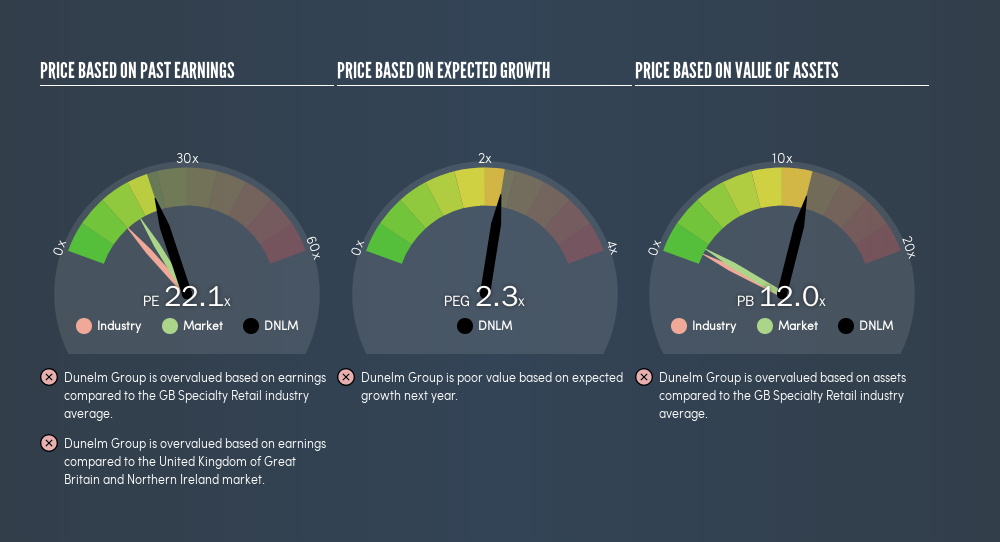
Dunelm Group's P/E tells us that market participants think the company will perform better than its industry peers, going forward.
A Limitation: P/E Ratios Ignore Debt and Cash In The Bank
One drawback of using a P/E ratio is that it considers market capitalization, but not the balance sheet. Thus, the metric does not reflect cash or debt held by the company. Theoretically, a business can improve its earnings (and produce a lower P/E in the future) by investing in growth. That means taking on debt (or spending its cash).
Spending on growth might be good or bad a few years later, but the point is that the P/E ratio does not account for the option (or lack thereof).
Is Debt Impacting Dunelm Group's P/E?
Dunelm Group has net debt worth just 3.9% of its market capitalization. It would probably trade on a higher P/E ratio if it had a lot of cash, but I doubt it is having a big impact.
The Verdict On Dunelm Group's P/E Ratio
Dunelm Group's P/E is 22.1 which is above average (16.4) in the GB market. Its debt levels do not imperil its balance sheet and it is growing EPS strongly. So on this analysis it seems reasonable that its P/E ratio is above average.
When the market is wrong about a stock, it gives savvy investors an opportunity. People often underestimate remarkable growth -- so investors can make money when fast growth is not fully appreciated. So this free report on the analyst consensus forecasts could help you make a master move on this stock.
Of course you might be able to find a better stock than Dunelm Group. So you may wish to see this free collection of other companies that have grown earnings strongly.
We aim to bring you long-term focused research analysis driven by fundamental data. Note that our analysis may not factor in the latest price-sensitive company announcements or qualitative material.
If you spot an error that warrants correction, please contact the editor at editorial-team@simplywallst.com. This article by Simply Wall St is general in nature. It does not constitute a recommendation to buy or sell any stock, and does not take account of your objectives, or your financial situation. Simply Wall St has no position in the stocks mentioned. Thank you for reading.
 mitchell_lawler
The Foxhole
Micron (MU) is booming, and it still doesn't look ‘expensive’ based on next year's earnings. So why does our own valuation say it could be worth 40% less?
2412
zoe_vi5fn
A low price to earnings ratio at the top of the cycle is a warning rather than a bargain, and a terrifyingly high one at the bottom is often the entry point
darius_xnnrd
Memory used to have a dozen participants racing each other into oversupply, and now it has three. High bandwidth memory is qualified into customer designs years ahead, sold under long-term agreements, and is far harder to switch away from than commodity DRAM.
About LSE:DNLM
Dunelm Group
Engages in the retail of homewares in the United Kingdom.
Undervalued established dividend payer.
Similar Companies
Market Insights

Advertisement
Weekly Picks
RI


Rick_Orford on Starfighters Space ·
The 1960s Fighter Jet That Could Crack Open a $20 Billion Satellite Market
Fair Value:US$515.2% undervalued
34 followersusers have followed this narrative
1 commentusers have commented on this narrative
6 likesusers have liked this narrative
FU


FundamentalFlow on Vertiv Holdings Co ·
The Short and Long Term Compounder of Liquid Cooling industry.
Fair Value:US$45034.7% undervalued
62 followersusers have followed this narrative
0 commentsusers have commented on this narrative
12 likesusers have liked this narrative
JO


John_Eric on SPX Technologies ·
I Fell in Love With a Data-Center Cooling Stock. Then I Opened the Filings.
Fair Value:US$2037.1% overvalued
26 followersusers have followed this narrative
2 commentsusers have commented on this narrative
10 likesusers have liked this narrative
TR


tripledub on GQG Partners ·
The Cheap Genius Problem
Fair Value:AU$3.2155.0% undervalued
36 followersusers have followed this narrative
0 commentsusers have commented on this narrative
24 likesusers have liked this narrative
Recently Updated Narratives
SE


Sertan1978 on International Business Machines ·
Why I See IBM as a Long-Term Enterprise AI and Hybrid Cloud Play
Fair Value:US$166.7340.5% overvalued
0 followersusers have followed this narrative
0 commentsusers have commented on this narrative
0 likesusers have liked this narrative
AN


andrei9868 on Vistra ·
Vistra Energy ($VST): The Flexible Power Platform Capturing AI Load Growth
Fair Value:US$22534.2% undervalued
1 followerusers have followed this narrative
0 commentsusers have commented on this narrative
0 likesusers have liked this narrative
AN

andrei9868 on Constellation Energy ·
Constellation Energy ($CEG): The Nuclear Scarcity Play Powering the AI Demand Boom
Fair Value:US$35019.3% undervalued
1 followerusers have followed this narrative
0 commentsusers have commented on this narrative
0 likesusers have liked this narrative
Popular Narratives
OS


oscargarcia on NVIDIA ·
The company that went from selling GPUs to gamers to becoming the AI arms dealer of the 21st century.
Fair Value:US$28019.6% undervalued
313 followersusers have followed this narrative
9 commentsusers have commented on this narrative
16 likesusers have liked this narrative
CU

CubanEros on Microsoft ·
A wonderful business at reasonable price.
Fair Value:US$419.9118.0% overvalued
171 followersusers have followed this narrative
0 commentsusers have commented on this narrative
8 likesusers have liked this narrative
KI

KiwiInvest on Amazon.com ·
Amazon's high growth, high tech segments propel its profits, while traditional segments plod along
Fair Value:US$475.0944.7% undervalued
192 followersusers have followed this narrative
1 commentusers have commented on this narrative
8 likesusers have liked this narrative
Trending Discussion
JA
james_rxfd8 on Starfighters Space ·
How is this different to Virgin Orbit, which didn’t seem to work out, with a very similar plan?
3
|2
GE

george_b177x on Bloom Energy ·
Brilliant analysis. Great company with proven product and service!
1
|1