
Advertisement
- United States
- /
- Life Sciences
- /
- NasdaqCM:HBIO
Harvard Bioscience (NASDAQ:HBIO) Is Making Moderate Use Of Debt
Warren Buffett famously said, 'Volatility is far from synonymous with risk.' When we think about how risky a company is, we always like to look at its use of debt, since debt overload can lead to ruin. We note that Harvard Bioscience, Inc. (NASDAQ:HBIO) does have debt on its balance sheet. But the more important question is: how much risk is that debt creating?
What Risk Does Debt Bring?
Debt assists a business until the business has trouble paying it off, either with new capital or with free cash flow. In the worst case scenario, a company can go bankrupt if it cannot pay its creditors. However, a more frequent (but still costly) occurrence is where a company must issue shares at bargain-basement prices, permanently diluting shareholders, just to shore up its balance sheet. Of course, debt can be an important tool in businesses, particularly capital heavy businesses. The first step when considering a company's debt levels is to consider its cash and debt together.
Check out our latest analysis for Harvard Bioscience
What Is Harvard Bioscience's Debt?
You can click the graphic below for the historical numbers, but it shows that Harvard Bioscience had US$44.4m of debt in June 2020, down from US$55.4m, one year before. However, it also had US$2.63m in cash, and so its net debt is US$41.8m.
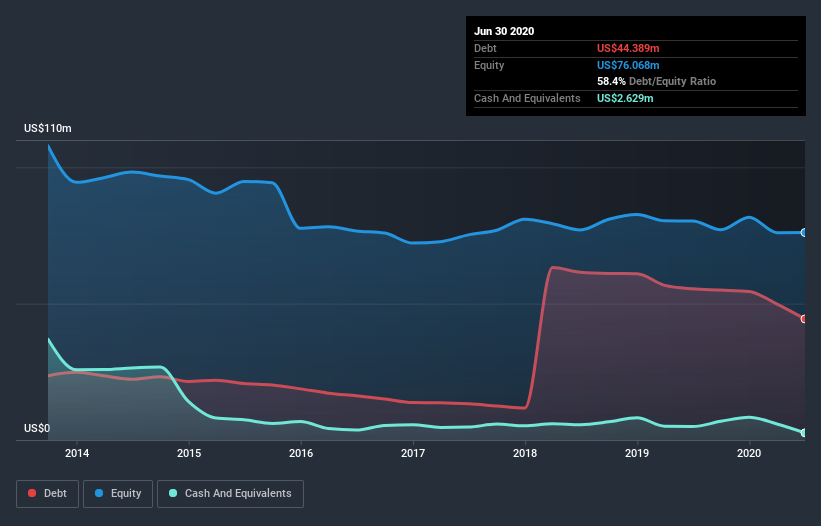
How Strong Is Harvard Bioscience's Balance Sheet?
Zooming in on the latest balance sheet data, we can see that Harvard Bioscience had liabilities of US$22.7m due within 12 months and liabilities of US$52.0m due beyond that. Offsetting these obligations, it had cash of US$2.63m as well as receivables valued at US$14.7m due within 12 months. So it has liabilities totalling US$57.3m more than its cash and near-term receivables, combined.
While this might seem like a lot, it is not so bad since Harvard Bioscience has a market capitalization of US$130.5m, and so it could probably strengthen its balance sheet by raising capital if it needed to. However, it is still worthwhile taking a close look at its ability to pay off debt. When analysing debt levels, the balance sheet is the obvious place to start. But ultimately the future profitability of the business will decide if Harvard Bioscience can strengthen its balance sheet over time. So if you're focused on the future you can check out this free report showing analyst profit forecasts.
Over 12 months, Harvard Bioscience made a loss at the EBIT level, and saw its revenue drop to US$105m, which is a fall of 12%. That's not what we would hope to see.
Caveat Emptor
Not only did Harvard Bioscience's revenue slip over the last twelve months, but it also produced negative earnings before interest and tax (EBIT). Indeed, it lost US$1.7m at the EBIT level. Considering that alongside the liabilities mentioned above does not give us much confidence that company should be using so much debt. Quite frankly we think the balance sheet is far from match-fit, although it could be improved with time. We would feel better if it turned its trailing twelve month loss of US$8.2m into a profit. So in short it's a really risky stock. When analysing debt levels, the balance sheet is the obvious place to start. But ultimately, every company can contain risks that exist outside of the balance sheet. For example, we've discovered 3 warning signs for Harvard Bioscience that you should be aware of before investing here.
At the end of the day, it's often better to focus on companies that are free from net debt. You can access our special list of such companies (all with a track record of profit growth). It's free.
If you decide to trade Harvard Bioscience, use the lowest-cost* platform that is rated #1 Overall by Barron’s, Interactive Brokers. Trade stocks, options, futures, forex, bonds and funds on 135 markets, all from a single integrated account. Promoted
Valuation is complex, but we're here to simplify it.
Discover if Harvard Bioscience might be undervalued or overvalued with our detailed analysis, featuring fair value estimates, potential risks, dividends, insider trades, and its financial condition.
Access Free AnalysisThis article by Simply Wall St is general in nature. It does not constitute a recommendation to buy or sell any stock, and does not take account of your objectives, or your financial situation. We aim to bring you long-term focused analysis driven by fundamental data. Note that our analysis may not factor in the latest price-sensitive company announcements or qualitative material. Simply Wall St has no position in any stocks mentioned.
*Interactive Brokers Rated Lowest Cost Broker by StockBrokers.com Annual Online Review 2020
Have feedback on this article? Concerned about the content? Get in touch with us directly. Alternatively, email editorial-team@simplywallst.com.
About NasdaqCM:HBIO
Harvard Bioscience
Develops, manufactures, and sells technologies, products, and services for life science applications in the Americas, Europe, the Middle East, Africa, Asia, and internationally.
Adequate balance sheet and fair value.
Similar Companies
Market Insights



Advertisement
Weekly Picks
CE


Ceazar on Sparc AI ·
When GPS fails: this small cap is fixing a $54B drone problem
Fair Value:CA$5.2537.3% undervalued
140 followersusers have followed this narrative
0 commentsusers have commented on this narrative
26 likesusers have liked this narrative
HA


HarishPK on Amdocs ·
Why Amdocs is a high conviction Buy for me?
Fair Value:US$82.0330.9% undervalued
15 followersusers have followed this narrative
1 commentusers have commented on this narrative
3 likesusers have liked this narrative
IV

Ivoed on SBM Offshore ·
Why SBM Offshore’s €30 Share Price May Be Too Harsh On Its Backlog
Fair Value:€44.528.6% undervalued
8 followersusers have followed this narrative
0 commentsusers have commented on this narrative
2 likesusers have liked this narrative
CL


Clive_Thompson on Green Tea Group ·
One of China's Fastest-Growing Restaurant Chains Trades on Just 7x Earnings and an 8% Dividend
Fair Value:HK$8.726.1% undervalued
21 followersusers have followed this narrative
3 commentsusers have commented on this narrative
14 likesusers have liked this narrative
Recently Updated Narratives
ON

Ontological on Ryde Group ·
Ryde Group Ltd (NYSE American: RYDE): A High-Growth Challenger in Asia’s Digital Mobility and Quick Commerce
Fair Value:US$8.1789.9% undervalued
1 followerusers have followed this narrative
0 commentsusers have commented on this narrative
0 likesusers have liked this narrative
DR


DrPotato on Yum! Brands ·
Yum! Brands: A High-Quality Compounder With Continued Global Growth Potential
Fair Value:US$179.8317.9% undervalued
1 followerusers have followed this narrative
0 commentsusers have commented on this narrative
0 likesusers have liked this narrative
TR


tripledub on EDU Holdings ·
The Tiny Australian School Stock That Bought Back a Quarter of Itself While Nobody Was Looking
Fair Value:AU$1.7732.8% undervalued
6 followersusers have followed this narrative
0 commentsusers have commented on this narrative
0 likesusers have liked this narrative
Popular Narratives
OS


oscargarcia on NVIDIA ·
The company that went from selling GPUs to gamers to becoming the AI arms dealer of the 21st century.
Fair Value:US$28024.3% undervalued
248 followersusers have followed this narrative
9 commentsusers have commented on this narrative
16 likesusers have liked this narrative
CU

CubanEros on Microsoft ·
A wonderful business at reasonable price.
Fair Value:US$419.9117.4% overvalued
118 followersusers have followed this narrative
0 commentsusers have commented on this narrative
7 likesusers have liked this narrative
TR

tripledub on Alphabet ·
Warren Buffett Just Bet $10 Billion on Google. The Catch? You May Already Be Too Late.
Fair Value:US$202.6286.4% overvalued
133 followersusers have followed this narrative
1 commentusers have commented on this narrative
18 likesusers have liked this narrative
Trending Discussion
GR

greg_xasak on Fiserv ·
As someone who has dealt directly with them as a CTO for a credit union, I have 8 years of horror stories about doing business with them. If there was any other competitor than could deliver 80% of Fiserv services, there would be a mad rush to migrate to them. They should thank their lucky stars they are a near monopoly. this industry is so ripe for a well funded competitor. Their integration of technology is awful, their ability to fix their own implementation screwups is sadly tragic. Sometimes they just silently kill support tickets without resolution and you never find out until you do a follow up inquiry. Why, because sometimes no one you are dealing with knows how to fix it and knows no one to ask for help. They can not meet their own implementation deadlines and sometimes there is no one on a technical team dealing with you that has any banking or credit union experience. The is an industry insider phrase when you meet other Fiserv customers called being "Fiserved". It means telling others of your worst stories of dealing with them. Ask around, all CTO's have some doozies.
4
|0
YA


Yash_Upadhyaya on Reddit ·
Steve blamed "choppy" Google referral traffic for the miss on US daily active user (DAU) WHILST being in a standoff with Google on the AI licensing deal... hmm 🤔 One way or another a deal is happening. What's gonna be interesting is to see how good or bad (which the market is pricing in) would it be. PS - I don't own the stock but like the company.
1
|0
