
Advertisement
- Hong Kong
- /
- Basic Materials
- /
- SEHK:2233
Does West China Cement Limited (HKG:2233) Have A Good P/E Ratio?
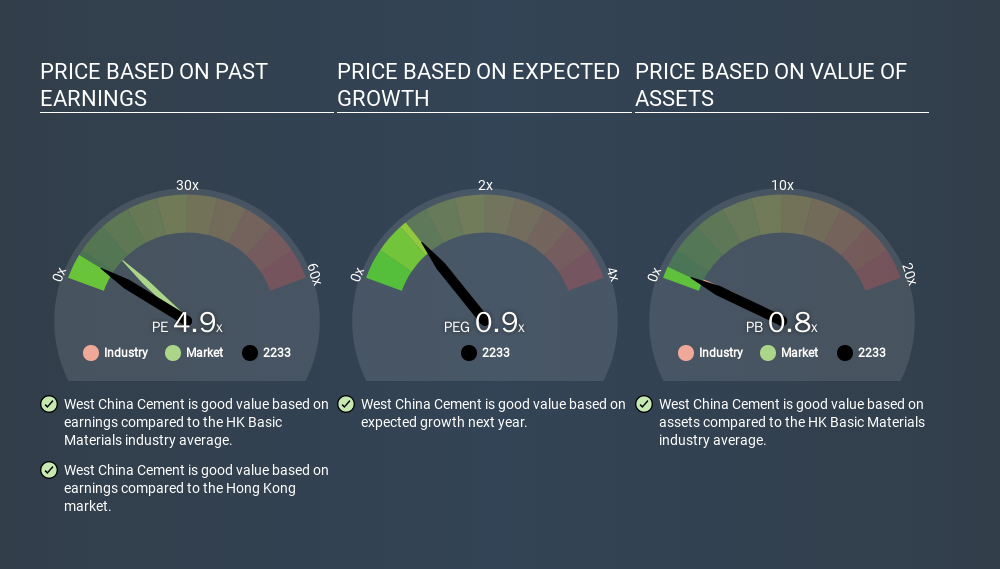
Today, we'll introduce the concept of the P/E ratio for those who are learning about investing. To keep it practical, we'll show how West China Cement Limited's (HKG:2233) P/E ratio could help you assess the value on offer. Based on the last twelve months, West China Cement's P/E ratio is 4.93. In other words, at today's prices, investors are paying HK$4.93 for every HK$1 in prior year profit.
See our latest analysis for West China Cement
How Do You Calculate A P/E Ratio?
The formula for P/E is:
Price to Earnings Ratio = Price per Share (in the reporting currency) ÷ Earnings per Share (EPS)
Or for West China Cement:
P/E of 4.93 = CNY1.19 (Note: this is the share price in the reporting currency, namely, CNY ) ÷ CNY0.24 (Based on the year to June 2019.)
Is A High Price-to-Earnings Ratio Good?
The higher the P/E ratio, the higher the price tag of a business, relative to its trailing earnings. That isn't necessarily good or bad, but a high P/E implies relatively high expectations of what a company can achieve in the future.
Does West China Cement Have A Relatively High Or Low P/E For Its Industry?
The P/E ratio essentially measures market expectations of a company. You can see in the image below that the average P/E (5.3) for companies in the basic materials industry is roughly the same as West China Cement's P/E.
That indicates that the market expects West China Cement will perform roughly in line with other companies in its industry. The company could surprise by performing better than average, in the future. Further research into factors such as insider buying and selling, could help you form your own view on whether that is likely.
How Growth Rates Impact P/E Ratios
Earnings growth rates have a big influence on P/E ratios. That's because companies that grow earnings per share quickly will rapidly increase the 'E' in the equation. That means unless the share price increases, the P/E will reduce in a few years. Then, a lower P/E should attract more buyers, pushing the share price up.
It's great to see that West China Cement grew EPS by 14% in the last year. And it has bolstered its earnings per share by 24% per year over the last five years. So one might expect an above average P/E ratio.
Remember: P/E Ratios Don't Consider The Balance Sheet
Don't forget that the P/E ratio considers market capitalization. In other words, it does not consider any debt or cash that the company may have on the balance sheet. Theoretically, a business can improve its earnings (and produce a lower P/E in the future) by investing in growth. That means taking on debt (or spending its cash).
Spending on growth might be good or bad a few years later, but the point is that the P/E ratio does not account for the option (or lack thereof).
Is Debt Impacting West China Cement's P/E?
West China Cement's net debt equates to 26% of its market capitalization. While it's worth keeping this in mind, it isn't a worry.
The Bottom Line On West China Cement's P/E Ratio
West China Cement's P/E is 4.9 which is below average (9.9) in the HK market. The company does have a little debt, and EPS growth was good last year. The low P/E ratio suggests current market expectations are muted, implying these levels of growth will not continue. Because analysts are predicting more growth in the future, one might have expected to see a higher P/E ratio. You can take a closer look at the fundamentals, here.
Investors should be looking to buy stocks that the market is wrong about. If it is underestimating a company, investors can make money by buying and holding the shares until the market corrects itself. So this free visualization of the analyst consensus on future earnings could help you make the right decision about whether to buy, sell, or hold.
Of course, you might find a fantastic investment by looking at a few good candidates. So take a peek at this free list of companies with modest (or no) debt, trading on a P/E below 20.
If you spot an error that warrants correction, please contact the editor at editorial-team@simplywallst.com. This article by Simply Wall St is general in nature. It does not constitute a recommendation to buy or sell any stock, and does not take account of your objectives, or your financial situation. Simply Wall St has no position in the stocks mentioned.
We aim to bring you long-term focused research analysis driven by fundamental data. Note that our analysis may not factor in the latest price-sensitive company announcements or qualitative material. Thank you for reading.
 mitchell_lawler
The Foxhole
People are still arguing about whether Nvidia's chips are the fastest. What if Jensen just built a moat that has nothing to do with the chips?
1112
PowerLaw
I wonder why Jensen is doing this. It just increases the risks of failure multifold.
zoe_vi5fn
The bearishness in threads like this is itself worth examining. Every large financing innovation has been called a bubble structure at inception, including securitisation of aircraft, of shipping, of fibre and of mortgages, and three of those four turned out to be genuinely useful market infrastructure that lowered the cost of capital for real assets. The failure case gets remembered because it was spectacular.
About SEHK:2233
West China Cement
An investment holding company, manufactures and sells cement and cement products in the People’s Republic of China, Mozambique, Ethiopia, Democratic Republic of Congo, Other African countries, and internationally.
Undervalued with reasonable growth potential.
Similar Companies
Market Insights

Advertisement
Weekly Picks
DA


davidlsander on Optimi Health ·
OPTH: A licensed manufacturer already selling MDMA while peers still wait on trials
Fair Value:US$1259.8% undervalued
21 followersusers have followed this narrative
0 commentsusers have commented on this narrative
2 likesusers have liked this narrative
FU


FundamentalFlow on Vertiv Holdings Co ·
The Short and Long Term Compounder of Liquid Cooling industry.
Fair Value:US$45036.2% undervalued
47 followersusers have followed this narrative
0 commentsusers have commented on this narrative
13 likesusers have liked this narrative
JO


John_Eric on SPX Technologies ·
I Fell in Love With a Data-Center Cooling Stock. Then I Opened the Filings.
Fair Value:US$2034.5% overvalued
20 followersusers have followed this narrative
1 commentusers have commented on this narrative
4 likesusers have liked this narrative
TR


tripledub on GQG Partners ·
The Cheap Genius Problem
Fair Value:AU$3.2155.5% undervalued
30 followersusers have followed this narrative
0 commentsusers have commented on this narrative
21 likesusers have liked this narrative
Recently Updated Narratives
ZO

zonedinout on Nasdaq ·
Nasdaq revenue will grow by 7.17% while profit margin surges to 35%
Fair Value:US$104.196.3% undervalued
1 followerusers have followed this narrative
0 commentsusers have commented on this narrative
0 likesusers have liked this narrative
MR


MRT23 on Fiserv ·
Q1 2026 FCF collapse has reset the debate from "fair value" to "distressed transformation"
Fair Value:US$5011.0% overvalued
5 followersusers have followed this narrative
1 commentusers have commented on this narrative
0 likesusers have liked this narrative
MR

MRT23 on CorMedix ·
CRMD is trading at 5.9x trough-year EBITDA with the market ascribing near-zero value to two near-term pipeline events
Fair Value:US$1337.4% undervalued
10 followersusers have followed this narrative
0 commentsusers have commented on this narrative
0 likesusers have liked this narrative
Popular Narratives
OS


oscargarcia on NVIDIA ·
The company that went from selling GPUs to gamers to becoming the AI arms dealer of the 21st century.
Fair Value:US$28019.5% undervalued
306 followersusers have followed this narrative
9 commentsusers have commented on this narrative
16 likesusers have liked this narrative
CU

CubanEros on Microsoft ·
A wonderful business at reasonable price.
Fair Value:US$419.9118.3% overvalued
164 followersusers have followed this narrative
0 commentsusers have commented on this narrative
8 likesusers have liked this narrative
KI

KiwiInvest on Amazon.com ·
Amazon's high growth, high tech segments propel its profits, while traditional segments plod along
Fair Value:US$475.0944.2% undervalued
185 followersusers have followed this narrative
1 commentusers have commented on this narrative
8 likesusers have liked this narrative
Trending Discussion
GE

george_b177x on Bloom Energy ·
Brilliant analysis. Great company with proven product and service!
1
|1
IA

ian_oii7z on Woodside Energy Group ·
Hey James! Thank you but I am not sure if I am reading this correctly as your analysis opens with "At A$36.602 per share, Woodside Energy Group (ASX: WDS) appears reasonably valued based on its existing operations and near-term production growth." I would like to say that the last time that WDS was above $36.00 per share was in October 2023, so I am a little confused by your statement w.r.t. current prices etc . Can you please explain?
1
|0