


Last Update 03 Apr 26
Fair value Increased 18%WULF: Power Portfolio Monetization And Crypto Policy Clarity Will Drive Future Returns
The analyst fair value estimate for TeraWulf has shifted from $17.00 to $20.00, reflecting updated views on its transition toward high performance computing, revised EBITDA assumptions, and a higher future P/E multiple that analysts link to growing confidence in the company fully utilizing its 2.2 GW power portfolio.
Analyst Commentary
Recent Street research around TeraWulf centers on how quickly and efficiently the company can shift away from Bitcoin mining toward high performance computing, and what that means for earnings power, capital needs, and the value of its 2.2 GW power portfolio. While several firms have adjusted price targets higher and highlighted long term potential tied to AI demand, not all commentary is uniformly positive.
Some research notes point out that recent quarterly results reflected higher operating expenses during the transition period and accounting changes linked to the Abernathy joint venture. These factors flow directly into EBITDA expectations and are feeding into more conservative modeling of future cash generation, which can influence target valuations and the P/E multiples analysts are willing to apply.
There is also active debate around how quickly TeraWulf can exit Bitcoin mining and fully commit its capacity to higher value compute workloads. The timing and pricing of 2026 lease signings, and how much of the 2.2 GW portfolio is ultimately contracted, are key swing factors for both bullish and bearish views on the stock.
Bearish Takeaways
- Bearish analysts have trimmed price targets in response to higher spending and revised EBITDA assumptions. This signals concern that the transition to high performance computing could be more costly than previously modeled.
- Some research highlights that the shift away from Bitcoin mining, along with equity method accounting for joint ventures such as Abernathy, adds execution risk and makes near term earnings trends harder for investors to interpret.
- Bearish analysts caution that recent share price pullbacks may reflect worries that the market is assigning limited value to current leases or applying very conservative expectations to 2026 lease signings and utilization of the 2.2 GW power portfolio.
- There is concern that if TeraWulf exits mining by year end but does not secure sufficient high performance computing demand on attractive terms, the company could face a gap between its power capacity and revenue. This would weigh on growth and valuation assumptions.
For you as an investor, the research suggests that the core debate is not just about long term demand for AI compute, but about how reliably TeraWulf can translate its power assets and transition plan into contracted revenue and earnings that justify current and targeted valuation levels.
What’s in the News
- U.S. crypto legislation, the Clarity Act, has hit an impasse as major banks declined to back a White House compromise on stablecoin rewards, with TeraWulf mentioned among publicly traded cryptocurrency related companies that could be affected by regulatory outcomes (Reuters).
- U.S. regulators have indicated plans to lay out clearer rules for the crypto sector, a step that could influence how companies such as TeraWulf operate within digital asset markets (WSJ).
- The White House scheduled a meeting with banks and crypto firms to discuss regulatory and policy issues around digital assets, a forum that could shape the operating backdrop for crypto exposed companies including TeraWulf (Reuters).
- European banks launched Qivalis, a euro stablecoin project backed by 12 institutions, underscoring continued institutional interest in blockchain based financial infrastructure that forms part of the broader ecosystem in which TeraWulf operates (CoinDesk).
- TeraWulf reported that from October 1, 2025 to December 31, 2025, it repurchased 0 shares for US$0 under its existing buyback, while overall completing the repurchase of 24,468,750 shares, representing 6.38% of shares, for US$151.36m under the program announced on October 23, 2024.
Valuation Changes
- Fair Value: The analyst fair value estimate has moved from $17.00 to $20.00, indicating a higher reference point for the shares in recent models.
- Discount Rate: The discount rate has risen from 8.86% to 10.83%, which generally implies a higher required return being applied to future cash flows.
- Revenue Growth: Modeled revenue growth has shifted slightly from 84.48% to 83.46%, showing only a modest adjustment to top line expectations.
- Profit Margin: The assumed profit margin has moved marginally from 11.39% to 11.36%, leaving earnings efficiency expectations broadly unchanged.
- Future P/E: The future P/E multiple has moved from 93.65x to 119.62x, indicating that updated models apply a higher earnings multiple to TeraWulf.
Key Takeaways
- Heavy investment in capacity and reliance on a few key clients exposes TeraWulf to pronounced operational, regulatory, and technological disruptions.
- Rising financing needs and tightening regulation pose risks to profitability, while rapid tech shifts could undermine its fundamental business model.
- Expansion into AI hosting, secured partnerships with major tech firms, and focus on sustainable infrastructure position TeraWulf for diversified growth and improved financial stability.
Catalysts
About TeraWulf- Operates as a digital asset technology company in the United States.
- The company's aggressive capacity expansion and complex hyperscale build-out, including 400 megawatts at Cayuga and over 200 megawatts for Fluidstack, expose TeraWulf to significant long-term operational and capital risk. If demand for AI and HPC infrastructure falters due to regulatory changes or shifts in technology, excess capacity could go underutilized, leading to lower than projected revenue and potential impairment charges.
- TeraWulf remains heavily reliant on a concentrated tenant base for its new digital infrastructure offerings, with deals that are complex and bespoke. Should key customers like Fluidstack or Google materially change their strategic priorities or face business headwinds, TeraWulf could suffer abrupt contract terminations or non-renewals, which would create a sharp decline in future revenue and erode the anticipated increase in net operating margins.
- The company's surging capital expenditures, with large portions back-ended and an ongoing need to raise external financing even after the Google backstop, increase balance sheet leverage and interest expense risk. If macroeconomic or industry-wide credit conditions tighten, TeraWulf may be forced to accept unfavorable debt terms or dilutive equity raises, significantly compressing future net margins and limiting shareholder returns.
- Global regulatory scrutiny targeting the energy consumption and environmental impact of large-scale digital infrastructure, particularly in cryptocurrency and AI data center operations, is mounting. If new rules impose higher compliance costs or restrict TeraWulf's operations, long-run earnings power could be impaired as electricity, permitting, and sustainability requirements become more onerous.
- Rapid advances in computing and blockchain consensus mechanisms, including a potential shift away from energy-intensive proof-of-work to alternative models like proof-of-stake, threaten the very relevance of TeraWulf's core business model. Should these technologies gain widespread adoption, the demand for TeraWulf's services may collapse, rendering much of its fixed-cost, capital-intensive infrastructure obsolete and severely impacting future cash flows and overall valuation.
TeraWulf Future Earnings and Revenue Growth
Assumptions
How have these above catalysts been quantified?
- This narrative explores a more pessimistic perspective on TeraWulf compared to the consensus, based on a Fair Value that aligns with the bearish cohort of analysts.
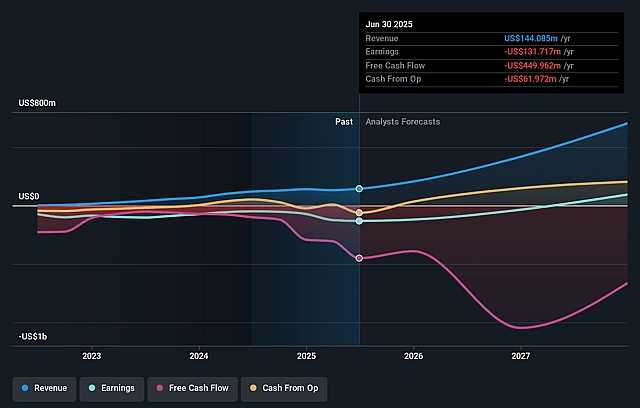
- The bearish analysts are assuming TeraWulf's revenue will grow by 83.5% annually over the next 3 years.
- The bearish analysts are not forecasting that TeraWulf will become profitable in next 3 years. To represent the Analyst Price Target as a Future PE Valuation we will estimate TeraWulf's profit margin will increase from -392.6% to the average US Software industry of 11.4% in 3 years.
- If TeraWulf's profit margin were to converge on the industry average, you could expect earnings to reach $118.1 million (and earnings per share of $0.23) by about April 2029, up from -$661.4 million today.
- In order for the above numbers to justify the price target of the more bearish analyst cohort, the company would need to trade at a PE ratio of 119.7x on those 2029 earnings, up from -9.5x today. This future PE is greater than the current PE for the US Software industry at 30.0x.
- The bearish analysts expect the number of shares outstanding to grow by 7.0% per year for the next 3 years.
- To value all of this in today's terms, we will use a discount rate of 10.83%, as per the Simply Wall St company report.
Risks
What could happen that would invalidate this narrative?- The execution of a 10-year, $3.7 billion+ hyperscale AI hosting agreement with Fluidstack, backstopped by Google, will diversify TeraWulf's revenue mix beyond bitcoin mining, potentially driving significant top-line growth and improving earnings stability even if BTC prices decline.
- Google's $1.8 billion credit backstop and equity participation significantly enhances TeraWulf's credit profile, enabling access to lower-cost capital, supporting scalable growth initiatives, and likely improving net margins by reducing financing costs.
- TeraWulf's ability to secure long-term, zero-carbon power sources at both Lake Mariner and the newly leased 400MW Cayuga site positions the company to benefit from the rising global demand for sustainable digital infrastructure, supporting competitive advantage and margin resilience.
- Growing enterprise and hyperscaler demand for AI infrastructure, validated by the urgency and scale of recent customer agreements, aligns TeraWulf with robust secular tailwinds in digitalization, which could drive strong, recurring revenue and support valuation multiples.
- The company's ongoing operational momentum, experienced team, and successful delivery on large projects for marquee clients like Core42, Fluidstack, and Google suggest continued execution strength, which may enhance TeraWulf's financial performance and drive improved net income in future years.
Valuation
How have all the factors above been brought together to estimate a fair value?
- The assumed bearish price target for TeraWulf is $20.0, which represents up to two standard deviations below the consensus price target of $25.66. This valuation is based on what can be assumed as the expectations of TeraWulf's future earnings growth, profit margins and other risk factors from analysts on the more bearish end of the spectrum.
- However, there is a degree of disagreement amongst analysts, with the most bullish reporting a price target of $37.0, and the most bearish reporting a price target of just $20.0.
- In order for you to agree with the more bearish analyst cohort, you'd need to believe that by 2029, revenues will be $1.0 billion, earnings will come to $118.1 million, and it would be trading on a PE ratio of 119.7x, assuming you use a discount rate of 10.8%.
- Given the current share price of $14.88, the analyst price target of $20.0 is 25.6% higher.
- We always encourage you to reach your own conclusions though. So sense check these analyst numbers against your own assumptions and expectations based on your understanding of the business and what you believe is probable.
Have other thoughts on TeraWulf?
Create your own narrative on this stock, and estimate its Fair Value using our Valuator tool.
Create NarrativeHow well do narratives help inform your perspective?
Disclaimer
AnalystLowTarget is a tool utilizing a Large Language Model (LLM) that ingests data on consensus price targets, forecasted revenue and earnings figures, as well as the transcripts of earnings calls to produce qualitative analysis. The narratives produced by AnalystLowTarget are general in nature and are based solely on analyst data and publicly-available material published by the respective companies. These scenarios are not indicative of the company's future performance and are exploratory in nature. Simply Wall St has no position in the company(s) mentioned. Simply Wall St may provide the securities issuer or related entities with website advertising services for a fee, on an arm's length basis. These relationships have no impact on the way we conduct our business, the content we host, or how our content is served to users. The price targets and estimates used are consensus data, and do not constitute a recommendation to buy or sell any stock, and they do not take account of your objectives, or your financial situation. Note that AnalystLowTarget's analysis may not factor in the latest price-sensitive company announcements or qualitative material.


