

Last Update 10 Jun 26
QLYS: AI Resilient Risk Prioritization And Guidance Updates Will Support EPS Durability
Analysts have trimmed their overall price target on Qualys by $26, reflecting a series of target reductions from multiple firms, partially offset by a smaller $5 increase, as they reassess the stock using slightly higher discount rate and future P/E assumptions.
Analyst Commentary
Recent research activity around Qualys shows a clear tilt toward more cautious views, with several firms trimming their price targets and one major bank modestly lifting its target. For you as an investor, the key themes center on how analysts see the balance between execution risk, growth expectations and what they are willing to pay for the stock.
Bullish Takeaways
- Bullish analysts point to enough fundamental support to justify maintaining coverage with only modest valuation changes, rather than stepping away from the stock entirely.
- The US$5 target increase from RBC Capital signals that at least one large bank sees room for upside relative to its prior view when applying its P/E framework.
- Supportive analysts appear comfortable assuming that Qualys can execute well enough for current earnings and cash flow assumptions to backstop their target prices, even after the broader round of cuts.
Bearish Takeaways
- Multiple bearish analysts have cut price targets, in some cases by US$25 to US$55, indicating reduced confidence in the risk or reward trade off at earlier valuation levels.
- The downgrade from William Blair adds a layer of concern around execution, signaling that some research desks now see better relative opportunities in the cybersecurity sector.
- Several firms lowering targets by US$21 to US$35 suggest a reset in growth or P/E assumptions, with analysts less willing to ascribe higher multiples without clearer evidence on future performance.
- The large US$49 target cut from RBC Capital, alongside its separate US$5 increase at a different point in time, highlights that views on valuation can shift quickly when analysts update discount rates or earnings frameworks.
What's in the News
- Qualys issued new guidance for the second quarter of 2026, signaling expected revenues of US$177.5 million to US$179.5 million and GAAP net income of US$1.24 to US$1.31 per diluted share, based on an assumed 21% tax rate and about 35.0 million diluted shares outstanding. (Corporate guidance)
- The company raised full year 2026 guidance, now targeting revenues of US$721.0 million to US$727.0 million, compared with a prior range of US$717.0 million to US$725.0 million, and GAAP net income of US$5.40 to US$5.61 per diluted share, up from US$5.20 to US$5.48, assuming a 21% tax rate and about 34.5 million diluted shares. (Corporate guidance)
- Qualys and Converge announced a joint offering that links Enterprise TruRisk Management data to cyber insurance pricing, using the Qualys Converge Connect Insurance Report to give underwriters standardized, real time visibility into security hygiene and potentially lower premiums for customers who maintain strong cyber controls. (Product related announcement)
- Within Enterprise TruRisk Management, Qualys launched Agent Val, an agent led exploit validation tool powered by TruConfirm that focuses on confirming real exploitability in production environments, prioritizing remediation for verified risks and providing evidence that can be used for board reporting. (Product related announcement)
- Qualys reported unaudited impairment charges for the first quarter of 2026, including impairment of property and equipment of US$624,000. (Impairments and write offs)
Valuation Changes
- Fair Value: Modelled fair value remains unchanged at US$107.39, indicating no adjustment to the central valuation estimate in this update.
- Discount Rate: The discount rate has risen slightly from 8.55% to about 8.62%, reflecting a modestly higher required return for Qualys in the current model.
- Revenue Growth: The long term revenue growth assumption is effectively stable, holding around 7.12% with only a very small numerical adjustment.
- Net Profit Margin: The net profit margin input remains almost identical, at roughly 26.38%, suggesting no meaningful change in expected profitability levels within the model.
- Future P/E: The future P/E assumption edges higher from 19.79x to about 19.83x, representing a minimal shift while applying a similar valuation multiple to projected earnings.
Key Takeaways
- Cloud-native platforms, AI innovation, and flexible pricing drive expansion, retention, and strong margins through unified cybersecurity and broadening market opportunities.
- Strategic partner ecosystem and government wins accelerate growth, international reach, and integrate regulatory compliance, bolstering Qualys' leadership in proactive risk management.
- Rapid AI security evolution, shifting customer preferences, pricing model uncertainty, macroeconomic challenges, and costly growth investments threaten Qualys' revenue visibility, margins, and long-term growth.
Catalysts
About Qualys- Provides cloud-based platform delivering information technology (IT), security, and compliance solutions in the United States and internationally.
- Adoption of Qualys' new cloud-native risk operations center (ROC) and Agentic AI platform positions the company as a leading pre-breach risk management provider, offering unified orchestration, automation, and remediation across both Qualys and non-Qualys data; this opens incremental greenfield opportunities and should support higher ARPU and expanded TAM, leading to durable revenue and earnings growth.
- Persistent digital transformation, cloud adoption, and increased regulatory scrutiny (such as GDPR and FedRAMP High compliance) are driving organizations globally to invest in proactive, unified cybersecurity solutions; Qualys' platform-first approach and recent government sector wins (aided by exclusive FedRAMP High authorization) are expected to drive faster land-and-expand cycles and incremental long-term revenues.
- Flex (QLU) pricing and expanded module integration reduce adoption friction and incentivize larger initial commitments as well as multi-module expansion within existing accounts, directly supporting higher net retention and improving margins by leveraging the SaaS delivery model's operating leverage.
- Strategic investments in partner ecosystems (reseller channels, mROC, and technical alliances) have increased channel contribution to nearly half of total revenues, which is scaling faster than direct sales; this should accelerate new logo acquisition, international reach, and upsell activity, thus supporting both revenue growth and healthy margin expansion.
- Rapid, continuous innovation-embedding AI-driven automation into remediation workloads and launching identity security posture management (ISPM)-is tightly aligned with industry shifts toward integrated, cloud-based, and continuous security, which strengthens Qualys' competitive position and increases the potential for higher customer retention, elevated margins, and sustained multi-year revenue growth.
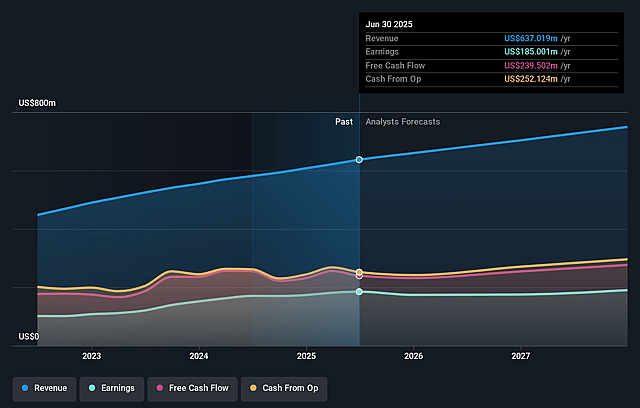
Qualys Future Earnings and Revenue Growth
Assumptions
How have these above catalysts been quantified?
- Analysts are assuming Qualys's revenue will grow by 7.1% annually over the next 3 years.
- Analysts assume that profit margins will shrink from 29.4% today to 26.4% in 3 years time.
- Analysts expect earnings to reach $222.1 million (and earnings per share of $6.21) by about June 2029, up from $201.4 million today. The analysts are largely in agreement about this estimate.
- In order for the above numbers to justify the price target of the analysts, the company would need to trade at a PE ratio of 20.3x on those 2029 earnings, up from 19.2x today. This future PE is lower than the current PE for the US Software industry at 27.3x.
- Analysts expect the number of shares outstanding to decline by 2.43% per year for the next 3 years.
- To value all of this in today's terms, we will use a discount rate of 8.62%, as per the Simply Wall St company report.
Risks
What could happen that would invalidate this narrative?- The pace of innovation in AI security is described as "rapid" and "dynamic," raising the risk that Qualys' internally developed AI agents and platform could quickly fall behind competitors or more agile upstarts, potentially resulting in increased R&D expense, product obsolescence, or customer attrition that would negatively affect revenue growth and net margins.
- Qualys acknowledges that customers increasingly prefer to consolidate certain security tools but often retain other vendors for key functions like identity or endpoint security, suggesting that vendor consolidation (especially with large platforms or hyperscalers) could eventually squeeze Qualys out of "all-in-one" enterprise deals, leading to slower revenue expansion or market share erosion.
- The newly introduced Flex pricing and QLU model, while designed to drive upsell and larger initial commitments, introduces uncertainty around usage patterns and may result in customers optimizing spend and using fewer Qualys units than anticipated, potentially impacting average revenue per customer and revenue visibility.
- Despite strong margins, the financial guidance and management's comments highlight continued macroeconomic uncertainty and "challenging environment for new business growth," indicating persistent headwinds that could prolong slower bookings, limit billings/revenue acceleration, and constrain near-term and potentially long-term earnings growth.
- The company's significant recent investments in go-to-market, public sector, and sales and marketing initiatives (including new executive hires) are intended to drive future growth, but if these investments do not lead to expected pipeline conversion, increased competition and operating expense growth could put pressure on free cash flow and EBITDA margins over the long term.
Valuation
How have all the factors above been brought together to estimate a fair value?
- The analysts have a consensus price target of $107.39 for Qualys based on their expectations of its future earnings growth, profit margins and other risk factors.
- However, there is a degree of disagreement amongst analysts, with the most bullish reporting a price target of $161.0, and the most bearish reporting a price target of just $85.0.
- In order for you to agree with the analysts, you'd need to believe that by 2029, revenues will be $841.9 million, earnings will come to $222.1 million, and it would be trading on a PE ratio of 20.3x, assuming you use a discount rate of 8.6%.
- Given the current share price of $109.71, the analyst price target of $107.39 is 2.2% lower. The relatively low difference between the current share price and the analyst consensus price target indicates that they believe on average, the company is fairly priced.
- We always encourage you to reach your own conclusions though. So sense check these analyst numbers against your own assumptions and expectations based on your understanding of the business and what you believe is probable.
Have other thoughts on Qualys?
Create your own narrative on this stock, and estimate its Fair Value using our Valuator tool.
Create NarrativeHow well do narratives help inform your perspective?
Disclaimer
AnalystConsensusTarget is a tool utilizing a Large Language Model (LLM) that ingests data on consensus price targets, forecasted revenue and earnings figures, as well as the transcripts of earnings calls to produce qualitative analysis. The narratives produced by AnalystConsensusTarget are general in nature and are based solely on analyst data and publicly-available material published by the respective companies. These scenarios are not indicative of the company's future performance and are exploratory in nature. Simply Wall St has no position in the company(s) mentioned. Simply Wall St may provide the securities issuer or related entities with website advertising services for a fee, on an arm's length basis. These relationships have no impact on the way we conduct our business, the content we host, or how our content is served to users. The price targets and estimates used are consensus data, and do not constitute a recommendation to buy or sell any stock, and they do not take account of your objectives, or your financial situation. Note that AnalystConsensusTarget's analysis may not factor in the latest price-sensitive company announcements or qualitative material.


