

Last Update 18 Aug 26
Fair value Increased 5.92%RKLB: Defense Contract Execution Will Test Vertically Integrated Platform Narrative
Rocket Lab's updated analyst price target has moved higher to $70.66 from $66.70, as analysts point to expanding national security contracts, the planned Iridium acquisition, and progress on the Neutron launch vehicle as key supports for the revised valuation assumptions.
Analyst Commentary
Recent Street research on Rocket Lab shows a broadly constructive view, with several firms lifting price targets and highlighting contract wins, backlog growth, and the planned Iridium acquisition. Analysts frequently point to record revenue in the latest reported quarter, a growing national security business, and progress on the Neutron launch vehicle as key factors behind more optimistic valuation frameworks.
Supportive analysts also stress the potential impact of the Iridium deal on Rocket Lab. They describe the acquisition as complementary to existing launch and space systems activities and see it as a way to create a vertically integrated space platform that spans satellite design and manufacturing, launch services, spectrum assets, and on orbit communications. Some research notes also highlight expectations for a higher mix of recurring revenue from space based applications over time, supported by the combination of satellite launch, manufacturing capability, and owned spectrum.
National security and government contracts remain a recurring theme in bullish commentary on Rocket Lab. Analysts reference contract awards related to hypersonics testing and satellite buses for the U.S. Space Force, which they say validate the company’s technical capabilities and role in defense related missions. They also point to multi program wins and a multi billion dollar backlog as key supports for revenue visibility, although the timing and execution of that backlog remain important watch points for investors.
On launch, several firms note that Electron’s position in small payload missions and the planned reusable Neutron rocket are central to their long term theses on Rocket Lab. Some research notes mention updated estimates that incorporate slight changes to Electron launch pricing, along with expectations that Neutron’s development remains on track based on the latest reported updates. At the same time, these views still depend on Rocket Lab delivering on its launch schedule and managing capital needs for larger projects.
The planned Iridium acquisition has also triggered a round of target price increases for Rocket Lab, with multiple firms describing the transaction as transformational for the company’s business mix. They see the deal as an entry into commercial, government, and defense services markets that rely on Iridium’s L band spectrum, with use cases that include assured communications and low bandwidth internet of things services. Some analysts also argue that the combined platform could create a stronger position relative to larger space and communications players.
Not all commentary is uniformly positive. One firm that prefers another space company cites valuation as the main reason for a Neutral view on Rocket Lab, even while acknowledging the strengths of Electron and the potential of Neutron. This highlights that, alongside enthusiasm for the company’s roadmap, there is still debate about how much future growth is already reflected in the current share price.
Bearish Takeaways
- Bearish analysts flag valuation as a key concern and cite a premium versus some large space peers, which they say limits upside if execution or market growth comes in below expectations.
- One research update lowered its Rocket Lab price target from US$130 to US$110, pointing to market valuations as the driver and underscoring that multiple expansion is not guaranteed even with contract wins and backlog growth.
- Neutral ratings tied to valuation suggest that some analysts see Rocket Lab’s growth story as already well reflected in the stock, which could leave less room for error on Neutron timing, launch cadence, or integration of the Iridium acquisition.
- Cautious views also highlight execution risk around large, multi program commitments and the upcoming Q4 Neutron launch timeline, since any delays or cost overruns could pressure both growth expectations and the company’s funding needs.
What’s in the News for Rocket Lab
- Rocket Lab secured a US$397 million U.S. Space Force SB AMTI contract to develop, launch, and operate advanced Flatellites on Neutron, with options for additional spacecraft and recurring mission work. Source: U.S. Space Force SB AMTI contract news
- The company reported record Q2 2026 revenue of US$234 million and a backlog of US$2.36 billion, while progressing its planned US$8 billion Iridium acquisition and outlining expectations for combined 2026 revenue of US$1.8 billion. Source: Q2 2026 earnings and Iridium deal update
- Rocket Lab was selected by Viasat to provide a Lightning GEO satellite bus for the U.S. Space Force Protected Tactical SATCOM Global program, supporting secure and anti jam military communications. Source: Viasat PTS G contract news
- Rocket Lab successfully launched eight MDA built satellites for Globalstar as part of a US$143 million, 17 platform constellation contract and confirmed all spacecraft are operating nominally in orbit. Source: MDA and Globalstar launch announcement
- The company established Rocket Lab Germany GmbH to create a European hub for satellite and component manufacturing and launch services on Electron and Neutron, with the goal of supporting sovereign space capabilities in Europe. Source: Rocket Lab Germany expansion news
Valuation Changes for Rocket Lab
- Fair Value has risen slightly, with the analyst estimate moving to $70.66 from $66.70.
- Discount Rate has edged higher to 7.97% from 7.83%, indicating a modestly higher required return in the updated model.
- Revenue Growth assumptions have been reduced, with the forecast moving to 32.28% from 37.32%.
- Net Profit Margin has increased significantly in the model, rising to 3.44% from 0.87%.
- Future P/E has dropped sharply, moving to 1,064.18x from 3,853.09x, reflecting a lower valuation multiple in the updated assumptions.
Catalysts
About Rocket Lab
Rocket Lab designs, manufactures and operates launch vehicles and space systems for government and commercial customers.
What are the underlying business or industry changes driving this perspective?
- Escalating capital intensity for Neutron, with cumulative spending already moving well above the original 250 million to 300 million budget range, risks structurally higher depreciation and R&D run rates. This could cap future operating leverage and delay sustainable earnings.
- Reliance on rapid growth in government space and defense programs, including SDA transport layers and hypersonic test initiatives, exposes revenue to budget debates, shutdowns and award timing. This could drive lumpier backlog conversion and slower top line growth than current expectations.
- Vertical integration and aggressive M&A, from component suppliers to payload and sensor businesses, increase fixed costs and integration complexity. This raises the risk that acquired revenue underperforms and compresses consolidated gross margins and free cash flow.
- Ambitious launch cadence targets for Electron and future Neutron missions depend on scaling highly specialized manufacturing and test infrastructure. Execution missteps or supply bottlenecks could constrain capacity, reduce launch availability and limit revenue growth while overhead remains elevated.
- Growing competition across small launch, satellite manufacturing and payload markets, including larger primes with deep capital bases, may force sharper pricing and contract terms. This could pressure average selling prices, net margins and long term return on invested capital.
Assumptions
How have these above catalysts been quantified?
- This narrative explores a more pessimistic perspective on Rocket Lab compared to the consensus, based on a Fair Value that aligns with the bearish cohort of analysts.
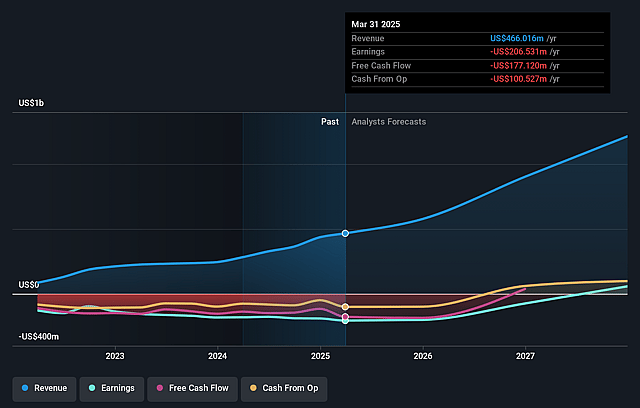
- The bearish analysts are assuming Rocket Lab's revenue will grow by 32.3% annually over the next 3 years.
- The bearish analysts assume that profit margins will increase from -21.5% today to 3.4% in 3 years time.
- The bearish analysts expect earnings to reach $61.3 million (and earnings per share of $0.12) by about August 2029, up from -$165.5 million today. However, there is some disagreement amongst the analysts with the more bullish ones expecting earnings as high as $195.6 million.
- In order for the above numbers to justify the price target of the more bearish analyst cohort, the company would need to trade at a PE ratio of 1064.2x on those 2029 earnings, up from -296.9x today. This future PE is greater than the current PE for the US Aerospace & Defense industry at 39.6x.
- The bearish analysts expect the number of shares outstanding to grow by 7.0% per year for the next 3 years.
- To value all of this in today's terms, we will use a discount rate of 7.97%, as per the Simply Wall St company report.
Risks
What could happen that would invalidate this narrative?
- Electron is demonstrating accelerating demand with 17 launches signed in a single quarter, a record annual launch cadence and a factory designed for significantly higher throughput, which could support sustained top line growth and operating leverage, improving revenue and earnings.
- Space Systems has scaled from small beginnings to contribute the majority of revenue with high margin satellite manufacturing, diversified government and commercial programs and a growing pipeline of large SDA and national security contracts, which may provide long duration, secular growth in space infrastructure spending that strengthens revenue visibility and margins.
- Long term government and defense trends, including hypersonic test programs like Golden Dome, SDA transport layers and increasing international agency reliance on Electron, position Rocket Lab as a key strategic supplier, which could drive structurally higher backlog, pricing power and gross margins.
- Vertical integration across launch, spacecraft buses, sensors and future laser communications, combined with disciplined M&A and a strong liquidity position above 1 billion dollars, may allow Rocket Lab to capture more of the value chain and outperform peers on cost and schedule, supporting higher net margins and cash flow over time.
- Neutron and the Archimedes engine are being developed with an emphasis on reliability, reusability and thorough ground testing, and if successful they could open a higher capacity, higher ASP launch market and enable larger satellite constellations, materially increasing long term revenue, gross margin and earnings potential.
Valuation
How have all the factors above been brought together to estimate a fair value?
- The assumed bearish price target for Rocket Lab is $70.66, which represents up to two standard deviations below the consensus price target of $112.94. This valuation is based on what can be assumed as the expectations of Rocket Lab's future earnings growth, profit margins and other risk factors from analysts on the more bearish end of the spectrum.
- However, there is a degree of disagreement amongst analysts, with the most bullish reporting a price target of $150.0, and the most bearish reporting a price target of just $64.0.
- In order for you to agree with the more bearish analyst cohort, you'd need to believe that by 2029, revenues will be $1.8 billion, earnings will come to $61.3 million, and it would be trading on a PE ratio of 1064.2x, assuming you use a discount rate of 8.0%.
- Given the current share price of $82.08, the analyst price target of $70.66 is 16.2% lower. Despite analysts expecting the underlying business to improve, they seem to believe the market's expectations are too high.
- We always encourage you to reach your own conclusions though. So sense check these analyst numbers against your own assumptions and expectations based on your understanding of the business and what you believe is probable.
Have other thoughts on Rocket Lab?
Create your own narrative on this stock, and estimate its Fair Value using our Valuator tool.
Create NarrativeHow well do narratives help inform your perspective?
Comments
0 commentsDisclaimer
AnalystLowTarget is a tool utilizing a Large Language Model (LLM) that ingests data on consensus price targets, forecasted revenue and earnings figures, as well as the transcripts of earnings calls to produce qualitative analysis. The narratives produced by AnalystLowTarget are general in nature and are based solely on analyst data and publicly-available material published by the respective companies. These scenarios are not indicative of the company's future performance and are exploratory in nature. Simply Wall St has no position in the company(s) mentioned. Simply Wall St may provide the securities issuer or related entities with website advertising services for a fee, on an arm's length basis. These relationships have no impact on the way we conduct our business, the content we host, or how our content is served to users. The price targets and estimates used are consensus data, and do not constitute a recommendation to buy or sell any stock, and they do not take account of your objectives, or your financial situation. Note that AnalystLowTarget's analysis may not factor in the latest price-sensitive company announcements or qualitative material.

