Over the last two weeks we have revisited EVs, renewable energy, and cybersecurity and cloud , which were amongst the ‘hottest’ themes earlier in the decade. Around the same time, the Metaverse , NFTs, and Web3 also burst into the spotlight, and then faded away just as quickly.
This week we are checking in on these themes - or what’s left of them anyway - and the closely related virtual and augmented reality industries.
Welcome to part 3 of the three-part “What’s happening with…” series.
What happened in the markets this week?
Here’s a quick summary of what’s been going on:
🛰️ Amazon doubles down on AI infrastructure and satellites ( Yahoo Finance )
- What happened : Amazon signed a US$11.57 billion deal to acquire Globalstar, sending its shares up more than 8%, and also partnered with Apple to provide satellite connectivity for iPhones and Apple Watch. How it impacts investors: Amazon is strengthening its position as core infrastructure across both AI and satellite connectivity, which could shift competitive dynamics in cloud, telecom, and space. This reinforces the “picks-and-shovels” investment theme, with second-order effects for partners and rivals.
- Next steps: Explore our prefiltered high-growth AI and infrastructure opportunities .
⚡ Intel’s surge raises valuation questions ahead of earnings ( CNBC )
- What happened : Intel shares surged 58% over nine consecutive days, adding more than US$100 billion in market value, before pulling back 5% on the tenth day. The rally was driven by AI-related partnerships and manufacturing progress, despite high valuation multiples and ongoing losses in its foundry unit.
- How it impacts investors: The rapid price move suggests strong belief in Intel’s AI turnaround, but elevated valuations increase downside risk if earnings or execution disappoint. Upcoming results could act as a key catalyst for sentiment.
- Next steps: Dive into Intel’s fundamentals and track analyst expectations with its company report .
🌍 UK growth outlook hit as global risks rise ( Reuters )
- What happened : The IMF cut its 2026 UK GDP growth forecast to 0.8%, the largest downgrade among G7 economies, citing the US-Iran war and weak momentum from late 2025. It also lowered global growth to 3.1% and raised UK inflation expectations to around 4% alongside a rise in unemployment.
- How it impacts investors: Rising geopolitical tension is feeding into inflation and growth risks, limiting central banks’ ability to respond and increasing the chance of stagflation. That backdrop typically pressures rate-sensitive sectors while supporting energy and defensive plays. The UK’s smaller, domestic companies are also more exposed, while many larger companies benefit from global diversification.
- Next steps: Compare UK sectors and industries on the markets’ page .
🛢️ Norway benefits from oil price surge amid supply shock ( Bloomberg )
- What happened : Norway’s crude export value jumped 68% year-on-year in March to US$6.1 billion as oil prices surged following the Strait of Hormuz disruption. The spike pushed the country’s trade surplus to its highest level in over three years.
- How it impacts investors: Elevated oil prices are boosting revenues for non-Gulf producers, reinforcing the earnings outlook for global energy companies.
- Next steps: You may revisit our previous edition of Market Insights focused on the Strait of Hormuz conflict . Also visit Norway’s market page to review key industries and stocks in the country.
🏦 Goldman Sachs equities strength offsets bond trading weakness ( CNBC )
- What happened : Goldman Sachs reported record equities trading revenue of US$5.33 billion in Q1 2026, up 27% year-on-year, driven by strong client activity during market volatility. Meanwhile, its fixed income division saw revenue fall 10% to US$4.01 billion amid challenging rate conditions.
- How it impacts investors: Strong equities and advisory performance signal improving capital markets activity, which could support earnings across investment banks. But it’s important to remember that trading profits aren’t annuity income and shouldn’t be extrapolated into the future.
- Next steps: Look into Goldman Sachs’s company report to spot key rewards and risks in the company.
VR, AR, Web3 and the Metaverse
Gartner’s hype cycle describes the typical path for the perceived value of a new technology after it becomes widely known, and promoted. The key phases of the cycle include:
- Innovation Trigger: Initial breakthrough with high publicity but unproven commercial viability.
- Peak of Inflated Expectations: High-profile success stories create excitement, accompanied by many failures.
- Trough of Disillusionment : Interest wanes as experiments fail to deliver, prompting a "shakeout" of providers.
- Slope of Enlightenment: Real-world benefits become clearer, and second-generation products emerge.
- Plateau of Productivity: Broad, stable adoption occurs as the technology proves its ROI.
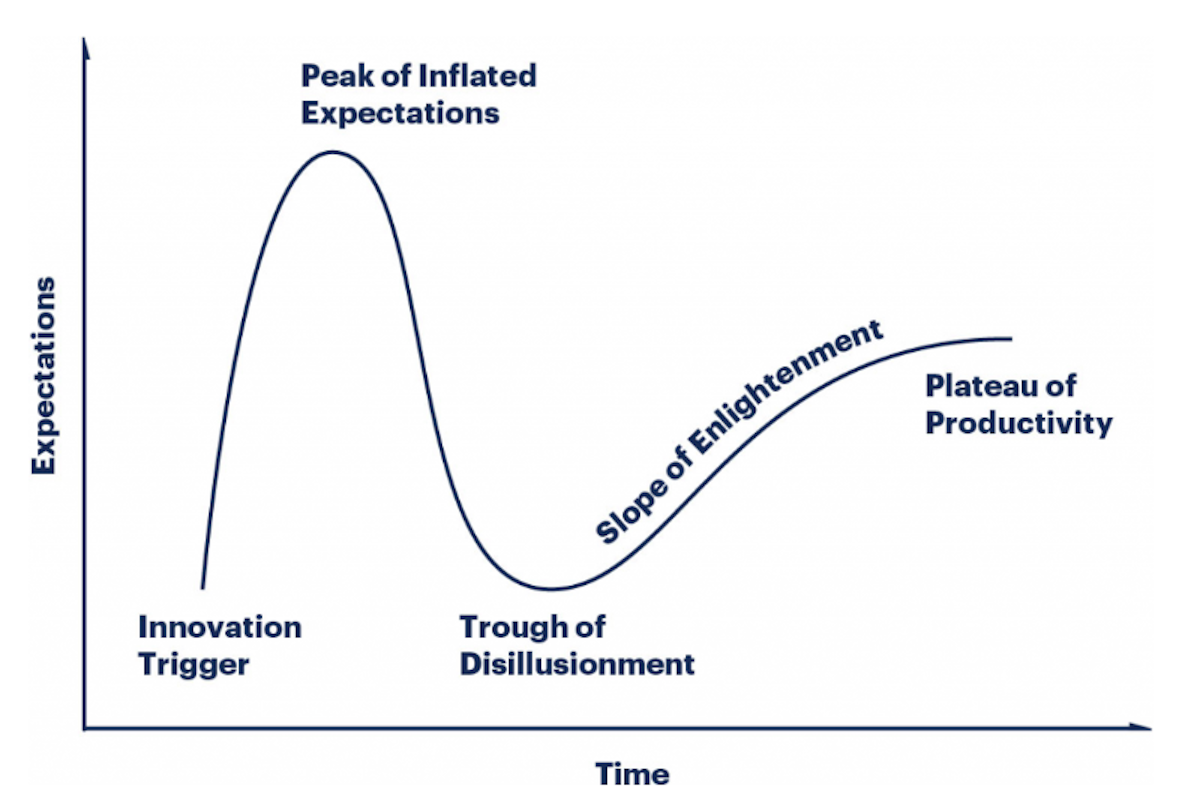
In reality, there are many variations on the above cycle. Some innovations move quickly through the various stages, while others spend years in one or other stages. Some technologies never emerge from the disillusionment phase, and others must morph into something completely different.
Virtual and augmented reality, web3, and the metaverse are good examples of how varied reality can be. We will start with the underwhelming and progress to the more promising examples…
The Metaverse: Maybe another time
In March, Meta announced that it was effectively closing Horizon Worlds, the company’s virtual reality social network.
The numbers tell a brutal story. The platform peaked in October 2022 at 200,000 monthly active users, missing its 280,000 target by a wide margin. By August 2023, daily active users had collapsed to roughly 900 .
Only 11% of users returned after their first week, and the platform's monetization strategy failed completely: tip features generated under US$500 globally, with total in-world payments reaching roughly US$10,000 cumulative.
Facebook, as it was known back then, went all-in on the ‘metaverse’, even changing its name (whoops)!
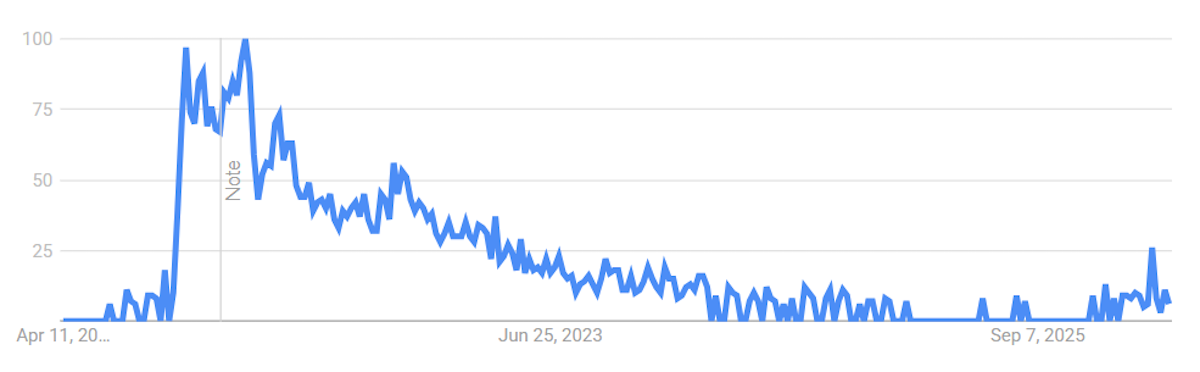
Google’s search trends for the term ‘metaverse’ reflect the disillusionment. But the recent spike had less to do with an emerging slope of enlightenment. It was simply prompted by the news of Horizon World’s demise.
The US$70B that Meta has invested in Reality Labs would have sunk most companies. Fortunately the company’s other assets have generated ~$200 billion in free cash flow over the last five years.
The metaverse was an idea, rather than a proven business model offering a solution to a problem. It was partly the result of the company’s strategy to compete with Apple and Alphabet, and partly the fact that it became closely linked to NFTs, another way to burn cash quickly.
Stats on NFT losses are hard to come by, but trading volumes reportedly reached $25 billion in 2021 , before evaporating. By 2023, most NFTs were said to be worthless .
Web3: Pivoting to I i nfrastructure
The concept of ‘Web3’ emerged alongside Ethereum, utility tokens, and smart contracts. The idea was that the internet would become decentralized and applications would be owned by the users rather than by centralized corporations. This world of decentralized applications (dApps) was enabled by blockchain technology.
As it turns out, decentralization is better suited to some use cases than others. Thousands of dApps amounted to pretty much nothing. Numerous pilot projects using blockchain technology to streamline the healthcare and logistics industries have also produced underwhelming results.
The web3 segment that has survived is DeFi (decentralized finance), despite a few spectacular blowups. Decentralized exchanges and stablecoins have been the most resilient parts of the ecosystem, and tokenization of assets is growing rapidly.
Stablecoins are being integrated with the broader financial system thanks to regulations like the GENIUS Act . The total value of stablecoins is now over $300 billion.
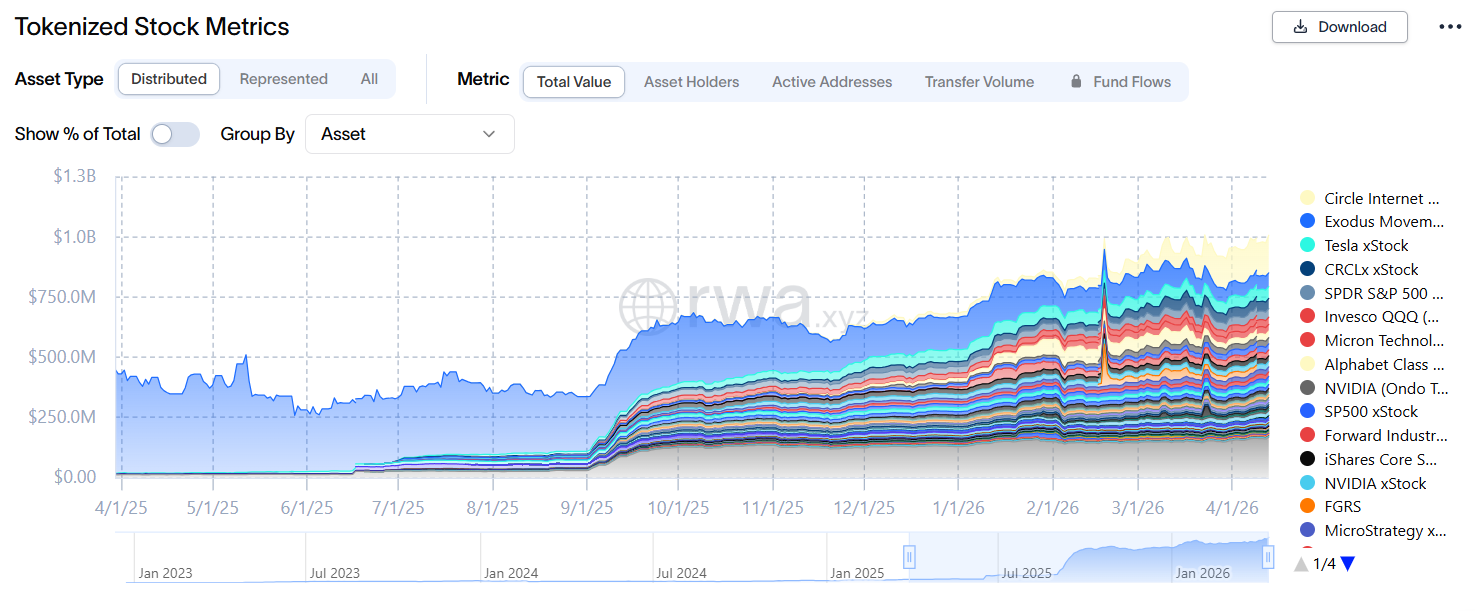
The current growth segment is real-world asset (RWA) tokenization. This is the process of converting the ownership rights of assets like stocks, real estate, fine art, or bonds into digital tokens on a blockchain. This process enables fractional ownership, and reduces transaction costs by utilizing smart contracts for automation.
The value of tokenized assets is now $24 billion. That’s still a small fraction of the total crypto market, but it’s up 380% in just five years . The largest segments shown below are bonds (blue), commodities (yellow) and asset backed credit (green).
Another web3 application gaining some traction is DePIN networks (decentralized physical infrastructure networks). DePIN uses a token-incentivized model where individuals or entities buy or deploy hardware (e.g., wifi hotspots, sensors) and, in return for providing service or data, earn cryptocurrency rewards. Examples include:
- Helium, a decentralized wireless network for 5G and IoT.
- Hivemapper’s Bee Maps, which uses crowdsourced geospatial data for more precise, up-to-date mapping.
These networks could become more prominent as AI compute moves to the edge, and as the number of connected devices increases.
The common denominator for surviving web3 projects is that they provide infrastructure, rather than applications. Ironically, many are centralized too.
The top 10 holdings for the Bitwise Web3 ETF (BWEB) are all datacenter and software companies.
👉For a broader selection of web3 related stocks take a look at the Crypto Picks and Shovels collection.
Extended Reality: Finally gaining traction
AR and VR, also known as extended reality (XR) and spatial computing have taken a long time to gain meaningful traction, but things are looking up.
Hardware is leading the charge. AR/VR headset shipments grew 39.2 percent in 2025, reaching 14.3 million units. Smart glasses, the fastest-growing segment, expanded 247.5 percent by IDC metrics .
While Meta’s Reality labs is still burning cash, hardware sales are at least generating some revenue. In 2025, revenue stood at $2.2 billion, but the operating loss amounted to $19.2 billion. But the company now dominates the AR/VR and smart glasses market.
The bigger growth engine has become the enterprise market, where VR training is a key growth driver. Enterprise VR training delivers quantifiable returns that consumer platforms never achieved. Trainees complete training four times faster than classroom instruction and show four times better focus improvement compared to e-learning.
In addition to training, VR is widely used in the enterprise market for simulation, prototyping and collaboration.
The key factor behind enterprise growth is the fact that ROI is measurable.
Fortune 500 adoption stands at 75 percent, signaling serious institutional validation. By 2030, enterprise applications are projected to capture 60 percent of VR revenue allocation.
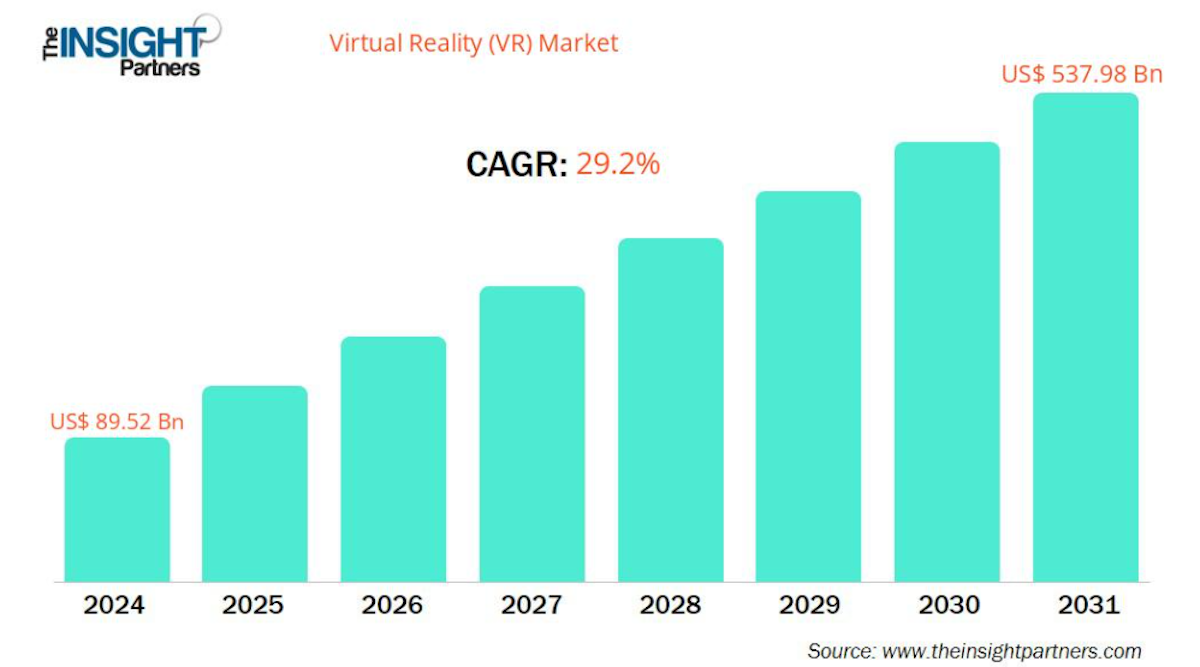
Forecasts for growth in the broader VR market range between 25-35% over the next decade. There aren’t many industries with forecasts that high, so what’s the catch?
The biggest challenge is the fact that VR/AR is largely about hardware, which requires significant capital and tends toward narrow margins. In this respect, it plays into the hands of the likes of Meta, Microsoft, and Apple.
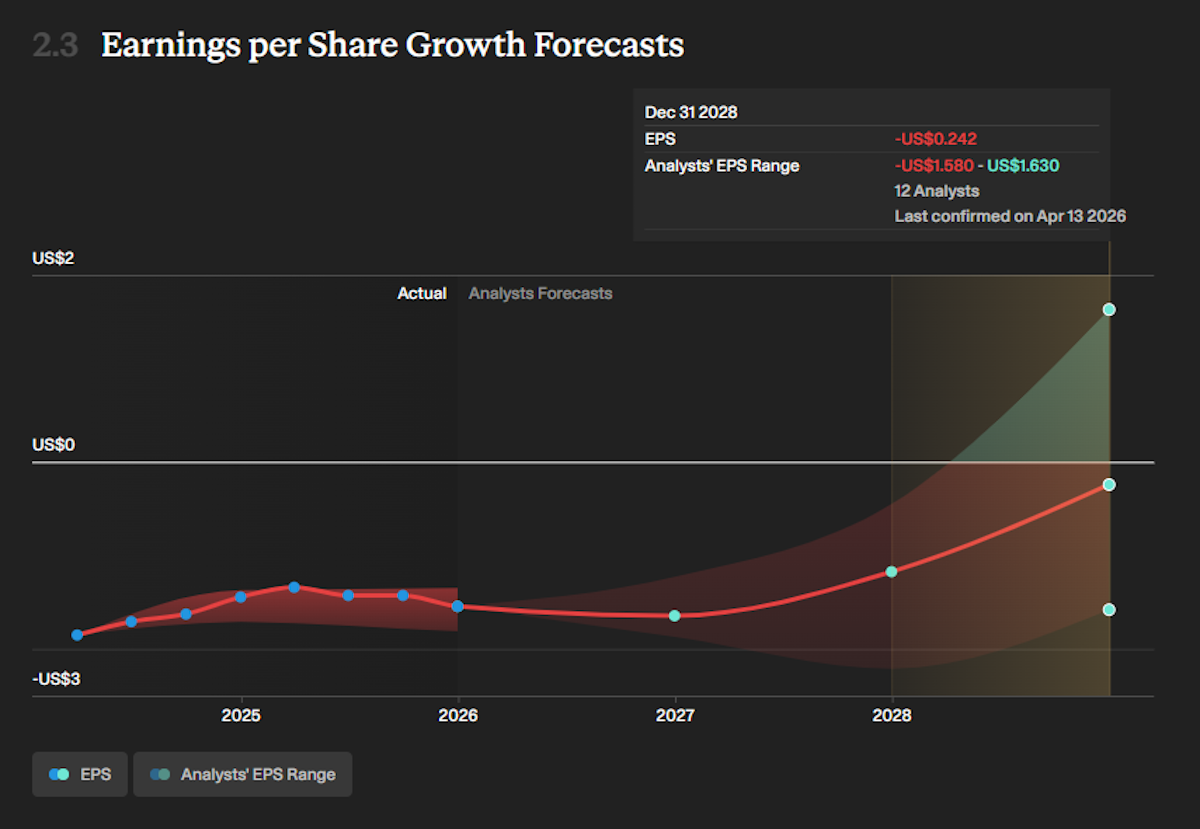
Last year, Roblox illustrated how much growth can cost in this space. While not primarily an AR/VR company, it has elements that tie it back to the industry. The stock price rallied 150% in H1 as revenue growth gathered momentum. Then reality set in as it became apparent that profits were still a long way off. The stock price has since given up all those gains.
Roblox is also facing increased regulatory scrutiny like many other companies. The company recently agreed to a $10 million settlement in Nevada for failing to protect young users. Age verification and protections for minors add another layer of costs for social media and gaming platforms like Roblox.
Elsewhere in the world of VR/AR, investors have a few options:
- Most of the leading semiconductor manufacturers are key suppliers to the industry.
- Leaders in the field of 3D software include Unity and Adobe.
- Small caps offer the potential for huge returns if they can develop proprietary technologies crucial to hardware manufacturers.
👉 This virtual and augmented reality watchlist includes the key companies in the industry.
The Insight: Successful businesses solve real problems
The graveyard of failed metaverse, NFTs, and speculative Web3 stocks teaches us to look for boring, compliant replacements, not experiences or new paradigms. When a technology requires sustained behavioral change but offers no clear return to the user, no amount of capital fixes it.
The winning plays across AR, VR, and Web3 improve existing workflows or products. The takeaway for investors is to beware of consumer-facing speculation. Target enterprise-backed use cases where ROI is measurable and proven, or consumer products with proven demand.
Key Events Next Week
Monday
-
🇨🇦 Canada CPI YoY (March)
-
📉 Forecast: 2.5%, Previous: 1.8%
-
➡️ Why it matters: A rebound driven by energy/tariff effects could pressure BoC to pause its easing cycle.
Tuesday
-
🇯🇵 Japan Balance of Trade (March)
-
📈 Forecast: 3.4%, Previous: 3.0%
-
➡️ Why it matters: A rising surplus signals strong global demand for Japan’s exports, while a miss hints at slowing trade momentum.
-
🇬🇧 UK Unemployment Rate (Feb)
-
📈 Forecast: 3.4%, Previous: 3.0%
-
➡️ Why it matters: A tighter labour market supports spending but could keep rates higher for longer.
Wednesday
-
🇬🇧 UK CPI YoY (March)
-
📈 Forecast: 3.4%, Previous: 3.0%
-
➡️ Why it matters: A rise toward the BoE's own forecast would reinforce its hold stance and delay any rate cut.
Friday
-
🇯🇵 Japan CPI YoY (March)
-
📈 Forecast: 2.0%, Previous: 1.3% (Feb)
-
➡️ Why it matters: A pickup in inflation strengthens the case for policy tightening, with potential ripple effects for the yen, bond yields, and global markets.
It’s a big week for earnings season with some of the largest companies reporting. Prominent names include:
Have feedback on this article? Concerned about the content? Get in touch with us directly. Alternatively, email editorial-team@simplywallst.com
Simply Wall St analyst Richard Bowman and Simply Wall St have no position in any of the companies mentioned. This article is general in nature. We provide commentary based on historical data and analyst forecasts only using an unbiased methodology and our articles are not intended to be financial advice. It does not constitute a recommendation to buy or sell any stock and does not take account of your objectives, or your financial situation. We aim to bring you long-term focused analysis driven by fundamental data. Note that our analysis may not factor in the latest price-sensitive company announcements or qualitative material.

Richard Bowman
Richard is an analyst, writer and investor based in Cape Town, South Africa. He has written for several online investment publications and continues to do so. Richard is fascinated by economics, financial markets and behavioral finance. He is also passionate about tools and content that make investing accessible to everyone.

