- United States
- /
- Specialty Stores
- /
- NYSE:HD
Assessing Home Depot Stock After Mixed Performance and Questions on Housing Market Strength

Reviewed by Bailey Pemberton
How Has Home Depot Stock Been Performing?
Before digging into what Home Depot might be worth, it helps to understand how the stock has actually been behaving in the market lately.
Over the past week, Home Depot has delivered a modest 1.6% gain, but that comes against a slightly negative 30 day move of 0.4%. Zooming out, the stock is down 8.2% year to date and 7.2% over the last year, even though it is still up 20.6% over three years and 49.3% over five years.
This mix of short term weakness and longer term strength often signals a market that is undecided about how much future growth to price in. For valuation focused investors, that kind of uncertainty is exactly where opportunities, or risks, tend to hide.
Recent news flow has revolved around consumer spending trends, the health of the US housing and renovation market, and how higher rates are affecting big ticket home improvement projects. Analysts and commentators have also been debating how durable Home Depot's competitive advantages are as smaller retailers and online players try to chip away at its dominance.
Right now, Simply Wall St's valuation framework gives Home Depot a score of 1 out of 6 on its undervaluation checks, suggesting the stock currently screens as undervalued on only one measure. In the next sections, we will break down what drives that score, compare multiple valuation methods, and then finish with a more holistic way of thinking about what Home Depot might really be worth in a long term portfolio.
Home Depot scores just 1/6 on our valuation checks. See what other red flags we found in the full valuation breakdown.
Approach 1: Home Depot Discounted Cash Flow (DCF) Analysis
A Discounted Cash Flow model estimates what a company is worth by projecting the cash it can generate in the future and then discounting those cash flows back to today in dollar terms.
For Home Depot, the model uses a 2 Stage Free Cash Flow to Equity approach. The company generated about $14.1 billion in free cash flow over the last twelve months. Analyst and model projections see this rising steadily, with free cash flow expected to reach roughly $21.0 billion by 2035, based on a mix of analyst forecasts for the earlier years and Simply Wall St extrapolations for the later ones.
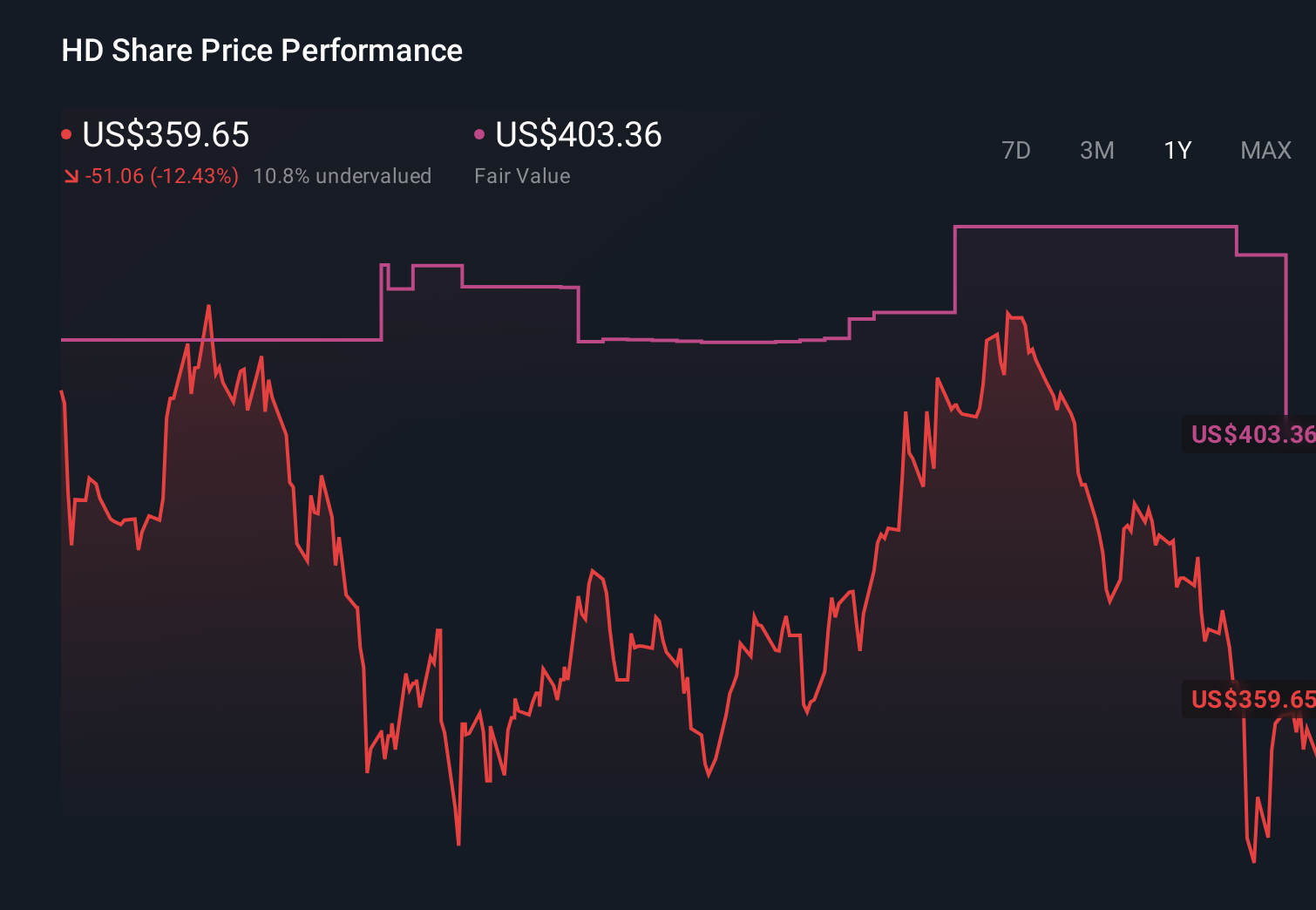
When these future cash flows are discounted back, the estimated intrinsic value from the DCF comes out at around $278 per share. Compared with the current share price, this implies the stock is about 28.3% overvalued on this model, suggesting investors are paying a premium for expected future growth.
Result: OVERVALUED
Our Discounted Cash Flow (DCF) analysis suggests Home Depot may be overvalued by 28.3%. Discover 914 undervalued stocks or create your own screener to find better value opportunities.

Approach 2: Home Depot Price vs Earnings
For a mature, consistently profitable company like Home Depot, the price to earnings ratio is a practical way to gauge valuation because it links the share price directly to the profits the business is generating today.
In general, faster growing and lower risk companies tend to justify a higher PE ratio, while slower growing or riskier names usually deserve a lower one. Home Depot currently trades at about 24.36x earnings, slightly below the 25.72x average of its closest peers, but above the broader Specialty Retail industry average of 20.59x, which reflects its stronger brand, scale and profitability.
Simply Wall St’s Fair Ratio for Home Depot is 23.47x, a proprietary estimate of what a reasonable PE should be once you factor in its earnings growth outlook, margins, industry positioning, size and risk profile. This makes it more tailored than a simple peer or industry comparison, which can overlook important differences in quality and prospects. With the market paying 24.36x versus a Fair Ratio of 23.47x, the stock appears slightly expensive on this metric, but not by a large margin.
Result: OVERVALUED
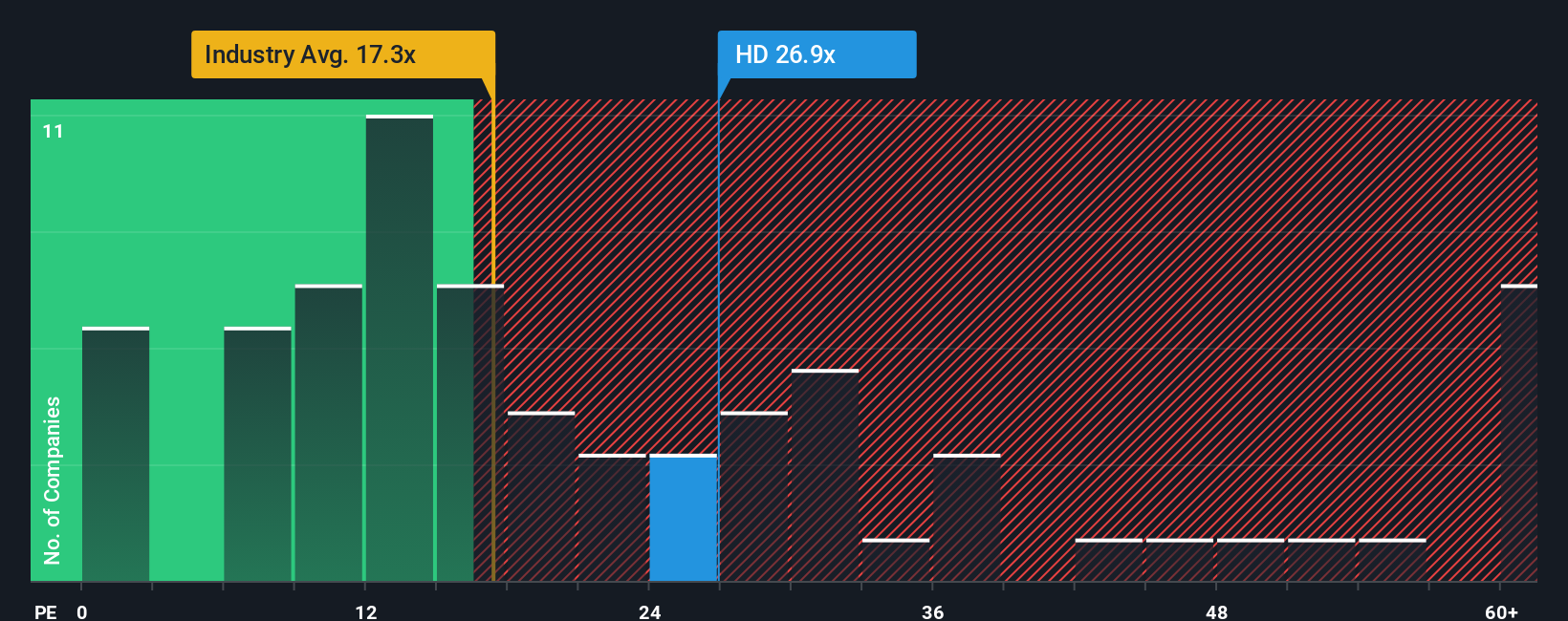
PE ratios tell one story, but what if the real opportunity lies elsewhere? Discover 1454 companies where insiders are betting big on explosive growth.
Upgrade Your Decision Making: Choose your Home Depot Narrative
Earlier we mentioned that there is an even better way to understand valuation, so let us introduce you to Narratives, a simple tool on Simply Wall St’s Community page that lets you tell the story behind your numbers by linking your view of a company’s future revenue, earnings and margins to a clear financial forecast, turning that forecast into a fair value, and then helping you decide when to buy or sell by comparing that fair value with today’s share price, all while staying up to date as new earnings or news arrive. For example, a very optimistic Home Depot Narrative might assume analyst style growth, margin expansion and a future PE near the Street’s high target of about $481 per share, while a more cautious Narrative might lean toward slower growth, tighter margins and a valuation closer to the bearish $335 target, giving two investors very different but clearly articulated paths to their own conviction.
Do you think there's more to the story for Home Depot? Head over to our Community to see what others are saying!
This article by Simply Wall St is general in nature. We provide commentary based on historical data and analyst forecasts only using an unbiased methodology and our articles are not intended to be financial advice. It does not constitute a recommendation to buy or sell any stock, and does not take account of your objectives, or your financial situation. We aim to bring you long-term focused analysis driven by fundamental data. Note that our analysis may not factor in the latest price-sensitive company announcements or qualitative material. Simply Wall St has no position in any stocks mentioned.
Mobile Infrastructure for Defense and Disaster
The next wave in robotics isn't humanoid. Its fully autonomous towers delivering 5G, ISR, and radar in under 30 minutes, anywhere.
Get the investor briefing before the next round of contracts
Sponsored On Behalf of CiTechValuation is complex, but we're here to simplify it.
Discover if Home Depot might be undervalued or overvalued with our detailed analysis, featuring fair value estimates, potential risks, dividends, insider trades, and its financial condition.
Access Free AnalysisHave feedback on this article? Concerned about the content? Get in touch with us directly. Alternatively, email editorial-team@simplywallst.com
About NYSE:HD
Home Depot
Operates as a home improvement retailer in the United States and internationally.
Established dividend payer with adequate balance sheet.
Similar Companies
Market Insights


Weekly Picks

Early mover in a fast growing industry. Likely to experience share price volatility as they scale


A case for CA$31.80 (undiluted), aka 8,616% upside from CA$0.37 (an 86 bagger!).


Moderation and Stabilisation: HOLD: Fair Price based on a 4-year Cycle is $12.08
Recently Updated Narratives


Title: Market Sentiment Is Dead Wrong — Here's Why PSEC Deserves a Second Look


An amazing opportunity to potentially get a 100 bagger

Amazon: Why the World’s Biggest Platform Still Runs on Invisible Economics
Popular Narratives


Crazy Undervalued 42 Baggers Silver Play (Active & Running Mine)


MicroVision will explode future revenue by 380.37% with a vision towards success


NVDA: Expanding AI Demand Will Drive Major Data Center Investments Through 2026
Trending Discussion
