- United States
- /
- Consumer Durables
- /
- NYSE:BZH
Does Beazer Homes USA (NYSE:BZH) Have A Healthy Balance Sheet?

Warren Buffett famously said, 'Volatility is far from synonymous with risk.' So it seems the smart money knows that debt - which is usually involved in bankruptcies - is a very important factor, when you assess how risky a company is. Importantly, Beazer Homes USA, Inc. (NYSE:BZH) does carry debt. But should shareholders be worried about its use of debt?
What Risk Does Debt Bring?
Debt is a tool to help businesses grow, but if a business is incapable of paying off its lenders, then it exists at their mercy. Part and parcel of capitalism is the process of 'creative destruction' where failed businesses are mercilessly liquidated by their bankers. While that is not too common, we often do see indebted companies permanently diluting shareholders because lenders force them to raise capital at a distressed price. Having said that, the most common situation is where a company manages its debt reasonably well - and to its own advantage. The first step when considering a company's debt levels is to consider its cash and debt together.
Check out our latest analysis for Beazer Homes USA
What Is Beazer Homes USA's Net Debt?
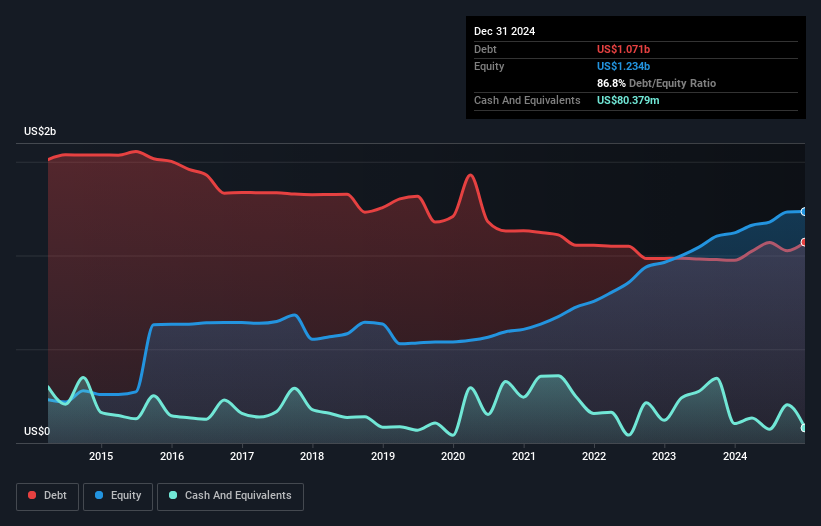
As you can see below, at the end of December 2024, Beazer Homes USA had US$1.07b of debt, up from US$974.6m a year ago. Click the image for more detail. However, it also had US$80.4m in cash, and so its net debt is US$990.9m.
How Healthy Is Beazer Homes USA's Balance Sheet?
According to the last reported balance sheet, Beazer Homes USA had liabilities of US$213.2m due within 12 months, and liabilities of US$1.15b due beyond 12 months. Offsetting these obligations, it had cash of US$80.4m as well as receivables valued at US$70.7m due within 12 months. So its liabilities outweigh the sum of its cash and (near-term) receivables by US$1.22b.
This deficit casts a shadow over the US$657.4m company, like a colossus towering over mere mortals. So we'd watch its balance sheet closely, without a doubt. After all, Beazer Homes USA would likely require a major re-capitalisation if it had to pay its creditors today.
We use two main ratios to inform us about debt levels relative to earnings. The first is net debt divided by earnings before interest, tax, depreciation, and amortization (EBITDA), while the second is how many times its earnings before interest and tax (EBIT) covers its interest expense (or its interest cover, for short). Thus we consider debt relative to earnings both with and without depreciation and amortization expenses.
As it happens Beazer Homes USA has a fairly concerning net debt to EBITDA ratio of 6.9 but very strong interest coverage of 1k. So either it has access to very cheap long term debt or that interest expense is going to grow! Shareholders should be aware that Beazer Homes USA's EBIT was down 25% last year. If that earnings trend continues then paying off its debt will be about as easy as herding cats on to a roller coaster. There's no doubt that we learn most about debt from the balance sheet. But ultimately the future profitability of the business will decide if Beazer Homes USA can strengthen its balance sheet over time. So if you're focused on the future you can check out this free report showing analyst profit forecasts.
Finally, a business needs free cash flow to pay off debt; accounting profits just don't cut it. So we clearly need to look at whether that EBIT is leading to corresponding free cash flow. Considering the last three years, Beazer Homes USA actually recorded a cash outflow, overall. Debt is usually more expensive, and almost always more risky in the hands of a company with negative free cash flow. Shareholders ought to hope for an improvement.
Our View
To be frank both Beazer Homes USA's EBIT growth rate and its track record of staying on top of its total liabilities make us rather uncomfortable with its debt levels. But on the bright side, its interest cover is a good sign, and makes us more optimistic. After considering the datapoints discussed, we think Beazer Homes USA has too much debt. While some investors love that sort of risky play, it's certainly not our cup of tea. There's no doubt that we learn most about debt from the balance sheet. However, not all investment risk resides within the balance sheet - far from it. These risks can be hard to spot. Every company has them, and we've spotted 2 warning signs for Beazer Homes USA (of which 1 is a bit concerning!) you should know about.
When all is said and done, sometimes its easier to focus on companies that don't even need debt. Readers can access a list of growth stocks with zero net debt 100% free, right now.
Valuation is complex, but we're here to simplify it.
Discover if Beazer Homes USA might be undervalued or overvalued with our detailed analysis, featuring fair value estimates, potential risks, dividends, insider trades, and its financial condition.
Access Free AnalysisHave feedback on this article? Concerned about the content? Get in touch with us directly. Alternatively, email editorial-team (at) simplywallst.com.
This article by Simply Wall St is general in nature. We provide commentary based on historical data and analyst forecasts only using an unbiased methodology and our articles are not intended to be financial advice. It does not constitute a recommendation to buy or sell any stock, and does not take account of your objectives, or your financial situation. We aim to bring you long-term focused analysis driven by fundamental data. Note that our analysis may not factor in the latest price-sensitive company announcements or qualitative material. Simply Wall St has no position in any stocks mentioned.
About NYSE:BZH
Very undervalued with mediocre balance sheet.
Similar Companies
Market Insights

Community Narratives