Advertisement
- United States
- /
- Leisure
- /
- NasdaqGS:PTON
Peloton Interactive, Inc.'s (NASDAQ:PTON) Ownership Structure is Shifting
- Amazon partnership is not a positive catalyst with negative margins
- Institutional investors are selling
- Short interest is not high enough for a retail-driven squeeze
Peloton Interactive, Inc. (NASDAQ: PTON) experienced multiple catalyst rallies on its way to erasing over 90% of its market cap from its peak. The latest one occurred on news of a collaboration with Amazon, hoping it would open up a new sales channel.
Yet, the optimism was short-lived as the latest earnings number showed the ugly reality of its unsustainable business model.
Check out our latest analysis for Peloton Interactive
Peloton's Earnings Results
- GAAP EPS: -US$3.68 (miss by US$2.97)
- Revenue: US$678.7m (miss by US$4.23m)
- Revenue growth: -27.6% Y/Y
Revenue was in line with analyst estimates. Earnings per share (EPS) missed analyst estimates by 66%. Over the next year, revenue is expected to shrink by 11% compared to a 4.4% growth forecast for the Leisure industry in the US.
Institutional ratings are mixed, with BMO Capital Market rating the stock as Underperform with a US$12 price target, MKM Partners holding a Neutral. In comparison, Bank of America has it as a Buy with a price target of US$23.
Institutional optimism might sound unwarranted in the face of the fact that the company reported an operating loss of US$1.2b. Meanwhile, its current market cap is US$3.53b. Furthermore, the company announced it would stop reporting its engagement metrics, driving speculations on declining subscription numbers.
Ownership Shifts Over the Last Few Months
To get a sense of who is truly in control of Peloton Interactive, Inc. (NASDAQ: PTON), it is important to understand the business's ownership structure. With a 77% stake, institutions possess the maximum shares in the company. Put another way, the group faces the maximum upside potential (or downside risk).
In the chart below, we zoom in on the different ownership groups of Peloton Interactive.
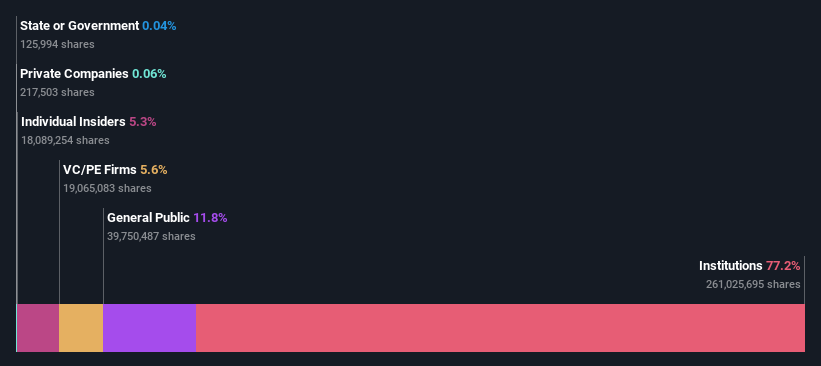
Institutional investors own over 50% of the company, so together, they can probably strongly influence board decisions. We note that hedge funds don't have a meaningful investment in Peloton Interactive. T. Rowe Price Group, Inc. is currently the largest shareholder, with 13% of shares outstanding. With 8.2% and 7.8% of the shares outstanding, respectively, Baillie Gifford & Co. and The Vanguard Group, Inc. are the second and third largest shareholders.
On further inspection, we found that more than half the company's shares are owned by the top 9 shareholders, suggesting that the interests of the more significant shareholders are balanced out to an extent by the smaller ones.
General Public Ownership is Increasing
With a 12% ownership, the general public, mostly comprised of individual investors, has some degree of sway over Peloton Interactive. This size of ownership, while considerable, may not be enough to change company policy if the decision is not in sync with other large shareholders.
Interestingly, General public ownership has increased from 5.4% since the last quarter.
Conclusion
Comparing the ownership structure from May, we can see the shift in ownership from institutions to the general public, which doubled its stake. Meanwhile, with 12.45% short interest, it is unlikely we will see a short squeeze in the likes of those that have been popular in the retail market.
The heart of the problem lies in profitability, less so than scalability - and opening new sales channels for a product that is losing money is seldom a smart thing to do. While the company can always try to raise the price, this is a questionable strategy given the existing pricing pressures on consumers who are already cutting on their leisure spending.
While it is well worth considering the different groups that own a company, there are other factors that are even more important. For example, we've discovered 4 warning signs for Peloton Interactive that you should be aware of before investing here.
NB: Figures in this article are calculated using data from the last twelve months, which refer to the 12-month period ending on the last date of the month the financial statement is dated. This may not be consistent with full year annual report figures.
New: Manage All Your Stock Portfolios in One Place
We've created the ultimate portfolio companion for stock investors, and it's free.
• Connect an unlimited number of Portfolios and see your total in one currency
• Be alerted to new Warning Signs or Risks via email or mobile
• Track the Fair Value of your stocks
Have feedback on this article? Concerned about the content? Get in touch with us directly. Alternatively, email editorial-team@simplywallst.com
Simply Wall St analyst Stjepan Kalinic and Simply Wall St have no position in any of the companies mentioned. This article is general in nature. We provide commentary based on historical data and analyst forecasts only using an unbiased methodology and our articles are not intended to be financial advice. It does not constitute a recommendation to buy or sell any stock and does not take account of your objectives, or your financial situation. We aim to bring you long-term focused analysis driven by fundamental data. Note that our analysis may not factor in the latest price-sensitive company announcements or qualitative material.

Stjepan Kalinic
Stjepan is a writer and an analyst covering equity markets. As a former multi-asset analyst, he prefers to look beyond the surface and uncover ideas that might not be on retail investors' radar. You can find his research all over the internet, including Simply Wall St News, Yahoo Finance, Benzinga, Vincent, and Barron's.
About NasdaqGS:PTON
Peloton Interactive
Provides fitness and wellness products and services in North America and internationally.
Reasonable growth potential with low risk.
Similar Companies
Market Insights


Advertisement
Weekly Picks
LO


Lou_Basenese on Virtuix Holdings ·
From a “Shark Tank” Snub to an Air Force “Yes”: Why Virtuix at $3.50 May Be the Market’s Most Mispriced AI Story
Fair Value:US$7.556.7% undervalued
35 followersusers have followed this narrative
0 commentsusers have commented on this narrative
6 likesusers have liked this narrative
HE


HedgeY on IonQ ·
The Best-Funded Quantum Platform and Still a Stock Priced for Perfection
Fair Value:US$487.1% overvalued
24 followersusers have followed this narrative
0 commentsusers have commented on this narrative
4 likesusers have liked this narrative
BL

BlackGoat on Cerebras Systems ·
The Wafer Giant Threatening NVIDIA's GPU Hegemony
Fair Value:US$415.5446.8% undervalued
38 followersusers have followed this narrative
1 commentusers have commented on this narrative
7 likesusers have liked this narrative
IV

Ivoed on Netflix ·
Netflix’s Business Quality Is Clear. The Harder Question Is Whether The Stock Is Still Cheap
Fair Value:US$829.5% undervalued
22 followersusers have followed this narrative
0 commentsusers have commented on this narrative
7 likesusers have liked this narrative
Recently Updated Narratives
BR

Bravosatya on Meta Platforms ·
Meta Platforms - Zuckerberg’s investment decisions are impulsive or Prudent?
Fair Value:US$730.0216.0% undervalued
2 followersusers have followed this narrative
0 commentsusers have commented on this narrative
0 likesusers have liked this narrative
JU

julio on FIGS ·
Figs valuation
Fair Value:US$14.3930.2% undervalued
20 followersusers have followed this narrative
6 commentsusers have commented on this narrative
0 likesusers have liked this narrative
AS


AstrisCorporateAdvisory on MIRAI ·
Improving NOI growth visibility on wider rent gap
Fair Value:JP¥77.06k46.1% undervalued
1 followerusers have followed this narrative
0 commentsusers have commented on this narrative
0 likesusers have liked this narrative
Popular Narratives
IN


Investingwilly on Mastercard ·
Mastercard: The Best Dividend Stock You're Ignoring
Fair Value:US$75030.3% undervalued
80 followersusers have followed this narrative
1 commentusers have commented on this narrative
9 likesusers have liked this narrative
HA


HarishPK on Adobe ·
Adobe: A Probabilistic Case for Undervaluation
Fair Value:US$319.9634.1% undervalued
62 followersusers have followed this narrative
9 commentsusers have commented on this narrative
19 likesusers have liked this narrative
MA


martinarauz on Nu Holdings ·
Investment Analysis (May 2026)
Fair Value:US$22.7441.1% undervalued
68 followersusers have followed this narrative
0 commentsusers have commented on this narrative
17 likesusers have liked this narrative