
Advertisement
- India
- /
- Metals and Mining
- /
- NSEI:JINDALSAW
Jindal Saw (NSE:JINDALSAW) Could Be A Buy For Its Upcoming Dividend
Jindal Saw Limited (NSE:JINDALSAW) is about to trade ex-dividend in the next three days. Typically, the ex-dividend date is two business days before the record date, which is the date on which a company determines the shareholders eligible to receive a dividend. The ex-dividend date is important as the process of settlement involves at least two full business days. So if you miss that date, you would not show up on the company's books on the record date. Accordingly, Jindal Saw investors that purchase the stock on or after the 5th of June will not receive the dividend, which will be paid on the 12th of July.
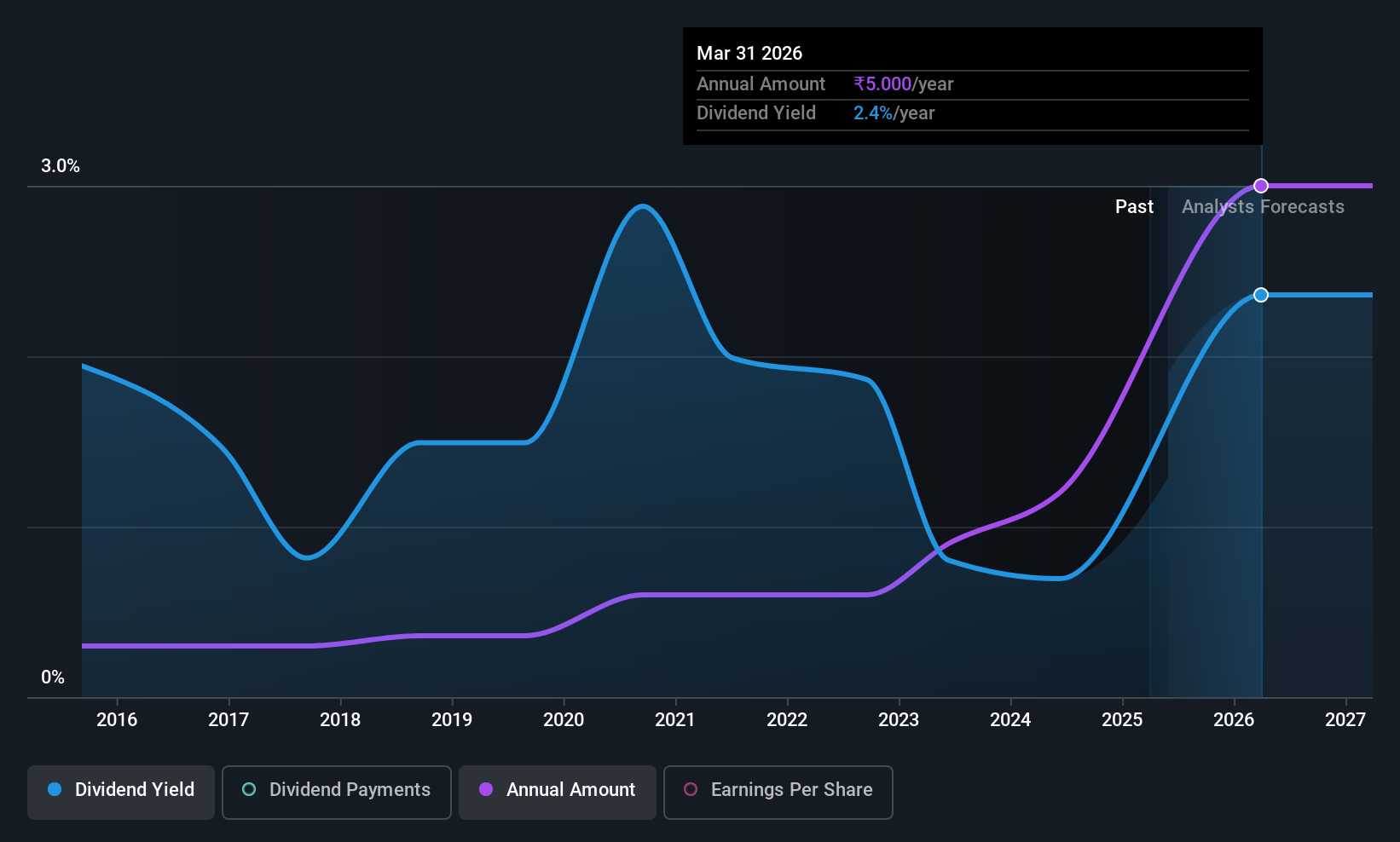
The company's next dividend payment will be ₹2.00 per share, and in the last 12 months, the company paid a total of ₹2.00 per share. Calculating the last year's worth of payments shows that Jindal Saw has a trailing yield of 0.9% on the current share price of ₹211.90. If you buy this business for its dividend, you should have an idea of whether Jindal Saw's dividend is reliable and sustainable. So we need to check whether the dividend payments are covered, and if earnings are growing.
Dividends are usually paid out of company profits, so if a company pays out more than it earned then its dividend is usually at greater risk of being cut. Jindal Saw is paying out just 7.3% of its profit after tax, which is comfortably low and leaves plenty of breathing room in the case of adverse events. Yet cash flow is typically more important than profit for assessing dividend sustainability, so we should always check if the company generated enough cash to afford its dividend. What's good is that dividends were well covered by free cash flow, with the company paying out 9.8% of its cash flow last year.
It's encouraging to see that the dividend is covered by both profit and cash flow. This generally suggests the dividend is sustainable, as long as earnings don't drop precipitously.
Check out our latest analysis for Jindal Saw
Click here to see the company's payout ratio, plus analyst estimates of its future dividends.
Have Earnings And Dividends Been Growing?
Companies with consistently growing earnings per share generally make the best dividend stocks, as they usually find it easier to grow dividends per share. If business enters a downturn and the dividend is cut, the company could see its value fall precipitously. It's encouraging to see Jindal Saw has grown its earnings rapidly, up 26% a year for the past five years. Jindal Saw looks like a real growth company, with earnings per share growing at a cracking pace and the company reinvesting most of its profits in the business.
Another key way to measure a company's dividend prospects is by measuring its historical rate of dividend growth. Since the start of our data, 10 years ago, Jindal Saw has lifted its dividend by approximately 15% a year on average. It's great to see earnings per share growing rapidly over several years, and dividends per share growing right along with it.

The Bottom Line
Has Jindal Saw got what it takes to maintain its dividend payments? Jindal Saw has been growing earnings at a rapid rate, and has a conservatively low payout ratio, implying that it is reinvesting heavily in its business; a sterling combination. There's a lot to like about Jindal Saw, and we would prioritise taking a closer look at it.
Ever wonder what the future holds for Jindal Saw? See what the three analysts we track are forecasting, with this visualisation of its historical and future estimated earnings and cash flow
If you're in the market for strong dividend payers, we recommend checking our selection of top dividend stocks.
New: Manage All Your Stock Portfolios in One Place
We've created the ultimate portfolio companion for stock investors, and it's free.
• Connect an unlimited number of Portfolios and see your total in one currency
• Be alerted to new Warning Signs or Risks via email or mobile
• Track the Fair Value of your stocks
Have feedback on this article? Concerned about the content? Get in touch with us directly. Alternatively, email editorial-team (at) simplywallst.com.
This article by Simply Wall St is general in nature. We provide commentary based on historical data and analyst forecasts only using an unbiased methodology and our articles are not intended to be financial advice. It does not constitute a recommendation to buy or sell any stock, and does not take account of your objectives, or your financial situation. We aim to bring you long-term focused analysis driven by fundamental data. Note that our analysis may not factor in the latest price-sensitive company announcements or qualitative material. Simply Wall St has no position in any stocks mentioned.
About NSEI:JINDALSAW
Jindal Saw
Engages in the manufacture and supply of iron and steel pipes, and pellets in India and internationally.
Adequate balance sheet average dividend payer.
Similar Companies
Market Insights

Advertisement
Community Narratives
Finding The True Value Of A Logistics Powerhouse
Fair Value US$95.21|8.5% undervalued
NV
Community Contributor
Paradigm Biopharmaceuticals Will Lead Osteoarthritis Treatment with Zilosul's FDA Success
Fair Value AU$5.50|91.8% undervalued
AM
Community Contributor
Barrick Mining (ABX:CA): A Gold Hedge against a U.S. Shutdown
Fair Value CA$60.00|26.5% undervalued
GM
Community Contributor